USAID DEC
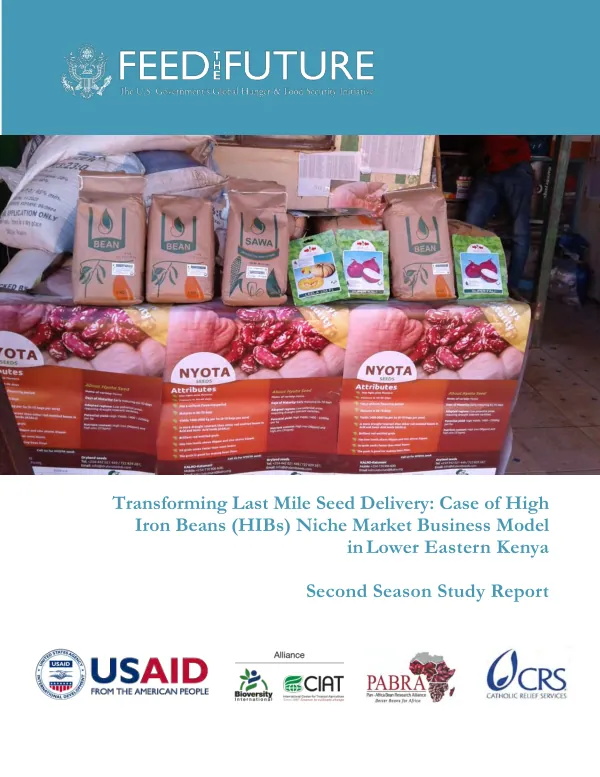
Transforming Last Mile Seed Delivery: Case of High Iron Beans (HIBs) Niche Market Business Model in Lower Eastern Kenya - Second Season Study Report
Sign inCATHOLIC RELIEF SERVICES ORGANIZATION
Transforming Last Mile Seed Delivery: Case of High Iron Beans (HIBs) Niche Market Business Model in Lower Eastern Kenya - Second Season Study Report
The High Iron Beans (HIBs) niche market business model in Lower Eastern Kenya was the focus of a second season study report.
2021 · 69 pages
Sign in to readA free account is required to download.
Abstract
The report was part of the Feed the Future Global Supporting Seed Systems for Development activity, which aimed to improve the functioning of high-impact integrated seed systems. The study was conducted in Lower Eastern Kenya, where common beans are a staple crop. The global and Kenyan perspectives on common beans highlighted the importance of this crop in addressing micronutrient deficiency. High iron and zinc beans, such as the Nyota variety, have the potential to play a significant role in addressing this issue. However, existing bean seed systems in Kenya faced several bottlenecks, including limited access to quality seeds and inadequate last-mile delivery services. The niche market business model was designed to address these bottlenecks by leveraging the use of motorbike riders (boda boda) for last-mile delivery of seeds. The model aimed to improve access to quality seeds, increase crop yields, and enhance the adoption of high iron and zinc beans among farmers. The study objectives were to assess the feasibility and effectiveness of the niche market business model, identify factors affecting farmers' willingness to test new micronutrient-high iron beans, and explore the potential benefits of using motorbike riders for last-mile delivery. The study was conducted in two phases: a baseline survey and a main survey. The baseline survey collected data on farmers' willingness to test new micronutrient-high iron beans, factors affecting their willingness, and potential benefits of using motorbike riders for last-mile delivery. The main survey built on the findings of the baseline survey and explored the perceptions of value chain actors on the last mile seed delivery business and the Nyota variety. Key findings from the baseline survey included factors affecting farmers' willingness to test new micronutrient-high iron beans, such as access to information, market demand, and availability of quality seeds. The study also identified potential benefits of using motorbike riders for last-mile delivery, including increased access to quality seeds and reduced transportation costs. Policy implications of the use of motorbike riders for last-mile delivery were also explored, including the need for regulatory frameworks to support the use of motorbike riders in seed delivery. The main survey findings reinforced the importance of access to information, market demand, and availability of quality seeds in influencing farmers' willingness to test new micronutrient-high iron beans. The study also highlighted the potential benefits of using motorbike riders for last-mile delivery, including increased access to quality seeds and reduced transportation costs. Value chain actors' perceptions on the last mile seed delivery business and the Nyota variety were also explored, with a focus on the need for coordinated, continuous, and sustained awareness and demand creation for enhanced adoption of HIBs. Farmer feedback after the harvest season highlighted the importance of information sources and agro-dealers in influencing farmers' decisions on seed access and cost. The study also identified gaps in production of the Nyota variety, including the need for improved seed availability and access to quality seeds. Based on the study findings, several recommendations were made to improve the functioning of the high-impact integrated seed systems in Kenya. These included the need for seed distribution to continue responding to farmers' needs about access and cost of seed, coordinated and sustained awareness and demand creation for enhanced adoption of HIBs, and the need for the Kenya Agricultural and Livestock Research Organization (KALRO) to focus on the production of early generation seed. The study also highlighted the need to facilitate enhanced use of motorbike riders for last-mile delivery of seed and consolidate policy support for last-mile delivery of HIBs.