USAID DEC
NFI Strategic Stock and Livelihood Assistance, 2nd Quarter Report 2014, AID-OFDA-G-13-00072
Sign inSAMARITAN'S PURSE
NFI Strategic Stock and Livelihood Assistance, 2nd Quarter Report 2014, AID-OFDA-G-13-00072
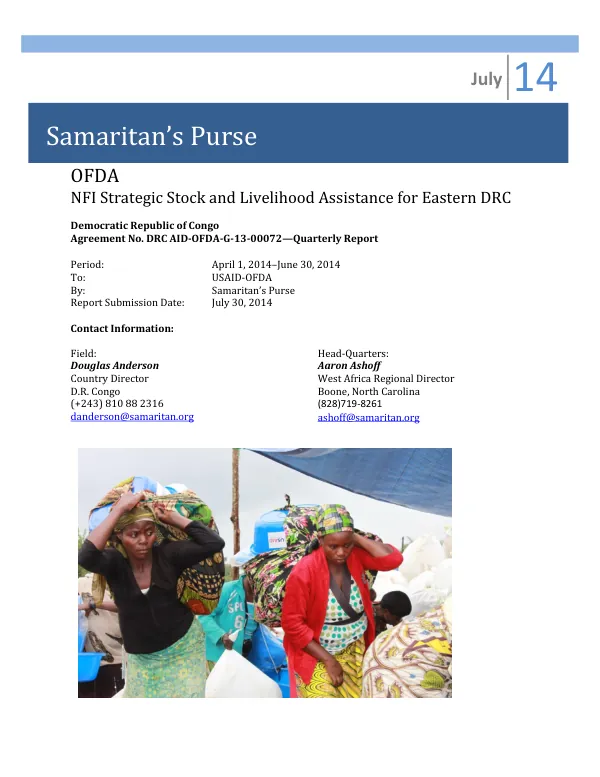
The NFI Strategic Stock and Livelihood Assistance project in Eastern DRC aims to rapidly and efficiently meet the emergency needs of conflict-affected households by prepositioning non-food-item (NFI) kits and increasing food security and household resiliency.
2014 · 5 pages
Sign in to readA free account is required to download.
Abstract
The project's goal is to quickly distribute NFI kits in emergency situations to help conflict-affected populations cope with displacement and loss. The kits include standard NFIs to assist households trying to recover from material loss. Implementation of the project focused on two sectors: Logistics Support and Relief Commodities, and Agriculture and Food Security. In the Logistics Support and Relief Commodities sector, the objective was to efficiently and rapidly respond to the needs of conflict-affected populations in Eastern Congo by strategically prepositioning NFI kits for distribution. A total of 3,244 households were reached with 18,943 beneficiaries. The NFI team distributed 1,284 kits in Bwanasura, with 18 extra kits provided by UNICEF. In the Agriculture and Food Security sector, the objective was to improve livelihood capacity through increased and diversified agricultural production. A total of 5,129 households were reached, with 28,393 beneficiaries. The Agricultural Training Group (ATG) attendance rate was 83%, and 60% of households participating in the Nutritional Demonstration Garden (NDG) program attended monthly trainings. Goat beneficiaries were trained on selecting quality goats, conditions for good goat reproduction, and prevention and management of internal and external parasites. The project achieved significant milestones, including the distribution of 561 goats, completion of all distribution and vaccination activities for livestock, and provision of a total of 60,279 kg of seeds for ATGs. Samaritan's Purse staff will continue to provide follow-up visits to goat beneficiaries to ensure proper care and facilitate hands-on training for livestock husbandry. In terms of performance indicators, the project exceeded its targets in several areas, including the distribution of NFIs, cash/vouchers, and transportation of commodities. The project also made significant progress in increasing food self-sufficiency, with a 2.6-month increase from baseline survey. The number of people benefiting from seed-system activities/agricultural input activities increased to 27,257, and the number of people benefiting from training on agricultural techniques and basic nutrition increased to 6,542. The project also made significant progress in livestock activities, with 561 goats distributed and 877 vaccinations administered. The number of people benefiting from livestock activities increased to 1,136, with 576 females and 560 males benefiting from the program. The project's success can be attributed to the effective implementation of its activities, including the distribution of NFIs, agricultural training, and livestock activities.