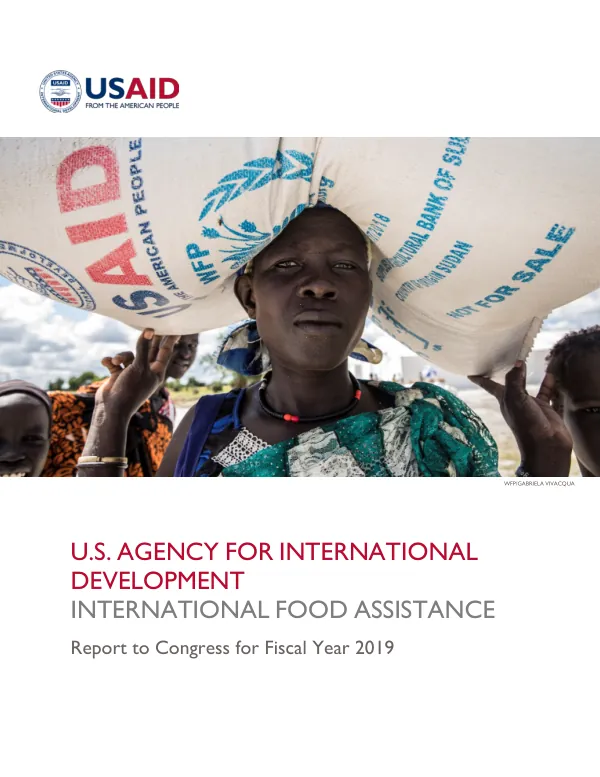
THE WORLD FOOD PROGRAMME
USAID FY 2019 EFSP REPORT
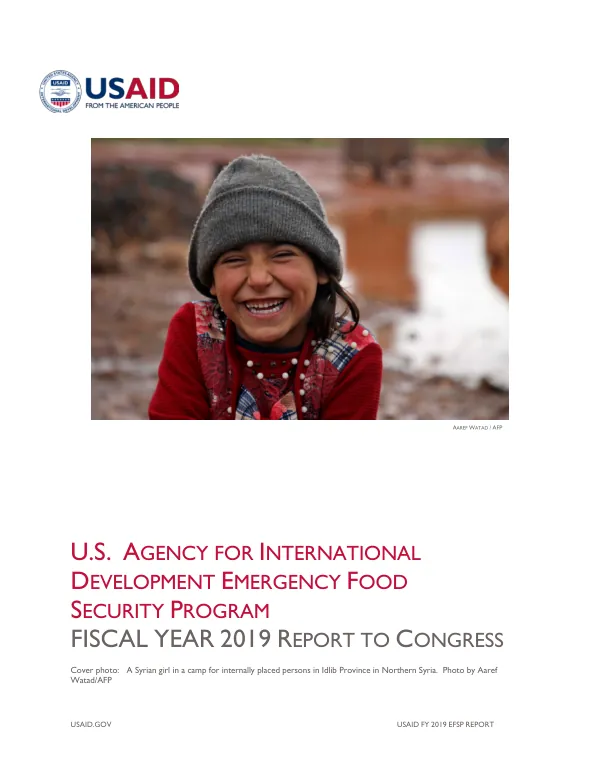
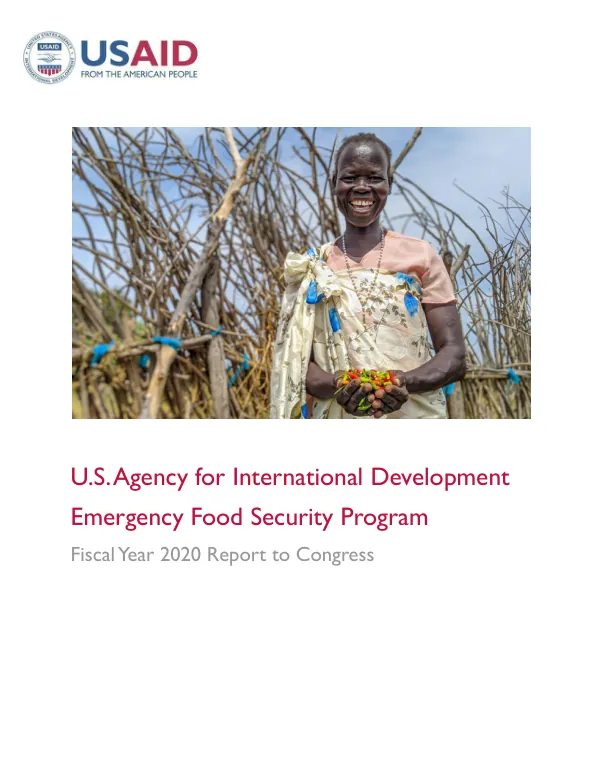
The Global Food Security Act of 2016 reauthorized the Emergency Food Security Program (EFSP) as a key component of the U.S.
2019 · 20 pages
Sign in to readA free account is required to download.
Abstract
Agency for International Development's (USAID) humanitarian assistance efforts. The program aims to mitigate the effects of manmade and natural disasters by utilizing innovative approaches to delivering aid that support affected persons and communities, build resilience and early recovery, and reduce opportunities for waste, fraud, and abuse. In FY 2019, USAID provided more than $2.4 billion in EFSP assistance, which reached over 39 million people in 50 countries. The program used market-based modalities, including local, regional, and international procurement (LRIP), cash transfers for food, and food vouchers. LRIP accounted for nearly 45 percent of EFSP funding, while food vouchers made up 27 percent, and cash transfers nearly 23 percent. The EFSP played a critical role in responding to humanitarian crises in FY 2019, including in the Republic of South Sudan, where more than four million people were displaced, and nearly seven million people needed life-saving food assistance. In South Sudan, DCHA/FFP contributed over $375 million in emergency food assistance, including $262 million in IDA funds and $114 million in Title II emergency funds. The majority of IDA funds were used for LRIP, which helped more than one million people and increased efficiencies in both cost and time. In the People's Republic of Bangladesh, the EFSP provided emergency food assistance to vulnerable populations in Cox's Bazar District, where more than 700,000 Rohingya refugees fled in 2017. DCHA/FFP contributed over $123 million in emergency food assistance, using IDA funds, to provide electronic food vouchers to Rohingya refugees so they can buy foods of their choice from vendors in the camps. The EFSP also supported humanitarian responses in other countries, including in the Horn of Africa, where severe drought compounded conflict and exacerbated humanitarian needs in the Federal Republic of Somalia and the Federal Democratic Republic of Ethiopia. In Southern Africa, Tropical Cyclones Idai and Kenneth caused catastrophic flooding, and the second-strongest Atlantic storm on record hit the islands of Grand Bahama and Abaco in the Commonwealth of The Bahamas. Overall, the EFSP played a critical role in addressing food insecurity and humanitarian needs in FY 2019, reaching over 39 million people in 50 countries. The program's market-based modalities, including LRIP, cash transfers for food, and food vouchers, helped to increase efficiencies in both cost and time, and improved dietary diversity for vulnerable populations. The EFSP's success in FY 2019 was due in part to the program's ability to adapt to changing humanitarian needs and contexts. In South Sudan, for example, the use of IDA for LRIP increased efficiencies in both cost and time, while in Cox's Bazar District, the use of electronic food vouchers improved dietary diversity for Rohingya families. The EFSP's flexibility and ability to respond to emerging humanitarian crises will be critical in FY 2020 and beyond. In FY 2019, the EFSP also supported the development of new modalities and approaches to delivering aid, including the use of cash transfers for food and the expansion of electronic food vouchers. These innovations have the potential to improve the efficiency and effectiveness of humanitarian assistance, and to reduce the risk of waste, fraud, and abuse. Overall, the EFSP's FY 2019 report highlights the program's critical role in addressing food insecurity and humanitarian needs around the world. The program's market-based modalities, flexibility, and ability to adapt to changing humanitarian needs and contexts make it an essential component of USAID's humanitarian assistance efforts.