USAID DEC
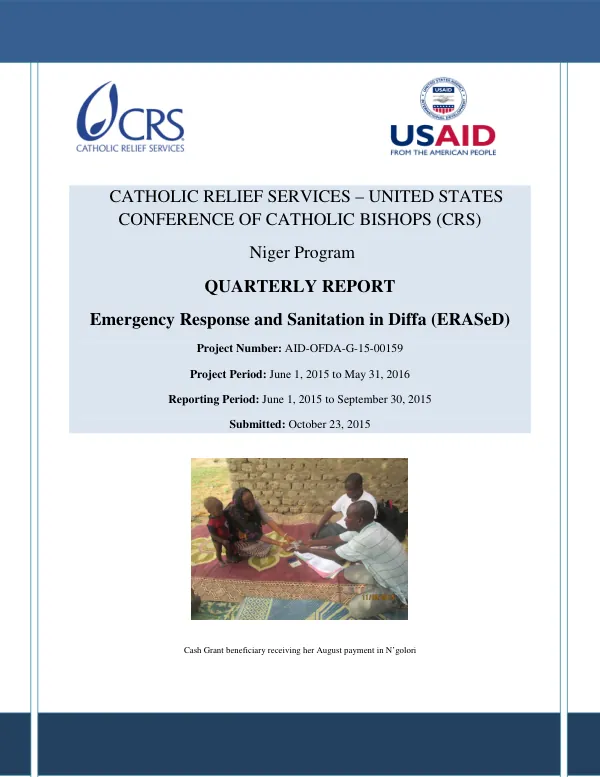
Emergency Response and Sanitation in Diffa (ERASeD) Quarterly Report, June-September 2015
Sign inCATHOLIC RELIEF SERVICES ORGANIZATION
Emergency Response and Sanitation in Diffa (ERASeD) Quarterly Report, June-September 2015
The Emergency Response and Sanitation in Diffa (ERASeD) project in Niger began in June 2015 with funding from the United States Office of Foreign Disaster Assistance (OFDA).
2015 · 9 pages
Sign in to readA free account is required to download.
Abstract
The project aims to support vulnerable households and communities in the Diffa region, which has been impacted by the influx of refugees and internally displaced persons (IDPs) from northern Nigeria. The goal of the project is to enable these households and communities to thrive during the lean season, strengthen their agricultural livelihoods, and improve their communal sanitation. The project focuses on three objectives: improving short-term and medium-term livelihood options for vulnerable households, strengthening the livelihoods of producer households, and promoting improved water, sanitation, and hygiene outcomes through a participatory, demand-led approach. The project targets 3,000 local households in 60 villages in the communes of Maïné-Soroa, Chetimari, and Goudoumaria, with a focus on female-headed households, elderly, people living with HIV/AIDS, and people living with disabilities. The project implemented a cash-for-work (CFW) program, which provided temporary employment opportunities for beneficiaries. A total of 3,000 households received 1,300 FCFA per day of work for 15 days, with each household working on communal land to restore degraded areas, clean drainage channels, and fence and fill eroded areas around schools and health centers. The CFW activities resulted in the restoration of 210.5 hectares of degraded land and the clearance of 4,450 meters of drainage channels. In addition to the CFW program, the project provided cash grants to the same 3,000 beneficiary households, with each household receiving 19,500 FCFA per month in August and September. The cash grants allowed households to work in their own fields and provided a consistent source of income during the lean season. A total of 117,000,000 FCFA (approximately $203,480) was paid to beneficiaries through the cash grant program. The project also initiated awareness campaigns on hygiene promotion in all three communes, led by DEMI-E field agents. The Community-Led Total Sanitation (CLTS) training was planned for October, ahead of triggering the CLTS process in target communities. The process of identifying local masons for sanitation infrastructure development was also underway in the 60 villages. Monitoring and evaluation of the project activities were conducted in close collaboration with DEMI-E, the Government of Niger's Environment and Forestry technical services, and the communities themselves. Joint supervision was conducted to evaluate activities and address any difficulties. The project achieved its target of assisting 3,000 people through livelihood restoration activities, with 910 women and 2,090 men benefiting from the program. The total USD amount channeled into the program area through sub-sector activities was $319,091, with $203,480 paid out in cash grants to beneficiaries.
Related documents