CATHOLIC RELIEF SERVICES ORGANIZATION
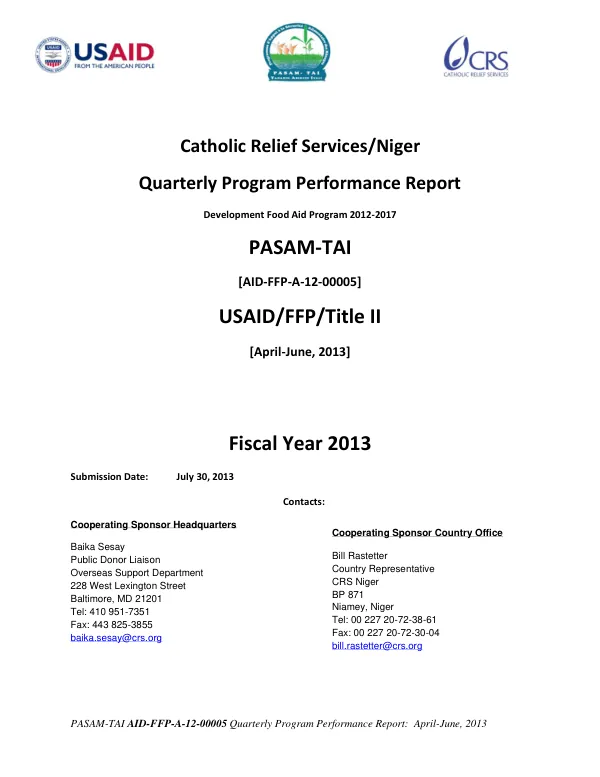
PASAM-TAI AID-FFP-A-12-00005 Quarterly Program Performance Report: April-June, 2013
Households in Niger continued to face challenges in accessing quality health, hygiene, and nutrition services.
2013 · 11 pages
Sign in to readA free account is required to download.
Abstract
The project PASAM-TAI aimed to address these challenges by strengthening staff capacity in health and nutrition service delivery. A total of 1000 Days community experts and volunteers were identified to support the implementation of health and nutrition activities in the target zone. Food distribution sites were also identified to serve as a point where beneficiaries gather each month to receive their Title II rations and health and nutrition services. The project conducted a workshop on health and nutrition in schools, focusing on the life skills approach. The workshop was attended by 30 people and aimed to identify tools for hygiene and nutrition teaching in Nigerien schools. A technical committee was established to propose content for principal health, hygiene, and WASH topics. A second workshop is scheduled for October 2013 to finalize the health, hygiene, and hygiene teaching curriculum. A total of 140 food distribution centers were mapped out, with criteria including a good road network, availability of storage facilities, and proximity to communities. These centers will serve as a point for beneficiaries to receive their Title II rations and health and nutrition services. Local nutrition experts and volunteers were identified to coordinate health and nutrition activities in their targeted zones. The project also conducted training for 17 field agents on Essential Nutrition Action (ENA), Infant and Child Feeding (IYCF), malnutrition screening, referral, and follow-up of malnourished children. The training took place from June 24-28 in Matamey and Mayahi, aiming to enhance the knowledge and skills of participants in negotiation and essential nutrition action. The Community Led Total Sanitation (CLTS) strategy was rolled out in 47 villages in Kantché and Mayahi departments. CLTS aims to improve hygiene and reduce open defecation. A field visit was conducted to identify communities for the rollout, and 23 sites were selected for the initial implementation. A training was held for all participants to ensure a proper rollout. The project also conducted a training for 77 field agents on the use of ICT4D field applications. However, the non-availability of monetization funds negatively impacted the project's ability to carry out planned activities. The project is working with USAID/FFP to find alternative solutions to the problem. The project's strategic objective is to reduce chronic malnutrition among households, especially pregnant and lactating women and children under five. The project has made progress in strengthening staff capacity in health and nutrition service delivery, identifying community experts and volunteers, and conducting training for field agents on essential nutrition action and CLTS. The project has also made progress in implementing the school WASH component, identifying food distribution centers, and conducting training for local nutrition experts and volunteers. However, the project faces challenges in accessing quality health, hygiene, and nutrition services due to the tense security environment and the non-availability of monetization funds. The project will continue to work with USAID/FFP to find alternative solutions to the problem and ensure the implementation of planned activities. The project will also continue to strengthen staff capacity in health and nutrition service delivery, identify community experts and volunteers, and conduct training for field agents on essential nutrition action and CLTS. The project's progress on PASAM-TAI objectives is as follows: * Strategic Objective 1: Households (especially pregnant and lactating women and children under five) have reduced chronic malnutrition + Progress made: Strengthening staff capacity in health and nutrition service delivery, identifying community experts and volunteers, and conducting training for field agents on essential nutrition action and CLTS. + Challenges faced: Non-availability of monetization funds, tense security environment. * Strategic Objective 2: Mother-child units have accessed community and facility-based health, WASH, and nutrition services + Progress made: Conducting training for 17 field agents on ENA, IYCF, malnutrition screening, referral, and follow-up of malnourished children. The project's progress on PASAM-TAI indicators is as follows: * IR 1.1: Households (especially pregnant and lactating women and children under five) have adopted health, hygiene, and nutrition behaviors + Progress made: Conducting training for 30 people on health and nutrition in schools, focusing on the life skills approach. * IR 1.2: Mother-child units have accessed community and facility-based health, WASH, and nutrition services The project's progress on PASAM-TAI activities is as follows: * Activity 1: Strengthening staff capacity in health and nutrition service delivery + Progress made: Conduct