FAO
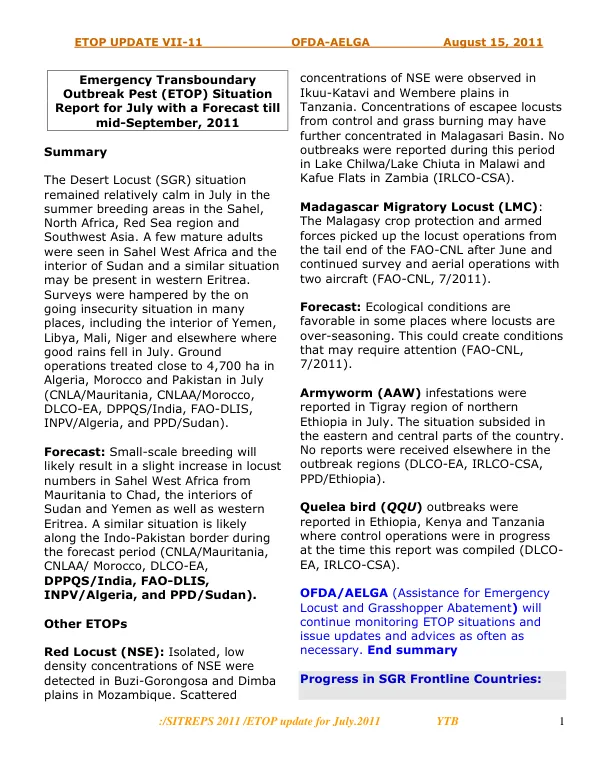
Emergency Transboundary Outbreak Pest (ETOP) Situation Report for December 2012
The Desert Locust (SGR1) situation improved in December in Sahel West Africa and Northwestern Africa.
2012 · 10 pages
Sign in to readA free account is required to download.
Abstract
Control operations coupled with unfavorable ecological conditions caused locust numbers to decline. The pest remained active in winter breeding areas in southeastern Egypt, the northern coast of Sudan, and Saudi Arabia along the Red Sea coasts, where egg laying and hoppers and bands were detected. Control operations continued through December and treated more than 120,000 ha since November. No locusts were reported in other countries during this period. The forecast indicates that the Desert Locust (SGR) will likely continue breeding and more hoppers, bands, and small swarms will form along the Red Sea coasts, but locust numbers will further decline in Sahel West Africa and Northwest Africa. Other outbreak and invasion regions will remain relatively calm during the forecast period. The African Development Bank, USAID, the World Bank, France, FAO, host-governments, neighboring countries, and others provided funds to equip national locust control units with tools and materials and strengthen the infrastructure in Sahel West Africa's frontline countries, namely Chad, Mali, Mauritania, and Niger. The Sahel West Africa's frontline countries have established autonomous national locust control units responsible for all DL activities. Funds provided by the African Development Bank, USAID, the World Bank, France, FAO, host-governments, neighboring countries, and others enabled the FCs to equip CNLAs with tools and materials and strengthen the infrastructure as well as help train staff to prevent and respond to SGR outbreaks. Through these, FCs were able to minimize and avoid the threats the SGR poses to food security and livelihoods of vulnerable communities. The ITCZ migrated further south and only light rain was reported in some of the locust breeding areas in southwestern Libya during the first dekad of December. Moderate to good rains that were recorded in November in a few places in winter breeding areas along the Red Sea coast improved breeding conditions in northeast Sudan, southeast Egypt, and northwestern Saudi Arabia. Wadis and low-lying grounds in Sudan sustained patches of green vegetation. Dry conditions prevailed in most of the SGR summer breeding areas. The rains commenced in previous months and continued in most of the NSE outbreak areas and breeding conditions improved from Tanzania to Zimbabwe. The Desert Locust Control Organization for Eastern Africa and the FAO are implementing a program to strengthen national and regional capacities in Central Asia and the Caucasus (CAC) to coordinate locust monitoring and reporting as well as jointly plan prevention and mitigation efforts to help abate and minimize the threats these pests pose to food security and livelihoods of vulnerable populations. OFDA has started supporting a program to strengthen national and regional capacities in Central Asia and the Caucasus (CAC) to coordinate locust monitoring and reporting as well as jointly plan prevention and mitigation efforts to help abate and minimize the threats these pests pose to food security and livelihoods of vulnerable populations.
Related documents