FAO
ETOP Situation Report for October with a Forecast till mid-December, 2011
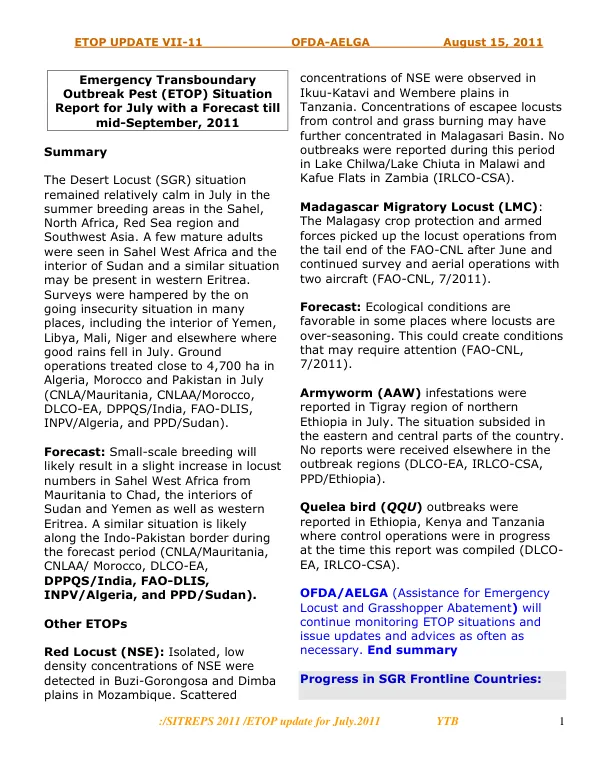
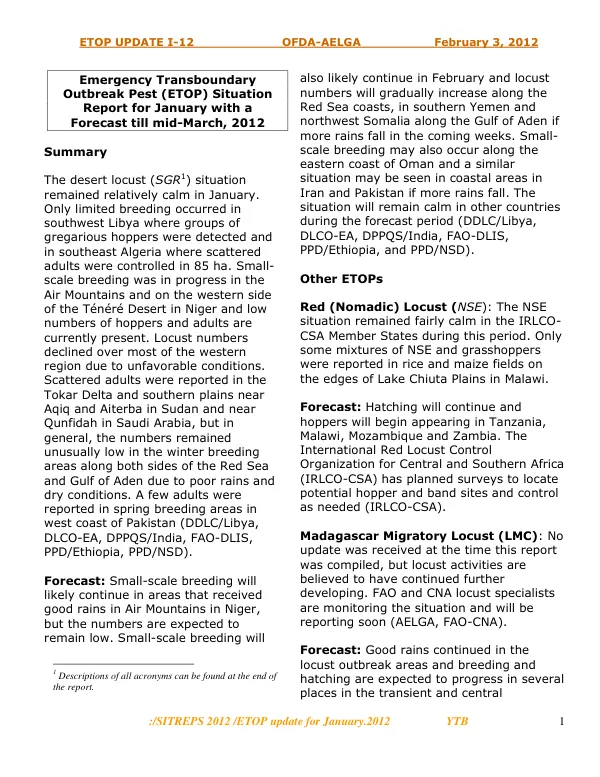
The desert locust (SGR1) situation in October 2011 remained relatively calm in Sahel West Africa, North Africa, the Red Sea coasts, and the Indo-Pakistan borders.
2011 · 10 pages
Sign in to readA free account is required to download.
Abstract
Scattered adults were observed in Chad, Mali, Niger, Sudan, and Pakistan, with small-scale breeding occurring in western Mauritania and coastal areas in Pakistan. Ground operations controlled adult groups and/or solitary individuals on 1,200 ha in northern Mali and 60 ha in western Mauritania, respectively. No locusts were reported elsewhere during this period. Adult SGR are forecast to move from the summer breeding areas in southern Mauritania to the winter breeding areas in northwest Mauritania and from the interior of Sudan to the Red Sea coasts in Sudan, Saudi Arabia, and Yemen, and begin breeding on the onset of the winter rains. Scattered adults will persist in northern Mali, Niger, and Chad. Small-scale breeding is likely in southwestern Morocco, central Sahara in Algeria, and southwestern Libya during the forecast period. Breeding may also occur in parts of Pakistan where massive rains and flooding occurred in August and September. The Red (Nomadic) Locust (NSE) situation remained relatively calm in Tanzania, with only low to medium density adult populations persisting in other outbreak areas in Malawi and Mozambique, and Zambia. The seasonal rains that fell in October in Tanzania, Malawi, and Mozambique outbreak areas may have triggered mating and egg-laying. Hoppers will begin appearing from December on in the outbreak areas in Tanzania, Malawi, Mozambique, and Zambia. The Madagascar Migratory Locust (LMC) situation is not updated in this report, but locust activities that were present during the previous month likely continued developing. Normal to above normal rainfall is predicted in October through December and could extend into January to March, and breeding and hatching are expected to progress in several places in the central gregarization zone and other zones during the forecast period. The Moroccan (DMA), Italian (CIT), and Migratory (LMI) locusts in Central Asia and the Caucasus (CAC) situation is not updated in this report, but some locust activities are likely in the region. The Armyworm (AAW) season has commenced in Tanzania, where the pest was observed on 35 ha of cereal crops in Sumbawanga district in Rukwa region in Tanzania. AAW will likely continue further developing in Tanzania and by the end of November and into early December, most IRLCO-CSA countries will likely experience some level of AAW activities. The Quelea (QQU) situation is characterized by low to high density populations and roosts of QQU birds detected in the rift valley areas and eastern Ethiopia, where sorghum crops were at risk. QQU activities were also reported in irrigated rice in Nyanza province in Kenya and in Kilimanjaro region in Tanzania as well as in irrigated wheat in Mashonaland West and Mashonaland East provinces of Zimbabwe. QQU activities will continue threatening crops during the forecast period as populations will begin progressively spreading to several areas. The African Development Bank, USAID, the World Bank, France, FAO, host-governments, neighboring countries, and others have provided funds to equip national locust control units (CNLAs) in Sahel West Africa with necessary tools, materials, and infrastructure as well as help train staff to prevent and respond to SGR outbreaks and avoid the threats they pose to food security and livelihoods of vulnerable communities. CNLAs' efforts to avert, mitigate, or respond to potentially devastating SGR outbreaks and invasions need to be supported and encouraged. The Inter-Tropical Front (ITF) progressed south over eastern and western Africa from October 21-31, 2011, with the mean western portion located at approximately 11.6N, 1.3 degrees south of the climatology mean and 1.7 degrees south of the previous dekad's position. This was caused by strong northerly winds that prevailed for the past three dekads and resulted in early termination of the seasonal rains across the Sahel and causing heavy, above-average rains along the Gulf of Guinea. The eastern portion of the ITF was approximated at 10.2N, 1.3 degrees south of the climatology mean position and 2.5 degrees south of the previous dekad's position.
Related documents