USAID DEC
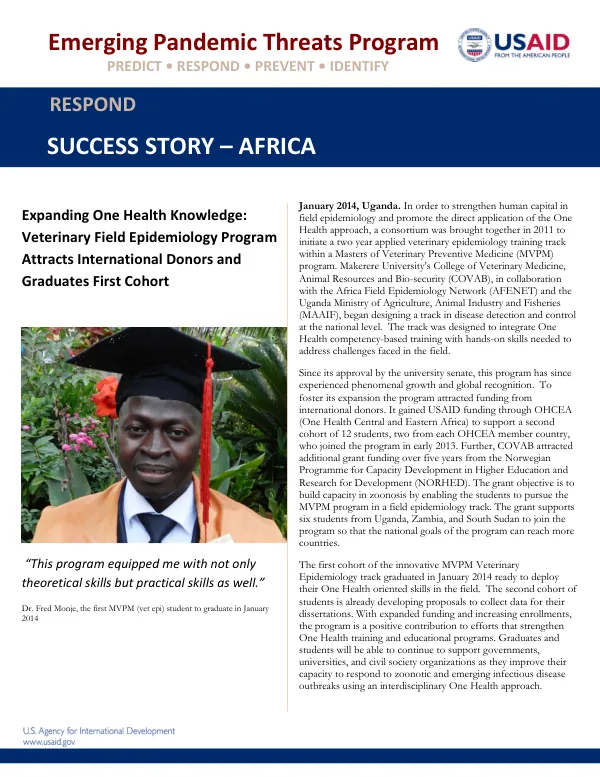
Emerging Pandemic Threats Program: Expanding One Health Knowledge: Veterinary Field Epidemiology Program
Sign inDAI
Emerging Pandemic Threats Program: Expanding One Health Knowledge: Veterinary Field Epidemiology Program
The Emerging Pandemic Threats Program's Veterinary Field Epidemiology Program, also known as PREDICT • RESPOND • PREVENT • IDENTIFY, has made significant strides in strengthening human capital in field epidemiology and promoting the One Health approach in Africa.
2015 · 1 pages
Sign in to readA free account is required to download.
Abstract
The program, initiated in 2011, aimed to provide a two-year applied veterinary epidemiology training track within a Master of Veterinary Preventive Medicine (MVPM) program at Makerere University's College of Veterinary Medicine, Animal Resources and Bio-security (COVAB). The program was designed to integrate One Health competency-based training with hands-on skills needed to address challenges faced in the field. The track was approved by the university senate and has since experienced phenomenal growth and global recognition. To foster its expansion, the program attracted funding from international donors, including USAID through the One Health Central and Eastern Africa (OHCEA) program, which supported a second cohort of 12 students from OHCEA member countries. Additionally, COVAB secured a five-year grant from the Norwegian Programme for Capacity Development in Higher Education and Research for Development (NORHED) to build capacity in zoonosis. The first cohort of the innovative MVPM Veterinary Epidemiology track graduated in January 2014, equipped with theoretical and practical skills to deploy their One Health-oriented skills in the field. The graduates are poised to support governments, universities, and civil society organizations in improving their capacity to respond to zoonotic and emerging infectious disease outbreaks using an interdisciplinary One Health approach. The program's success has been marked by the development of proposals by the second cohort of students to collect data for their dissertations, indicating a strong commitment to the program's goals. The program's expansion has been facilitated by the increasing enrollments and expanded funding. The graduates and students will be able to continue to support governments, universities, and civil society organizations as they improve their capacity to respond to zoonotic and emerging infectious disease outbreaks using an interdisciplinary One Health approach. The program's success is a positive contribution to efforts that strengthen One Health training and educational programs in Africa. The program's impact is expected to be far-reaching, with the graduates and students playing a crucial role in improving the capacity of governments, universities, and civil society organizations to respond to zoonotic and emerging infectious disease outbreaks. The program's focus on One Health competency-based training and hands-on skills will enable the graduates to address challenges faced in the field and make a significant contribution to the control and prevention of emerging infectious diseases in Africa.