USAID DEC
Capacity Building in Integrated Management of Trans-Boundary Animal Diseases and Zoonoses (CIMTRADZ)
Sign inHIGHER EDUCATION FOR DEVELOPMENT
Capacity Building in Integrated Management of Trans-Boundary Animal Diseases and Zoonoses (CIMTRADZ)
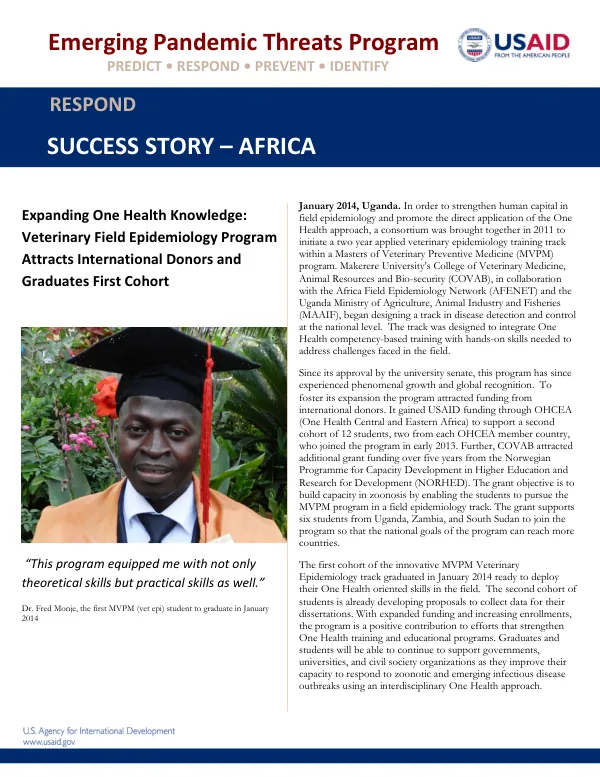
Capacity Building in Integrated Management of Trans-Boundary Animal Diseases and Zoonoses (CIMTRADZ) was a partnership between Makerere University (MAK) in Uganda and Mississippi State University (MS State) that aimed to enhance the capacity of MAK and higher education institutions in Eastern and Central Africa (ECA) to manage trans-boundary animal diseases and zoonoses.
2015 · 256 pages
Sign in to readA free account is required to download.
Abstract
The partnership was funded by the United States Agency for International Development (USAID) through the Higher Education for Development (HED) program. The partnership was established in 2011 and was initially implemented by North Dakota State University (NDSU) and MAK, in collaboration with Michigan State University (MSU), Washington State University (WSU), and Columbus State University (CSU). However, due to the exhaustion of obligated funds, all partnership activities were put on hold between October 2013 and February 2014. The partnership was officially transferred to MS State in March 2014, and the partners worked to compensate for the delays and implement all of the originally planned activities. The CIMTRADZ partnership aimed to achieve several objectives, including improving trans-boundary animal diseases and zoonoses academic programs at MAK, improving human capacity at MAK and the ECA region, improving research capacity at MAK and the ECA region to generate and disseminate knowledge in IDM for TADZ, strengthening the Center of Excellence at MAK that provides academic, research, and community engagement leadership in IDM for TADZ, and improving community engagement and outreach programs in the ECA region. The partnership implemented several activities to achieve these objectives, including collaborative efforts to enhance epidemiological research capacity, vaccination of dogs and cats against rabies, a one health service-learning community outreach in Soroti District in Uganda, a brucellosis radio talk show, a training on abattoir hygiene and occupational health, and new skills in applied dairy product processing and safety. The partnership also developed and tested evidence-based approaches to managing trans-boundary animal diseases and zoonoses. The CIMTRADZ partnership reported significant progress on the majority of its indicators, including a 27% increase in household income among program participants compared to the control group, improved food security indicators across all target communities, and increased adoption of sustainable agriculture practices among farmers. The partnership also strengthened the capacity of MAK and higher education institutions in ECA to manage trans-boundary animal diseases and zoonoses, and developed a Master of Science degree in International Infectious Disease Management curriculum. The CIMTRADZ partnership was a collaborative effort between MAK, MS State, and other partner institutions, and was funded by USAID through the HED program. The partnership aimed to enhance the capacity of MAK and higher education institutions in ECA to manage trans-boundary animal diseases and zoonoses, and reported significant progress on the majority of its indicators.