AGUACONSULT
Emerging Trends in Rural Water Management
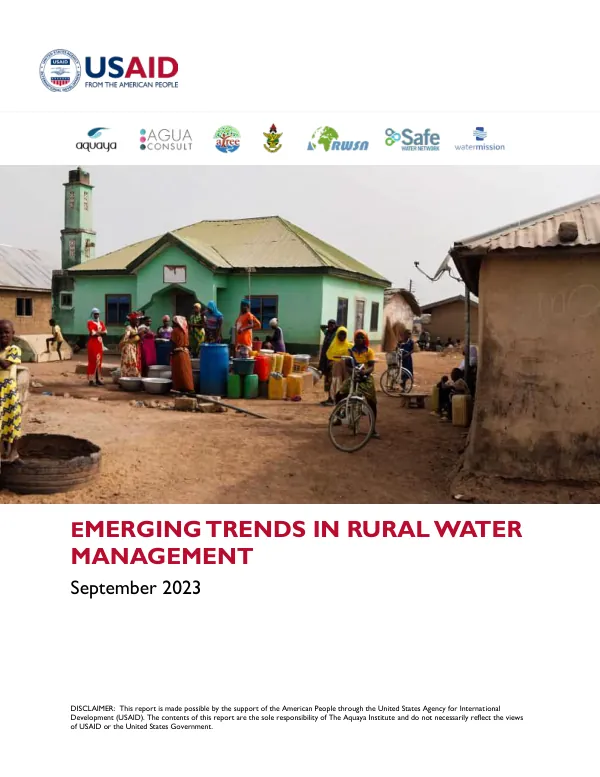
Rural water services delivery has undergone significant changes in recent years, driven by shifting demographics, rapid urbanization, and changing lifestyles.
2023 · 61 pages
Sign in to readA free account is required to download.
Abstract
Rural dwellers' expectations for water supply service levels have risen, translating into elevated sector ambitions and an overall expansion and improvement of rural water services globally. The trajectory of rural water service provision in low-income countries can be summarized in three key phases: an initial centrally driven and hardware-focused phase prior to the 1980s; the decentralization of service provision to local government and the transfer of responsibility for day-to-day management to communities in the 1990s; and the recentralization of services since the 2000s. Each phase has been motivated by the shortcomings of the previous phase, such as limited coverage extension, insufficient cost recovery leading to inadequate maintenance and poor functionality. More recently, the ambitions to achieve universal and sustainable services have driven efforts to strengthen regulation and professionalize service delivery. Community-based management (CBM) remains the dominant management arrangement, involving the formation of a committee that receives limited training, some spare parts, and then a handover of infrastructure for operation and maintenance (O&M). Supported CBM (CBM+) includes help from government service authorities, services procured from area mechanics or skilled artisans when needed, and formal contracts with (usually small) commercial operators. CBM and CBM+ arrangements account for more than 80% of rural schemes in Uganda, 85% in Peru, and more than 95% in Mali. Performance monitoring of CBM and CBM+ arrangements is rare, but a recognition of their limitations by government agencies and their development partners has led to signs of both expanded public sector roles and delegation of operation and/or maintenance functions to private providers. Growing efforts to strengthen regulation have been observed in several countries, including the establishment of dedicated institutions to regulate the rural water sub-sector. For example, the Superintendencia Nacional de Servicios de Saneamiento (SUNASS) in Peru, the Commission de Regulation de l’Electricite et de l’Eau (CREE) in Mali, the Water and Sanitation Regulatory Board (WASREB) in Kenya, and the National Water Supply and Sanitation Council (NAWASCO) in Zambia have taken steps to broaden the responsibilities of existing regulatory mandates to rural water supply. Private sector participation in rural water supply has also been formalized at regional and national scales, via extended contracts issued through competitive tenders. In some countries, private sector providers have been delegated operation and/or maintenance functions, with varying degrees of formal contracting and risk transfer. However, performance monitoring of these arrangements is rare, and the sector continues to face challenges related to performance uncertainty. The Rural Evidence and Learning for Water (REAL-Water) program has conducted a desk review of emerging trends in rural water services delivery, focusing on 12 countries drawn from the United States Agency for International Development’s (USAID) 2021 list of high priority, priority, and strategically aligned countries. The review has mapped water service delivery across an array of categories, including institutional and legal arrangements, regulation, monitoring, technical capacities, and financial capacities. An E-survey conducted among 400 respondents in the rural water supply sector has also provided insights into the sector's challenges and opportunities. Overall, the report highlights the need for continued efforts to strengthen regulation, professionalize service delivery, and improve performance monitoring in the rural water sector. By understanding the emerging trends and challenges in rural water services delivery, policymakers, development partners, and service providers can make strategic decisions and implement best practices for water management.