USAID
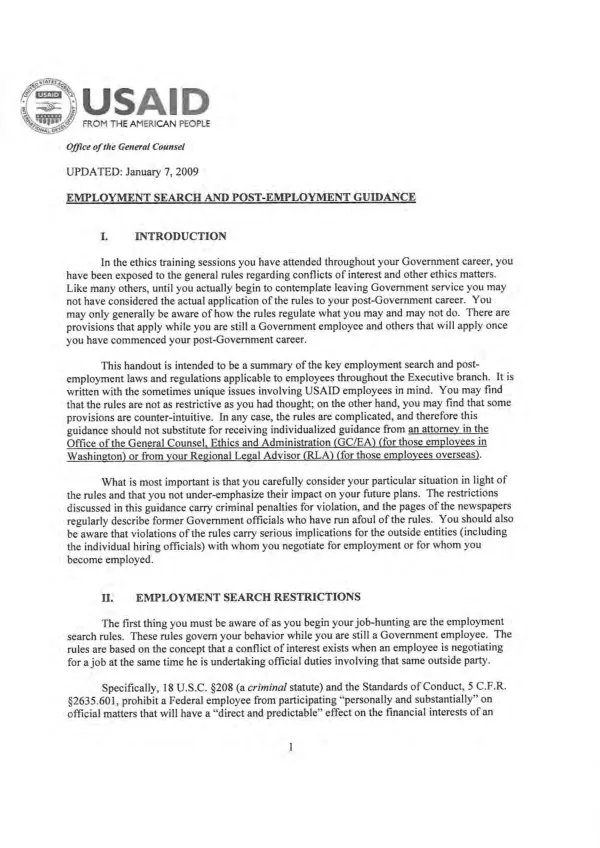
Employment Search and Post-Employment Guidance for USAID Employees
The employment search and post-employment guidance for USAID employees is governed by various laws and regulations.
2009 · 8 pages
Sign in to readA free account is required to download.
Abstract
The rules are designed to prevent conflicts of interest and ensure that employees do not use their Government positions for personal gain. The guidance is intended to provide a summary of the key employment search and post-employment laws and regulations applicable to employees throughout the Executive branch, with a focus on the unique issues involving USAID employees. The employment search rules prohibit a Federal employee from participating personally and substantially on official matters that will have a direct and predictable effect on the financial interests of an entity with whom the employee is negotiating or has any arrangement with concerning future employment. Once an employee begins seeking employment with a particular employer, they must immediately recuse themselves from issuing decisions, approvals, disapprovals, recommendations, or the rendering of advice in any matter regarding the potential non-Federal employer. The rules define "seeking employment" as submitting a resume or job proposal, or if the employee has not unilaterally rejected an unsolicited job offer from an outside employer. The search for outside employment is considered active until one or both sides definitively reject the potential employment or, in the case of the unsolicited offer, two months have lapsed without communication between the employee and potential employer. Employees who, even theoretically, may have some duties that involve the potential employer should formalize this arrangement by filing a written recusal. This recusal alerts supervisors, subordinates, and others who may deal with the employee on matters involving the potential employer that the employee is disqualified from participation. The Procurement Integrity rules found at 41 U.S.C. §423 apply to employees participating personally and substantially in a Federal contract valued at $100,000 or more. These rules require employees to immediately report all employment discussions between themselves and the bidder or offeror to the Designated Agency Ethics Official (GC/EA or RLA). Full disclosure is extremely important, and employees may continue working on the procurement if they unequivocally reject the employment offer. The post-employment restrictions apply to all direct-hire employees and Personal Services Contractors (PSCs). The principal post-employment conflict of interest statute is 18 U.S.C. §207, which contains a permanent bar and a two-year bar that are applicable for all employees. The key concept in all of these provisions is "representation" back to the U.S. Government or USAID. "Representing" is defined as a communication or appearance with the intent to influence a Federal department, agency, or court on a particular matter. Prohibited communications include telephone calls, letters, or meetings with Federal personnel. If an employee's post-Government career will involve no representation back to the Government, these rules will not apply. The permanent bar under 18 U.S.C. §207(a)(1) prohibits employees from representing any other person or entity before any U.S. Government department, agency, or court on any particular matter involving specific parties in which the United States is a party or has a direct and substantial interest and in which the employee participated personally and substantially as a Government employee. The two-year bar under 18 U.S.C. §207(a)(2) applies when an employee had no personal and substantial involvement but an employee they supervised did have such involvement during their last year of Government service. If this is the case, for two years after they leave USAID, they may not represent any other person or entity back to the Government on any particular matter in which their subordinate was involved in their last year. The permanent and two-year bars are focused on "particular matters involving specific parties in which the United States is a party or has a direct and substantial interest." Employees must be familiar with these rules if they plan to work in a position that will bring them into contact with Government officials.
Related documents