USAID
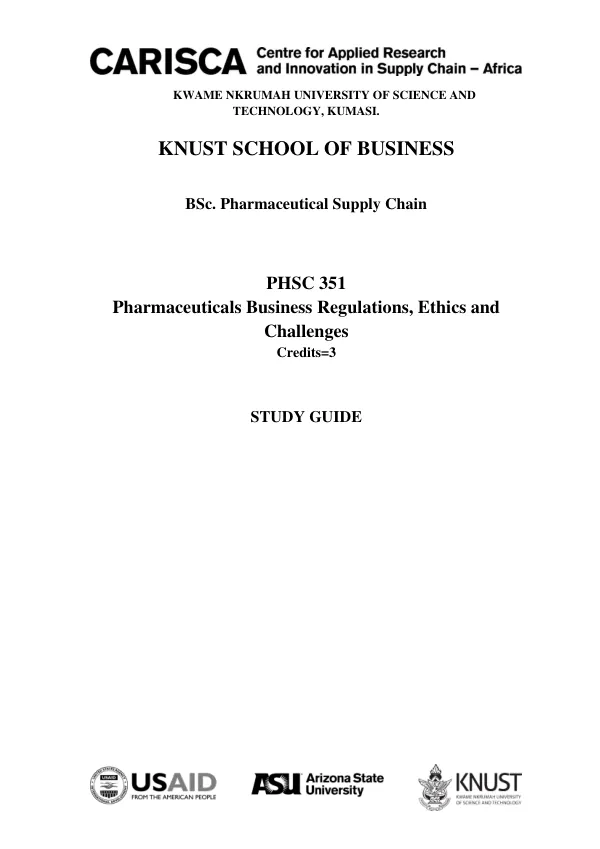
Pharmaceutical Business Regulations, Ethics and Challenges Study Guide
Pharmaceutical regulation is the combination of legal, administrative, and technical measures that governments take to ensure the safety, efficacy, and quality of medicines, as well as the relevance and accuracy of product information.
29 pages
Sign in to readA free account is required to download.
Abstract
Pharmaceuticals or medicines are one of the most regulated commodities because the use of ineffective, poor quality or toxic drugs may result in therapeutic failure, exacerbation of diseases and sometimes death. The legal basis for the regulations is the laws or legislations. Regulations are implemented through various guidelines, procedures, recommendations, and policies. To protect public health, good and effective regulatory systems should be established by national governments to ensure that pharmaceuticals are regulated appropriately. In this regard, key principles of good regulatory practices such as legality, independence, consistence, impartiality, and clarity should be adhered to. Pharmaceutical regulation reflects all these key principles. The regulation of pharmaceuticals involves several key concepts and principles. These include the basic definitions of laws, regulations, and guidelines, as well as the principles of good regulatory practices for pharmaceuticals. Good regulatory practices are essential for ensuring the safety, efficacy, and quality of medicines. The World Health Organization (WHO) has established guidelines for good regulatory practices in the regulation of medical products, which include principles such as legality, independence, consistence, impartiality, and clarity. The regulation of pharmaceuticals also involves the implementation of good regulatory practices. This includes the establishment of regulatory systems, the development of guidelines and procedures, and the enforcement of regulations. The regulation of pharmaceuticals is a complex process that requires the involvement of various stakeholders, including governments, regulatory agencies, pharmaceutical companies, and healthcare professionals. The course objectives are to expose students to some of the regulations governing pharmaceutical operations, introduce students to the ethical issues in pharmaceutical supply chain operations, discuss the key national and international regulatory frameworks and bodies in pharmaceutical operations, highlight the key pharmaceutical supply chain operational challenges and remedies, assist students in understanding the governance issues and good manufacturing practices in pharmaceutical business operations, and expose students to the regulatory requirements on good manufacturing practices for pharmaceuticals. On completion of the course, students should be able to outline the key principles of good regulatory practices for pharmaceuticals, outline the framework for the regulation of pharmaceuticals, discuss the operational challenges in pharmaceutical business, explain the regulatory requirement for good manufacturing practices, outline the codes of professional conduct for pharmaceutical supply chain professionals, outline the ethical and unethical pharmaceutical business promotion issues, explain the need for the global harmonization of pharmaceutical regulations, and recognize key factors that promote good regulatory practices. The course will cover basic concepts and principles in pharmaceutical regulation, regulatory framework and bodies in pharmaceutical business operations, compliance codes in pharmaceutical business operations, professional codes and conduct of pharmaceutical supply chain professionals, ethical and unethical pharmaceutical business promotion issues, governance issues in pharmaceutical business, pharmaceutical business operational challenges and a general overview of pharmaceutical supply chains. The content of this course is divided into 9 units, which are sub-divided into sections. Each unit has about 3-5 sections. To facilitate understanding of the subject matter, the key concept under each section is limited to at most two. The course will also cover the required textbooks and readings, which include "Pharmaceutical systems: global perspectives" by Lilja, Salek, Alvarez, and Hamilton, "Quality systems and controls for pharmaceuticals" by Sarker, "The pharmaceutical regulatory process" by Berry and Martin, and "Ghana National Drugs Policy, FDA Policies, WHO Policies on Pharmaceuticals regulations". The grading for the course will be based on hand-ins, including one individual essay (Term Paper- optional), one group assignment, participation in group discussions, mid-semester examinations, and end of term examinations. The academic/scientific writing requirement for the course is that students are required to exhibit utmost academic and scientific writing skills in their presentations and assignments. The term paper (optional) gives students the opportunity to explore, in greater detail, one of the topics covered in the course. The paper must have a volume of maximum of 2000 words. Deliverable assignments should be written in Times New Roman, Font size 12, 1.5 spaced with one-inch margins, and with a list of references based on and formatted to the Harvard Style. The assignment schedule for the course includes all assignments due before the end of the specified day of delivery (GMT 23:59). All assignments are to be uploaded to the hand-in folder for this course unless other instructions are given. If a student is unable to hand in their assignment on the LMS of IDL KNUST (vclass), they may email it to the course facilitator (on the said day of delivery). Failure to deliver assignments on the specified date will attract penalties in the form of a reduced grade.
Related documents
Documents in this collection
 2020
2020USAID DEC
Human Security Risk and Vulnerability Assessment Manual
Open record 2019
2019USAID DEC
Strengthening the Implementation of the Convention on International Trade in Endangered Species of Wild Flora and Fauna (CITES) in West Africa and Central Africa: A Training Manual for Customs Officers
Open record