USAID DEC
Empoderando as Comunidades Através do Fortalecimento Integrado de Sistemas em Nampula
Sign inCARE
Empoderando as Comunidades Através do Fortalecimento Integrado de Sistemas em Nampula
In Mozambique, the project Fortalecimento das Comunidades através de Programação Integrada—SCIP (2009-2014) is financed by PEPFAR and USAID Moçambique.
2012 · 8 pages
Sign in to readA free account is required to download.
Abstract
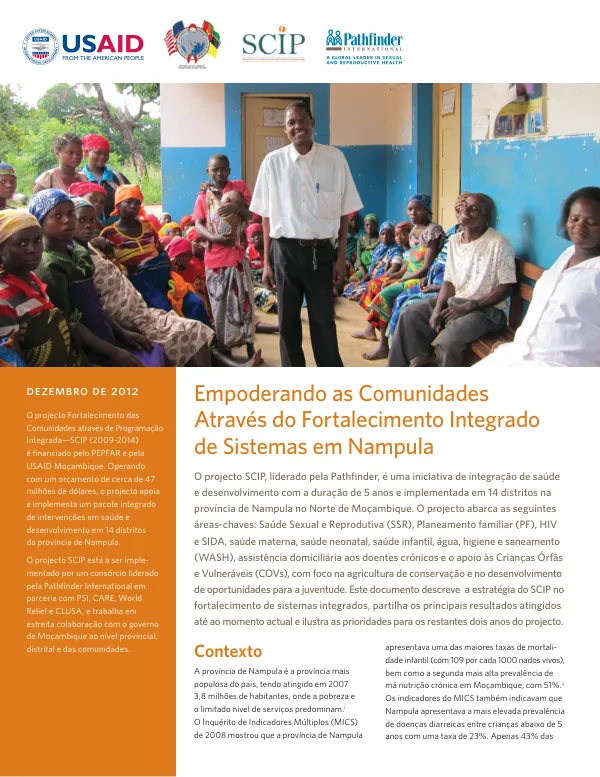
Operating with a budget of approximately 47 million dollars, the project supports and implements an integrated package of interventions in health and development in 14 districts of the province of Nampula. The project SCIP is being implemented by a consortium led by Pathfinder International in partnership with PSI, CARE, World Relief, and CLUSA, and works in close collaboration with the government of Mozambique at the provincial, district, and community levels. The province of Nampula is the most populous province in the country, having reached 3.8 million inhabitants in 2007, where poverty and limited access to services predominate. The Multiple Indicator Cluster Survey (MICS) of 2008 showed that the province of Nampula presented one of the highest infant mortality rates (109 per 1,000 live births), as well as the second highest prevalence of chronic malnutrition in Mozambique, with 51%. The MICS indicators also indicated that Nampula had the highest prevalence of diarrheal diseases among children under 5 years old, with a rate of 23%. Only 43% of households had access to safe water, and a mere 15.2% had access to sanitation. The literacy rate for women was a mere 21%, and the contraceptive prevalence rate was the second lowest in the country, at around 4%. The National Survey on HIV and AIDS Prevalence, Risk Behavior, and Information in Mozambique (INSIDA) conducted in 2009 revealed a prevalence of HIV of 4.6% in Nampula. Despite this prevalence being lower than the national average of 11.6%, this rate still represents approximately 175,000 people living with HIV (PLHIV). The INSIDA data also revealed several risk behaviors that could exacerbate the epidemic. In comparison with other provinces in the country, women in Nampula exhibited the lowest levels of knowledge about HIV and AIDS; men reported the highest rates of multiple sexual partners (25%), a low rate of condom use (5.7%), and a low rate of HIV testing (3.8%). As a result of the HIV epidemic, 13% of children under 17 years old are in a situation of vulnerability and orphanhood. To address the complexity of health and development challenges in Nampula, a multi-sectoral response was necessary. Guided by the USAID assistance strategy for Mozambique, the SCIP project was designed based on ongoing initiatives implemented by USAID partners in Nampula, including nutrition and food security, water and sanitation, HIV care and treatment. In this way, the SCIP is currently implementing three integrated packages (Basic, Complementary, and Specialized), specifically designed to cover the gaps detected and increase efforts in the development program for the 14 target districts of the project. The figure 1 illustrates the coverage of each of the interventions of these packages. The SCIP's approach is based on the Pathfinder's Integrated Systems Strengthening (ISS) model, which recognizes the community and the health system as interdependent and focuses efforts on the "zone of interaction" where community members and the formal health system meet and interact. The activities that strengthen this zone of interaction aim to operationalize six key functions: 1) community empowerment and self-confidence; 2) organizational strengthening, governance, and leadership; 3) social networks and advocacy; 4) service delivery; 5) evidence-based decision-making; and 6) health resources. By prioritizing these activities, the SCIP reinforces the capacity of communities to access health information and services, increases the capacity of the health system to respond to the needs of the population in these communities, and supports communities to autonomously identify, express, and take actions to resolve their own problems. The majority of the SCIP's components serve to strengthen the functions within the zone of interaction of the ISS model, where communities and the formal health system meet and, in most cases, operationalize simultaneously more than one function. Creating strong community social networks, improving access and quality of health services, increasing data flow and its use are the key components of the project. All these elements are described below through the perspective of the ISS. Empowering communities through the development of strong and autonomous social networks is fundamental to the missions of both Pathfinder and SCIP. Within the integrated system model, this premise is achieved through activities that aim to concretize two fundamental functions: 1) empowerment and self-sustainability; and 2) community platform and advocacy. Aligned with Mozambique's decentralization policy, the SCIP develops the capacities of local leadership