USAID DEC
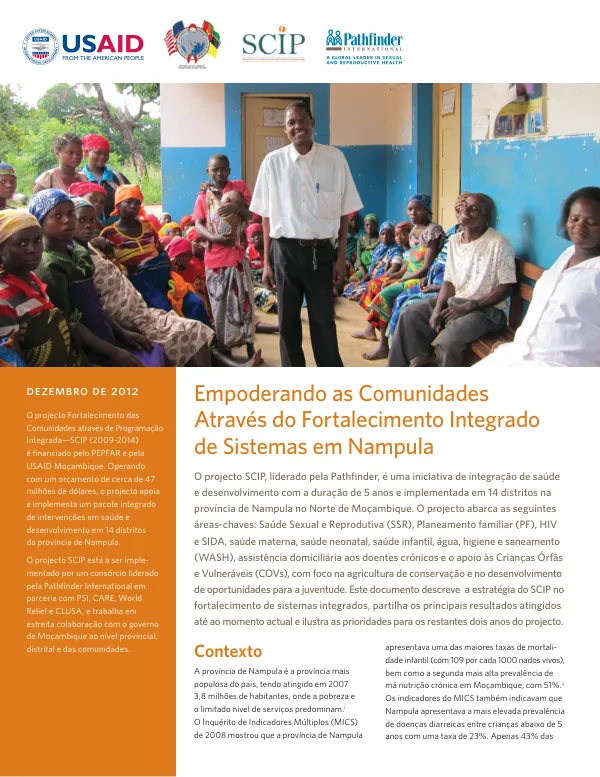
SCIP 2009-2014: Reunião de 30 de Maio 2013 - Visita da sua Excia o Sr Secretário Provincial de Nampula
Sign inCARE
SCIP 2009-2014: Reunião de 30 de Maio 2013 - Visita da sua Excia o Sr Secretário Provincial de Nampula
The agricultural development initiative in Mozambique's Nampula Province began in 2013 with the support of various international organizations, including CARE, Pathfinder International, and World Relief.
2013 · 29 pages
Sign in to readA free account is required to download.
Abstract
The initiative aimed to improve access to clean water and sanitation, as well as promote agricultural development and community engagement. The initiative focused on 14 districts in Nampula Province, with a goal of creating a more sustainable and resilient community. The main objectives of the initiative were to improve access to healthcare services, promote preventive behaviors, increase community participation in decision-making, and enhance the use of clean water and sanitation facilities. Implementation of the initiative involved the establishment of community-led total sanitation (CLTS) programs, which aimed to create a supportive environment for behavior change and community engagement. The initiative also promoted the use of participatory approaches, such as the "Modelo Socio-Ecologico para Saúde," which emphasized the importance of acting at different levels, including the individual, family, and community. The initiative established various community structures, including the "Conselho Local da Localidade" (CLL), which was responsible for analyzing monthly data, discussing problems, and developing community action plans. The initiative also established the "Conselho Local do Posto Administrativo" (CLPA), which was responsible for providing feedback to users on the quality of services, as well as the "Conselho Local Distrital" (CLD), which was responsible for presenting and discussing trends in health indicators. The initiative also promoted the training of community leaders and volunteers in areas such as health, water and sanitation, and agricultural development. By the end of the initiative, over 14,000 community leaders had been trained in health issues, and over 32,000 volunteers had been trained in various areas. Additionally, over 2,250 community trainers had been trained to train volunteers, and over 700 community leaders had been trained as facilitators of debates on various topics, including gender-based violence and male involvement in reproductive health. The initiative achieved significant results, including the establishment of over 1,860 community structures, the training of over 14,000 community leaders, and the training of over 32,000 volunteers. The initiative also promoted the use of clean water and sanitation facilities, with over 1,722 households benefiting from the initiative.