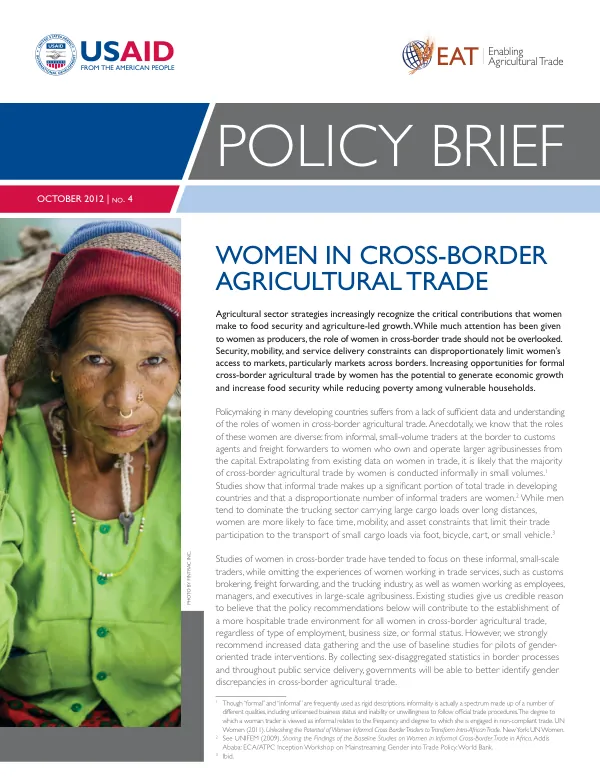
FINTRAC
Enabling Agricultural Trade: Women in Cross-Border Agricultural Trade
The agricultural development initiative in the Enabling Agricultural Trade (EAT) program began with a focus on increasing women's participation in cross-border agricultural trade.
2012 · 8 pages
Sign in to readA free account is required to download.
Abstract
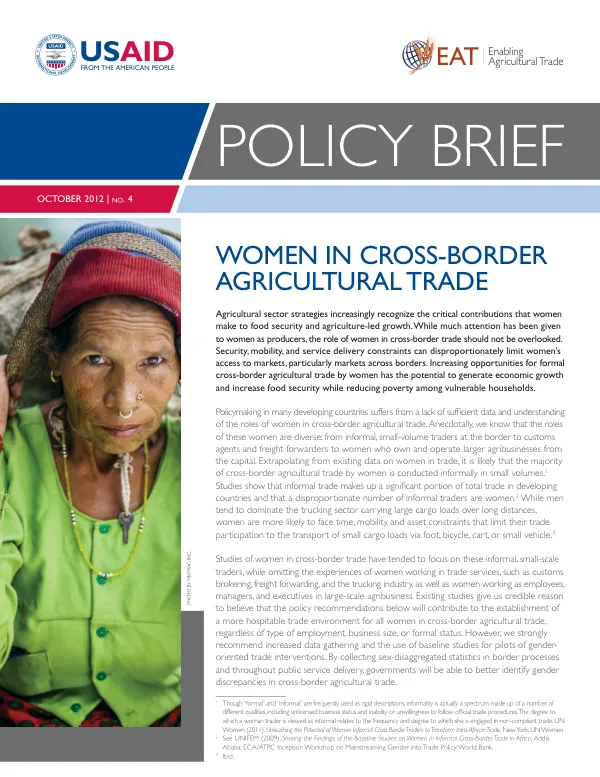
The program aimed to improve the trade environment for women traders, particularly those who are disadvantaged by the existing trade environment. The initiative recognized the critical role women play in trade, with women traders handling 60-90 percent of domestic produce production and delivery in West Africa. The program's central tenet is that trade reform activities must specifically target the participation of women cross-border agricultural traders. To achieve this, the initiative is organized into three principles: ensuring women's rights to equal access to trade and related services, increasing market opportunities for women traders, and designing the policy-planning process to ensure the voices of women traders are heard. Women face a wide range of legal restrictions that limit their ability to participate in cross-border agricultural trade. These restrictions include limitations on the right to own a passport or other laws that create an effective barrier to women's independence or mobility. The program aims to address these issues by promoting equality in the legal framework and ensuring that women's legal rights are respected in practice. The program's first principle is to ensure women's rights to equal access to trade and related services. This includes providing training for customs and border officials in policies and practices that encourage the inclusion of women. The program also aims to increase market opportunities for women traders by providing greater security, mobility, and service delivery. The initiative recognizes that women's participation in trade is critical to achieving broad-based and more equitable growth, food security, and poverty reduction. By helping women traders formalize and increasing their access to markets, governments can increase the flow of products to food-deficit areas and increase income for women traders and their families. The program's second principle is to increase market opportunities for women traders, particularly those who are disadvantaged by the existing trade environment. This includes providing greater security, mobility, and service delivery to women traders, as well as promoting equality in the legal framework. The program's third principle is to design the policy-planning process to ensure the voices of women traders are heard. This includes collecting sex-disaggregated statistics in border processes and throughout public service delivery to better identify gender discrepancies in cross-border trade. The program's focus on women's participation in cross-border agricultural trade has the potential to improve food security and reduce poverty among vulnerable populations. By increasing women's access to trade and related services, the program can help women traders formalize and increase their income and improve their economic status. The program's recommendations are based on existing data on women in cross-border trade, which shows that women traders are more likely to face time, mobility, and asset constraints that limit their trade participation. The program's focus on women's participation in cross-border agricultural trade is critical to achieving broad-based and more equitable growth, food security, and poverty reduction. The program's approach to increasing women's participation in cross-border agricultural trade is based on the following key interventions: 1. Ensuring women's rights to equal access to trade and related services 2. Increasing market opportunities for women traders, particularly those who are disadvantaged by the existing trade environment 3. Designing the policy-planning process to ensure the voices of women traders are heard 2. Increasing market
Related documents