FINTRAC
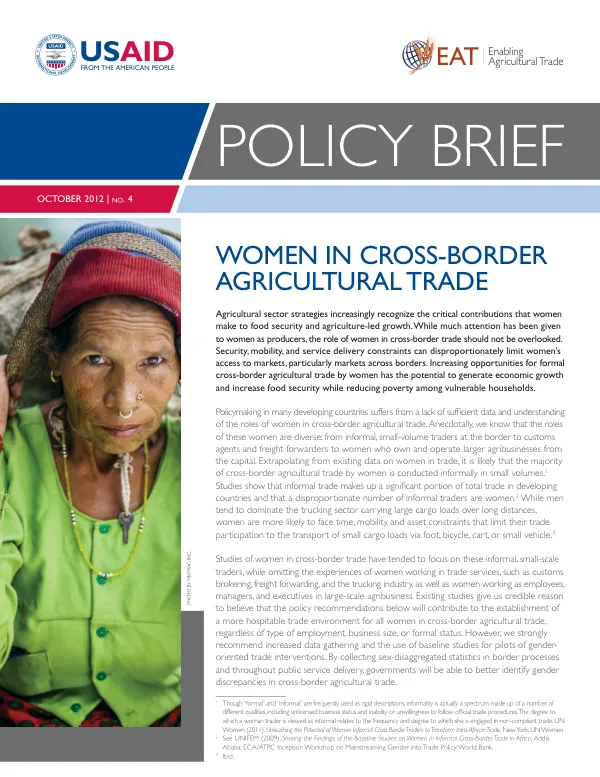
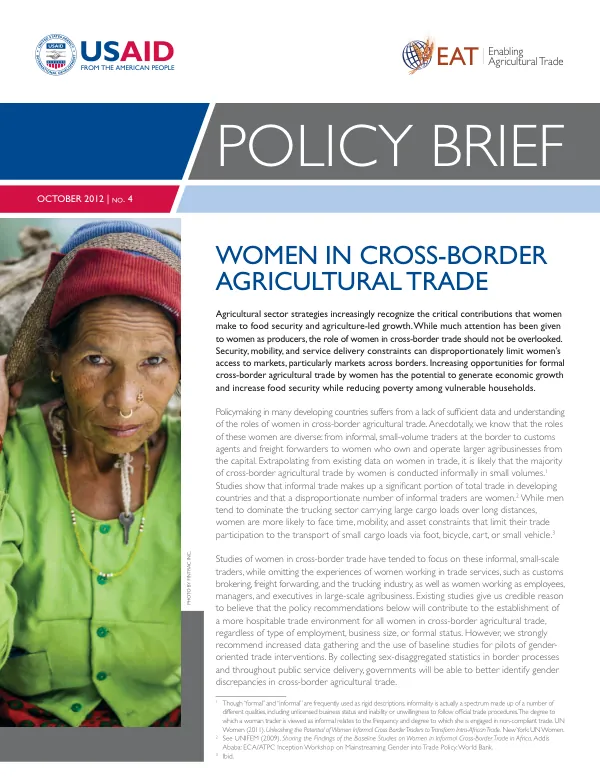
Enabling Agricultural Trade: Women in Cross-Border Agricultural Trade
Agricultural sector strategies increasingly recognize the critical contributions that women make to food security and agriculture-led growth.
2012 · 8 pages
Sign in to readA free account is required to download.
Abstract
While much attention has been given to women as producers, the role of women in cross-border trade should not be overlooked. Security, mobility, and service delivery constraints can disproportionately limit women's access to markets, particularly markets across borders. Increasing opportunities for formal cross-border agricultural trade by women has the potential to generate economic growth and increase food security while reducing poverty among vulnerable households. Policymaking in many developing countries suffers from a lack of sufficient data and understanding of the roles of women in cross-border agricultural trade. Anecdotally, women play diverse roles in cross-border trade, from informal, small-volume traders at the border to customs agents and freight forwarders to women who own and operate larger agribusinesses from the capital. Extrapolating from existing data on women in trade, it is likely that the majority of cross-border agricultural trade by women is conducted informally in small volumes. Studies show that informal trade makes up a significant portion of total trade in developing countries and that a disproportionate number of informal traders are women. Women in cross-border agricultural trade frequently include economically disadvantaged women for whom increased formal access to markets can have a powerful effect on alleviating poverty. In West Africa, women in cross-border trade support an average of over six dependents, and in Kenya, 79.3 percent of women cross-border traders rely on cross-border trade as their sole source of income. By helping these women traders formalize through greater security, greater mobility, and better service delivery, governments have the ability to increase the flow of agricultural products to food-deficit areas and increase income for women traders and their families. The value of informal cross-border trade in southern Africa, seventy percent of which is conducted by women, is estimated to be above US$7 billion. Informality not only limits government revenue but also constrains business growth by limiting access to formal credit and making businesses more vulnerable to harassment and the inconsistent application of trade policies. Improving the trade environment for women would stimulate greater formalization, increased national revenue, and new opportunities for women-owned businesses. Increasing the ability of women to engage freely in cross-border agricultural trade also has the potential to improve food security and reduce poverty among vulnerable populations. Women face a wide range of legal restrictions that limit their ability to participate in cross-border agricultural trade. While limitations on the right to own a passport or other identification clearly prevent cross-border activity, other laws may create an effective prohibition by limiting women's independence or mobility. In Indonesia, for example, women are not allowed to legally enter into a contract on their own behalf. Until 2008, Mongolia prohibited women from working in several sectors, including transportation, and the Philippines and Papua New Guinea place limitations on the ability of women to work at night. An increase in women's access to trade and related government services begins with equality in the legal framework. Where there is not equality under the law, for instance, where married women do not have the right to hold a passport, women's participation in trade will be severely curtailed. Steps must be taken to ensure that women's legal equality in the trade environment is respected in practice, including gender training for border officials, investments in infrastructure to ensure safety and privacy, greater communication with women on their rights in the border process, and provision of an avenue for redress in the event of harassment or discrimination.
Related documents