USAID DEC
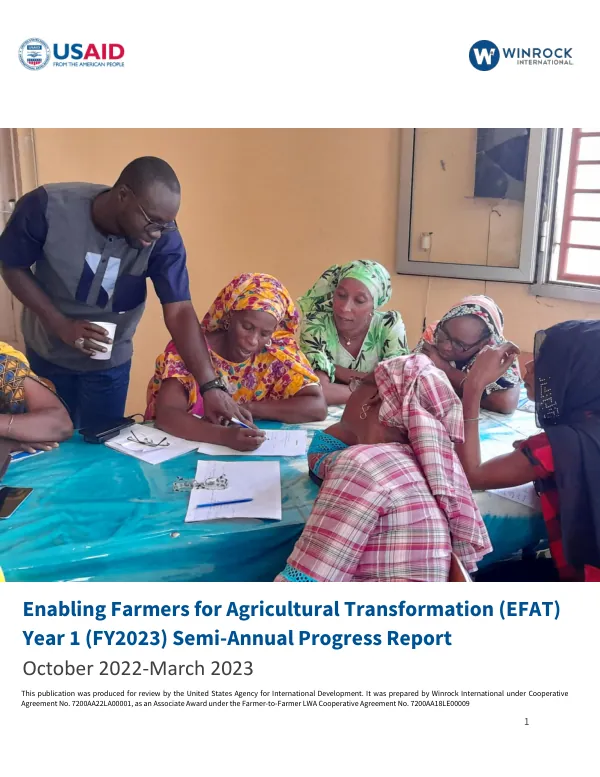
Enabling Farmers for Agricultural Transformation (EFAT) FY2023 Semi-Annual Progress Report
Sign inFOOD AND AGRICULTURE ORGANIZATION OF THE UNITED NATIONS IN GEORGIA
Enabling Farmers for Agricultural Transformation (EFAT) FY2023 Semi-Annual Progress Report
The Enabling Farmers for Agricultural Transformation (EFAT) project is a five-year initiative that began on October 1, 2022, and aims to strengthen pluralistic extension and advisory services (EAS) for the effective delivery and scaling of climate-smart agricultural innovations.
2023 · 25 pages
Sign in to readA free account is required to download.
Abstract
The project is funded by the United States Agency for International Development (USAID) and is implemented by Winrock International. EFAT has three broad objectives: to pilot EAS delivery models, to engage with USAID missions to strengthen EAS programming, and to strengthen a global community of practice (CoP) on EAS. The project focuses on Senegal, Ghana, and Niger, with additional activities taking place globally. The project team is led by Dr. Soniia David, who was approved by USAID on October 6, 2022, and began work on October 17, 2022. The Senegal Country Director, Mr. Amath Diop, started work on February 6, 2023, after a prolonged search. The MEL specialist, Mr. Assane Sow, will join the project on April 17, 2023, and the EAS specialist, Mr. Nar Gade Diagne, is expected to start work in early May. The project team is also supported by a team of Winrock's home office staff and consultants. The EFAT project has made significant progress in its first six months, including the establishment of a project management unit in Senegal and the development of a comprehensive work plan. The project has also engaged with various stakeholders, including USAID missions, local private sector providers, and civil society organizations. One of the key challenges faced by the project is the recruitment of staff, particularly in Niger and Ghana. However, the project team is working to address this challenge and has identified a finalist candidate for the Ghana position. The project team is also working to establish a global community of practice (CoP) on EAS, which will provide a platform for learning, knowledge exchange, and scaling of proven EAS practices, methods, and approaches. The EFAT project has several planned activities for the next six months, including the implementation of pilot EAS delivery models, the engagement with USAID missions to strengthen EAS programming, and the strengthening of the global CoP on EAS. The project team is committed to achieving its objectives and making a positive impact on the lives of smallholder farmers, particularly women and youth. The EFAT project is part of a larger effort to strengthen EAS in West Africa, which is critical for boosting agricultural productivity, incomes, and resilience of smallholder producers and value chain actors. The project's success will depend on its ability to effectively implement its objectives and engage with various stakeholders to achieve its goals.