UNIVERSITY RESEARCH CORPORATION CO., LLC
Enabling Writers Workshop Program
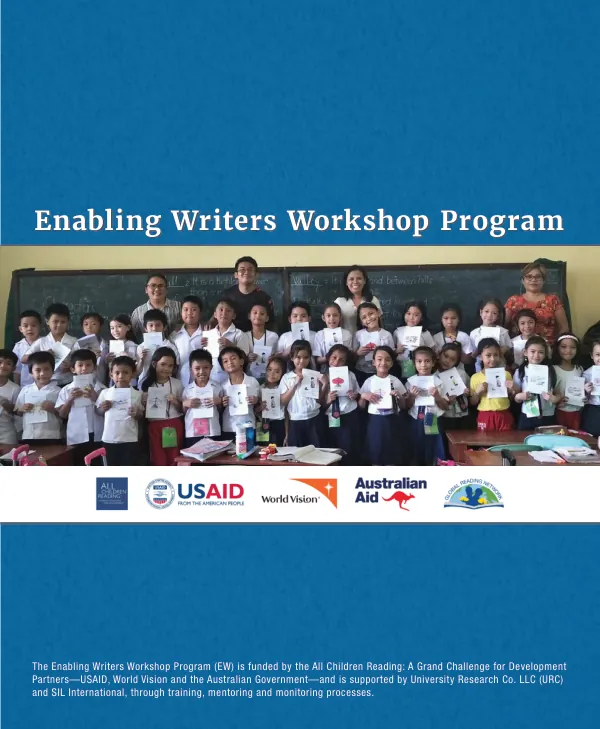
The Enabling Writers Workshop Program (EW) is a collaborative initiative funded by the All Children Reading: A Grand Challenge for Development Partners—USAID, World Vision, and the Australian Government—and supported by University Research Co.
2019 · 4 pages
Sign in to readA free account is required to download.
Abstract
LLC (URC) and SIL International. The program aims to develop high-quality books for early grade reading in developing countries. To ensure book quality, the EW program employs a comprehensive approach that includes common program resources, a standardized training process, monthly coaching via distance learning, and book team reviewers comprising Ministry of Education language experts and early grade reading specialists. The program also utilizes book quality review protocols, a structured school-based field testing process, and periodic reporting. The program produces electronic book files for uploading to the Global Digital Library, Bloom online library, and other digital library platforms. These products are made available for national adoption and large-scale printing by countries implementing the program. The program has produced a significant number of titles in various languages, including Hausa in Nigeria, Cebuano, Boholano, Kagay-anon, and Kalanguya in the Philippines, Bangla in Bangladesh, Bahasa Indonesia in Indonesia, and Awadi, Bhojpuri, Doteli, Maithili, Nepal Bhasa, Nepali, and Tharu in Nepal. The EW program utilizes Bloom software to support writers in creating decodable and leveled text for young readers. The program is implemented through training and book-writing workshops, which focus on production of quality books. The program's objectives are centered around five key areas: understanding of early grade reading and book usage in the classroom, basic quality text development criteria, writing decodable and leveled texts, using the Bloom software, and production of targeted texts. The program works with local country project teams to ensure that the content of books created aligns with the national curriculum in reading skills development and grade-appropriate content. The program also develops guidelines for developing young learners' books, including alignment of decodable text sequence with letter/sound introduction in phonics instruction, alignment of leveled text with basic additional reading skills, and alignment of leveled non-fiction text with content curriculum. The program encourages local country teams to incorporate cross-cutting issues relevant to the national, cultural, or social context, such as gender equity, people with disabilities, religious tolerance, moral values, under-represented ethnic and cultural sub-populations, and HIV/AIDS. The program is currently being implemented in six countries—Bangladesh, Indonesia, Nigeria, Nepal, Philippines, and Haiti—with the objectives of developing substantial sets of high-quality decodable and leveled books for adoption by Ministries of Education and use by schools in developing countries, developing local capacity for sustainable creation of quality decodable and leveled books, and producing a large set of quality books for sharing via the Global Digital Library and other online e-book access points.