USAID DEC
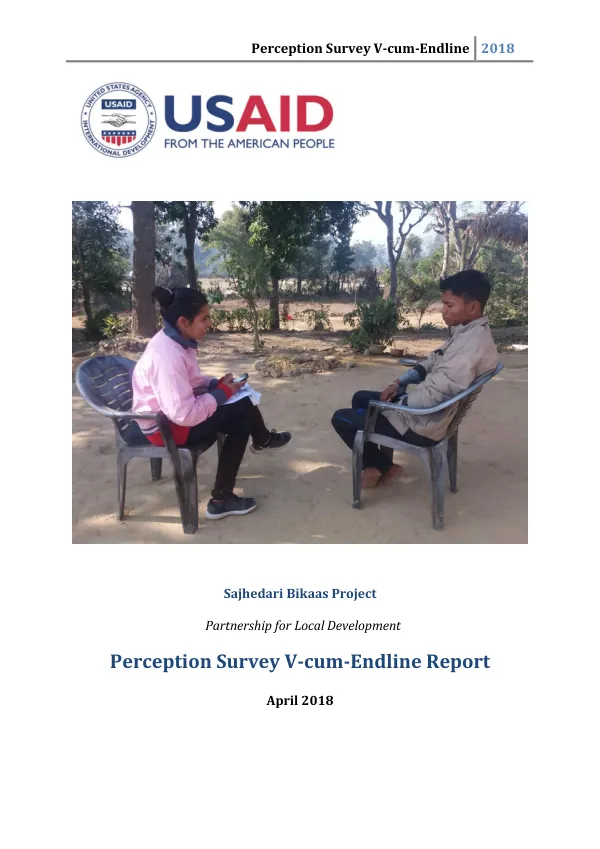
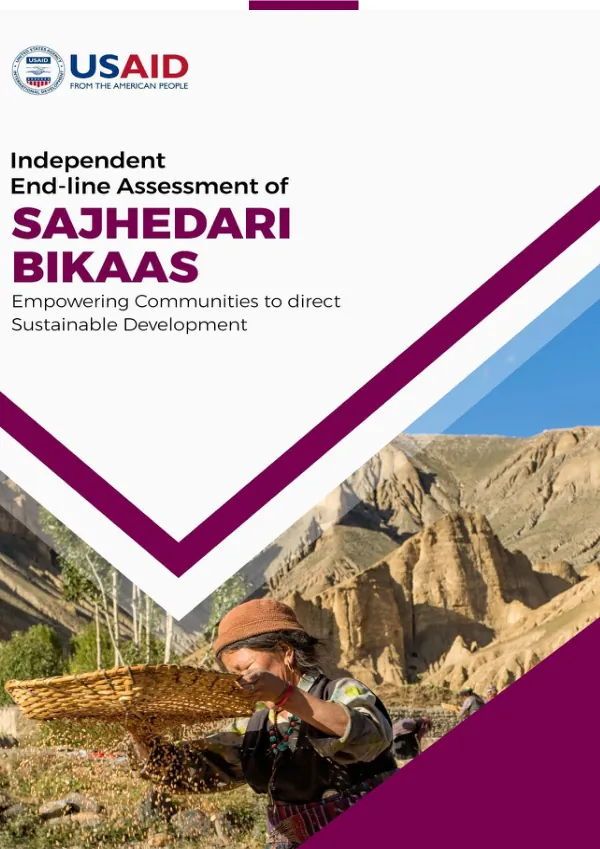
End-line Evaluation of the Sajhedari Bikaas Programme
The Sajhedari Bikaas (SB) program was initiated in 2015 to support the recovery efforts in Nepal following the devastating earthquake.
2018 · 79 pages
Sign in to readA free account is required to download.
Abstract
The program aimed to engage with local governments and jointly execute projects that were not funded by the Nepal Government through the Ward Citizen Forums (WCFs) and Village Development Committees (VDCs). Prior to the program intervention, the VDCs were responsible for executing infrastructure projects, but the processes were poorly implemented with a lack of transparency within the system. The program adopted a bottom-up approach to ensure that community members were equal stakeholders in the development process. This enabled the communities to develop a sense of ownership with the project, resulting in better quality of work at reasonable prices. The involvement of communities in the development process led to the resolution of community-level problems through community-driven solutions, which is a key factor in ensuring sustainable outcomes. The SB program focused on improving performance across 6 outcome-level indicators in the first phase, and in the current phase, it includes evaluating performance of 7 additional recovery indicators along with the 6 governance indicators. The analysis is based on conducting quantitative surveys across approximately 9000 respondents, of which ~3000 households belonged to a control group where the SB intervention was not executed. To gain deeper insight into the interventions, implementation challenges, and processes followed, 10 Focus Group Discussions (FGDs) and 20 In-Depth Interviews (IDIs) were conducted with mixed groups and ex-VDC officials. The findings from this study indicate that while there is a lack of clear quantitative ability to attribute specific outcomes to certain interventions, the qualitative discussions with mixed groups suggest that the systemic approach of SB in strengthening community participation and equitable voice in planning through a process-driven approach is what makes the program a clear differentiator from similar interventions. The baseline and end-line comparative study indicates that across 7 out of the 13 indicators, there has been significant improvement. Additionally, across control and treatment groups, improvement has been recorded for 8 of the 13 indicators. The governance indicators showed significant improvement from the baseline to the end-line, especially with respect to the functioning of Ward Citizen Forums. The SB program's approach to community participation and equitable voice in planning has been instrumental in ensuring sustainable outcomes. The program's focus on community-driven solutions has led to the resolution of community-level problems, and the involvement of communities in the development process has resulted in better quality of work at reasonable prices. The program's success can be attributed to its systemic approach, which has strengthened community participation and equitable voice in planning. The analysis of the SB program's impact and sustainability reveals that the program has made significant progress in improving performance across various indicators. The program's focus on community participation and equitable voice in planning has been instrumental in ensuring sustainable outcomes. The program's approach has been successful in strengthening community participation and equitable voice in planning, and its impact can be seen in the significant improvement in governance indicators. The SB program's success can be attributed to its ability to engage with local governments and jointly execute projects that were not funded by the Nepal Government. The program's focus on community-driven solutions has led to the resolution of community-level problems, and the involvement of communities in the development process has resulted in better quality of work at reasonable prices. The program's approach has been successful in ensuring sustainable outcomes, and its impact can be seen in the significant improvement in governance indicators.
Related documents