USAID DEC
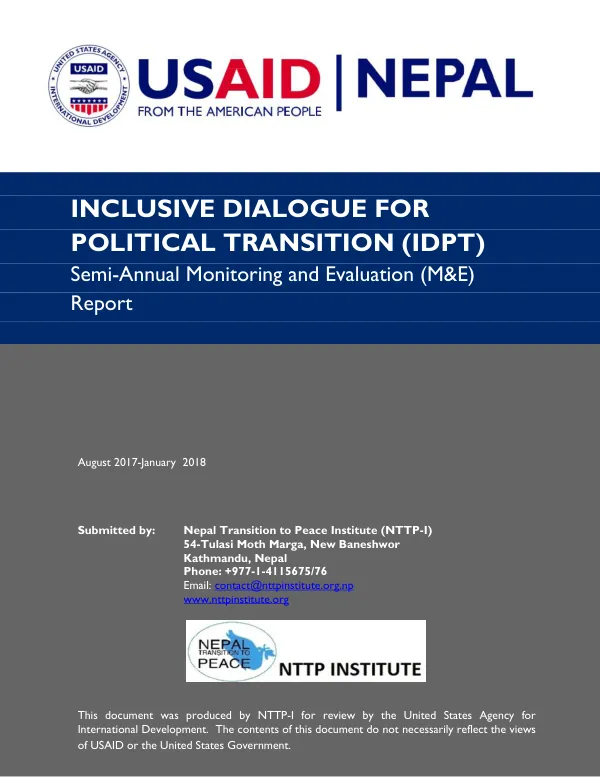
Inclusive Dialogue for Political Transition (IDPT) Semi-Annual Monitoring and Evaluation (M&E) Report
Sign inUSAID
Inclusive Dialogue for Political Transition (IDPT) Semi-Annual Monitoring and Evaluation (M&E) Report
The Inclusive Dialogue for Political Transition (IDPT) project in Nepal aimed to promote peaceful political environment and reconciliation among key national political actors.
2018 · 34 pages
Sign in to readA free account is required to download.
Abstract
The project was implemented by the Nepal Transition to Peace Institute (NTTP-I) from 2015 to 2018, with funding from the United States Agency for International Development (USAID). The project's objectives were to strengthen NTTP-I for its sustainability and continued effectiveness, improve knowledge management for decision making and peaceful political environment, and continue dialogue activities to narrow down political differences and mitigate violence. The project's results framework was designed to achieve the following three key objectives: strengthening NTTP-I, improving knowledge management, and continuing dialogue activities. The project's activities included conducting inclusive dialogues at the NTTP Forum, thematic groups, and other bilateral and multilateral meetings. NTTP-I also facilitated series of dialogues to create an environment for elections in Province No 2, which had been boycotting the constitution promulgated in 2015. NTTP-I explored the potential contributions of non-political actors to shorten Nepal's democratic transition by smooth conduction of elections participated by all major political forces. The team traveled to Province No 2 to hold dialogues with civil society leaders, media persons, academia, lawyers, government officials, and local people to assess the situation at local levels and explore ways to minimize the gap between Madhes and Kathmandu. NTTP-I also improved archives of the peace process-related documents and published abstracts of past research papers and articles featured in the NTTP-I publication, Nepal Transition to Peace: A decade of the Comprehensive Peace Accord (2006-2016). The Institute shared experience of key people involved in Nepal's peace process with the rest of the world and made available a list of books and other resources available at the Institute through its website. A two-day residential workshop was organized for senior politicians involved in Nepal's peace process to share their experience, evaluate the efficacy of Track 1.5 process of negotiation, mediation, and dialogue, and foresee the prospect of conflict in Nepal and the usefulness of the platform of confidential dialogues like NTTP-I in the future. Four research papers and four policy briefs were prepared and fed into dialogues on the issues of political transition and other thematic dialogues. The project's findings indicate that an atmosphere of trust was developed, differences on political issues were narrowed down, and constructive options were taken to the highest decision-making level. Themes related to women, Madhesis, Dalit, Janajati, and Youth were discussed and taken up, and dialogue processes took place at the sub-national level and were supported by deeper knowledge and cross-linkages with the center. NTTP-I's strategy, fundraising, and sustainability plans were produced, administrative management and internal governance were defined, and continuous monitoring and process learning was systematized. The project's results were measured against the objectives and reviewed the level of success of the activities in meeting the project objectives, based on monitoring information compiled in quarterly basis.