ELIZABETH GLASER PEDIATRIC AIDS FOUNDATION
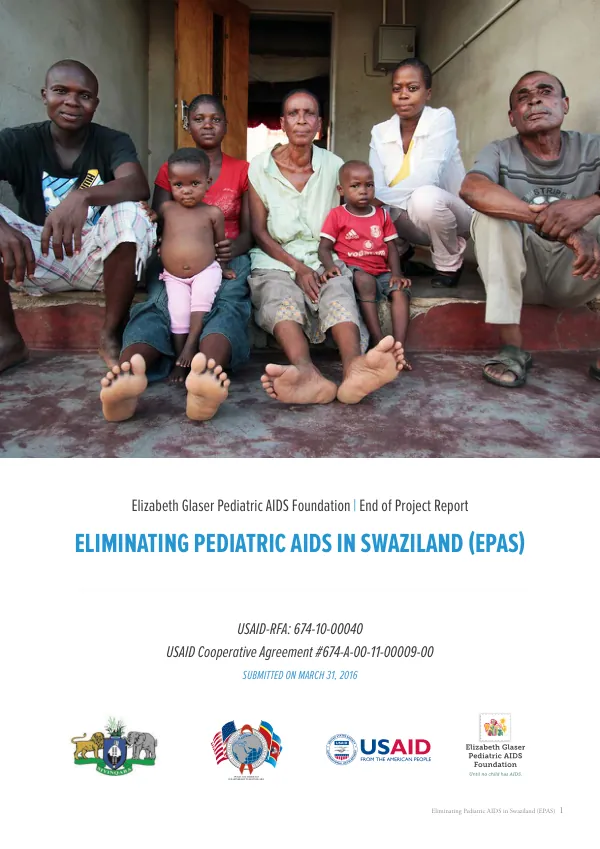
End of Project Report: Eliminating Pediatric AIDS in Swaziland (EPAS)
The Eliminating Pediatric AIDS in Swaziland (EPAS) Project was a five-year initiative that aimed to support the government of Swaziland in its efforts to achieve virtual elimination of pediatric HIV.
2016 · 44 pages
Sign in to readA free account is required to download.
Abstract
The project was implemented by the Elizabeth Glaser Pediatric AIDS Foundation (EGPAF) with funding from the United States Agency for International Development (USAID) through the U.S. President's Emergency Plan for AIDS Relief (PEPFAR). The project's specific objectives included universal access to Prevention of Mother-to-Child Transmission (PMTCT) services, sustained quality comprehensive integrated PMTCT services at government health facilities, strengthened national health system, and reviewed and improved policies, protocols, and guidelines for PMTCT services. EGPAF provided support at national, regional, facility, and community levels to achieve the EPAS objectives. Key strategies focused on increasing access to PMTCT through scaling up the number of health facilities providing comprehensive PMTCT services, strengthening the Maternal, Newborn, and Child Health (MNCH) platform, reducing missed opportunities for service delivery, and addressing cultural norms that limit service uptake. The project facilitated a seamless continuum of care for mothers and their families by improving and sustaining quality PMTCT services, strengthening comprehensive care for mothers and their families, achieving full integration of HIV services into MNCH platforms, and strengthening community linkages. The project implemented several interventions to achieve its objectives. These included the scaling up of comprehensive PMTCT services, strengthening the MNCH platform, reducing missed opportunities for service delivery, and addressing cultural norms that limit service uptake. The project also worked to improve the policies, protocols, and guidelines on PMTCT, HIV care, and treatment through participation in technical working groups and their sub-committees. Additionally, the project contributed to building the capacity of the national health system by strengthening human resources, improving strategic information, strengthening logistics management, and building capacity for support. The project achieved significant results in its five-year implementation period. These included a significant increase in the number of health facilities providing comprehensive PMTCT services, improved quality of PMTCT services, and increased access to HIV care and treatment services. The project also contributed to the strengthening of the national health system, improved policies, protocols, and guidelines for PMTCT services, and enhanced community linkages. The project's success was attributed to its collaborative approach, which involved working closely with key stakeholders at national, regional, facility, and community levels. The project's focus on strengthening the national health system, improving quality of PMTCT services, and increasing access to HIV care and treatment services also contributed to its success. The project's achievements have set the stage for continued efforts to eliminate pediatric HIV in Swaziland and to strengthen the national health system. The project's impact was also evident in the reduction of mother-to-child transmission of HIV (MTCT) and the increase in the number of children accessing HIV care and treatment services. The project's efforts to strengthen the MNCH platform and reduce missed opportunities for service delivery also contributed to improved health outcomes for mothers and their families. The project's success has also been recognized by the government of Swaziland, which has committed to continuing the efforts to eliminate pediatric HIV in the country.
Related documents
Documents in this collection
 2021
2021USAID DEC
Assessing the effects of the implementation of the WHO “Treat All” guidelines on treatment outcomes, service quality, and cost in Namibia
Open record 2018
2018USAID DEC
Coordinating Comprehensive Care for Children (4Children) Semi-Annual Performance Report (October 2017 – March 2018)
Open record