USAID DEC
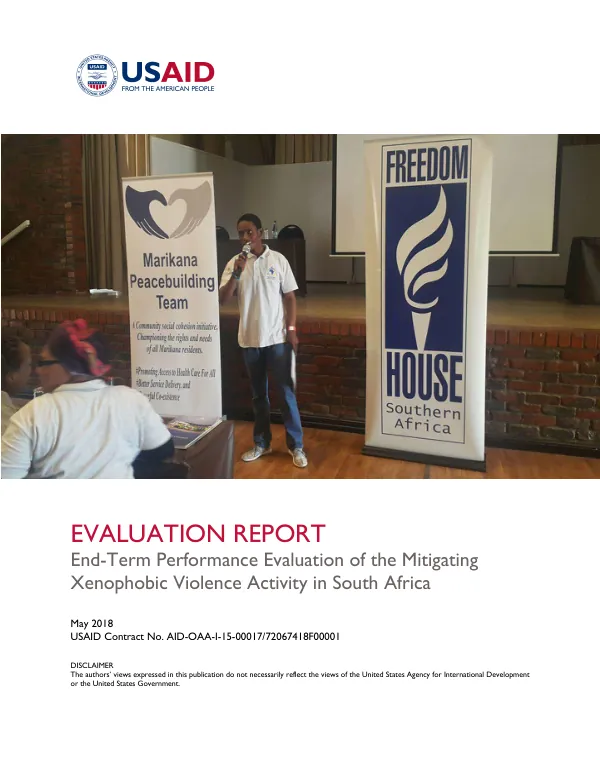
End-Term Performance Evaluation of the Mitigating Xenophobic Violence Activity in South Africa
Sign inDEMOCRACY INTERNATIONAL, INC.
End-Term Performance Evaluation of the Mitigating Xenophobic Violence Activity in South Africa
The "Mitigating Xenophobic Violence" (MXV) activity was a 23-month, $4.2 million activity implemented by Freedom House in 16 "hotspot" communities throughout South Africa.
2018 · 150 pages
Sign in to readA free account is required to download.
Abstract
The activity aimed to identify local conflict drivers and improve accountability for government social service delivery to mitigate the outbreak of violence. It was supported by USAID Southern Africa (USAID/SA) with Complex Crisis Fund (CCF) funding. The MXV activity focused on improving community-driven efforts to mitigate violence, particularly against foreign nationals. It worked with local communities to establish and develop capacity of Peacebuilding Teams (PBTs), develop community action plans, form civic education circles, and provide service delivery monitoring training. The activity also aimed to address the factors that fuel violence in South Africa, including poverty, inequality, and poor service delivery. The evaluation of the MXV activity was conducted by Democracy International (DI) in December 2017. The evaluation utilized a mixed methods approach, including desk review and secondary data mining, key stakeholder and small group interviews, roundtable discussions, and a brief electronic survey. The primary audience of the evaluation was USAID/Southern Africa, USAID/Washington, CCF managers, and Freedom House. The evaluation found that the MXV activity made a number of notable achievements, including completing 16 in-depth community conflict assessments and establishing and developing capacity of PBTs. However, the evaluation struggled to identify community-wide results due to the lack of baseline data and the activity's limited timeframe and financial resources. The activity also struggled to identify explicit linkages between gender and xenophobic violence. The evaluation found that the PBTs showed promising sustainability, with personal commitment and dedication from members and strong community support. However, other aspects of the program, such as service delivery and civic education training, looked less likely to continue without additional outside support. The evaluation also found that the MXV activity addressed the factors that fuel violence in South Africa, including poverty, inequality, and poor service delivery. The evaluation focused on answering five primary evaluation questions structured along four criteria: effectiveness, appropriateness, sustainability, and exportability. The evaluation found that the MXV activity was effective in improving community capacity to mitigate violence, but struggled to achieve community-wide results. The activity was also found to be appropriate in addressing the factors that fuel violence in South Africa, but struggled to identify explicit linkages between gender and xenophobic violence. The evaluation recommended that the MXV model be replicated and potentially scaled up in the future, with a focus on sustainability and exportability. The evaluation also recommended that future programming address the factors that fuel violence in South Africa, including poverty, inequality, and poor service delivery.