USAID DEC
ENGINE Sheep & Goat Production Facilitators Handbook
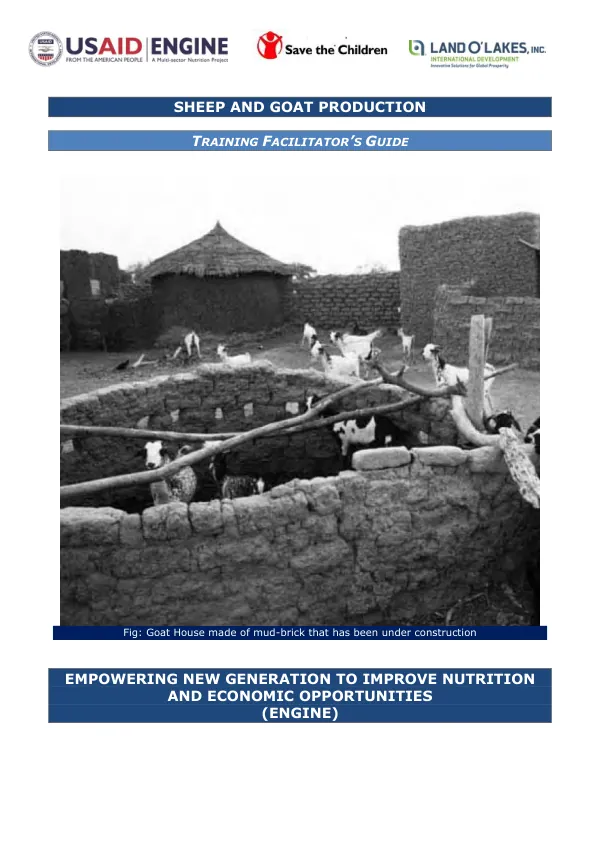
The ENGINE Sheep and Goat Production Training Facilitator's Guide is designed to assist in the training of smallholder households in improved sheep and goat production and marketing.
2013 · 23 pages
Sign in to readA free account is required to download.
Abstract
The guide is intended for use by ENGINE staff and partners when working with sheep and goat producers supported by the ENGINE program. It can be adapted by other organizations and institutions for their own field trainings. The overall training purpose is to enable participating households to understand, demonstrate, and invoke change in approaches to sheep and goat reproduction, management, housing, feeding, and healthcare. Upon completion of the full 10-session training, participating households will be able to adopt improved techniques for sheep and goat production, improve family health and nutrition through better feeding practices and increased production from their own herds, and have a greater awareness of gender-related issues in sheep and goat rearing. The guide recommends the use of various training materials, including illustrations, live animals, locally relevant veterinary drugs and equipment, and field visits to nearby Farmer Training Centers or farmer's houses. The training methods and techniques include group exercises, lecturing, brainstorming, field visits, question and answer sessions, case studies, role-playing, and demonstrations. Preparation for the training is crucial, and the trainer should prepare each session and group exercises in advance. The trainer should also decide on the most effective way of communicating the information and practice conducting the session or training. The training venue should be suitable for training, with enough space for participants to break into small groups and for the trainer to conduct in-field demonstrations. The facilitator guide provides step-by-step directions for conducting exercises to help participants learn techniques of improved sheep and goat production. The trainer should not feel limited by this training manual and is encouraged to develop their own exercises, case studies, and training tools. Session 1: Getting to Know Each Other is the first session of the training program. The session objective is for participants to get to know each other and become comfortable working with each other. The group will establish workshop norms and rules, including start and end times, communication and participation, punctuality, and respect for others. The trainer will facilitate group exercises and activities to achieve these objectives. The trainer will use various techniques, including group exercises, brainstorming, and role-playing, to help participants get to know each other and establish a positive and productive working relationship. The trainer will also use visual aids, such as illustrations and pictures, to facilitate the learning process. By the end of Session 1, participants will have established a positive and productive working relationship, and they will be ready to begin learning about sheep and goat production and marketing. The trainer will have established a clear understanding of the training objectives and will be able to facilitate the learning process effectively. The ENGINE Sheep and Goat Production Training Facilitator's Guide provides a comprehensive framework for training smallholder households in improved sheep and goat production and marketing. The guide is designed to be flexible and adaptable to the specific needs of the communities being served. The trainer is encouraged to develop their own exercises, case studies, and training tools to enhance the learning process. The guide emphasizes the importance of group exercises, brainstorming, and role-playing in facilitating the learning process. The trainer is also encouraged to use visual aids, such as illustrations and pictures, to facilitate the learning process. The guide provides a clear understanding of the training objectives and the techniques to be used to achieve these objectives. Overall, the ENGINE Sheep and Goat Production Training Facilitator's Guide provides a comprehensive framework for training smallholder households in improved sheep and goat production and marketing. The guide is designed to be flexible and adaptable to the specific needs of the communities being served, and it provides a clear understanding of the training objectives and the techniques to be used to achieve these objectives.