USAID DEC
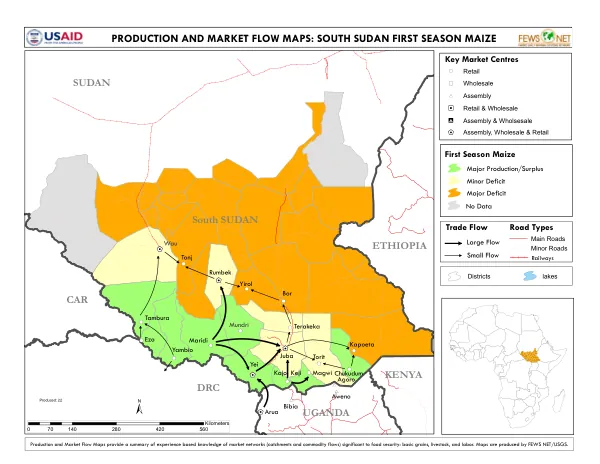
Production and Market Flow Maps: South Sudan First Season Maize
Production and Market Flow Maps for South Sudan's first season maize production highlight the country's complex market network.
1 pages
Sign in to readA free account is required to download.
Abstract
The maps illustrate the movement of maize from production areas to key market centers, providing insights into the commodity flow and potential trade opportunities. South Sudan's maize production is concentrated in the western and central regions, with major production areas including Wau, Tonj, Rumbek, and Yirol. The maps indicate that the majority of maize production is surplus, with significant quantities being traded to neighboring countries, including Ethiopia, the Central African Republic, Kenya, the Democratic Republic of Congo, and Uganda. Key market centers, such as Juba, Torit, and Yei, serve as major hubs for maize trade, with retail, wholesale, and assembly markets operating in these areas. The maps also highlight the importance of road networks, with main roads and minor roads facilitating the movement of maize from production areas to market centers. The maps further illustrate the significance of trade flows, with large flows of maize being transported along main roads, while smaller flows are observed along minor roads and railways. The maps also provide information on district boundaries, lakes, and other geographical features that may impact maize production and trade. The production and market flow maps are an essential tool for understanding the complexities of South Sudan's maize market and identifying opportunities for improving food security. The maps are produced by FEWS NET/USGS, utilizing experience-based knowledge of market networks and commodity flows. The information provided is significant for understanding the dynamics of basic grains, livestock, and labor markets in South Sudan. By analyzing the maps, stakeholders can gain insights into the country's maize production and trade patterns, ultimately informing decision-making and policy development to improve food security and market access for smallholder farmers. The maps highlight the importance of infrastructure development, particularly road maintenance and expansion, to improve the efficiency of maize trade. Additionally, the maps suggest that market linkage facilitation and farmer training programs could be effective interventions to improve maize production and trade in South Sudan. By understanding the complexities of the maize market, stakeholders can develop targeted interventions to address the challenges facing smallholder farmers and improve food security in the country.