CENTER FOR EDUCATIONAL DEVELOPMENT
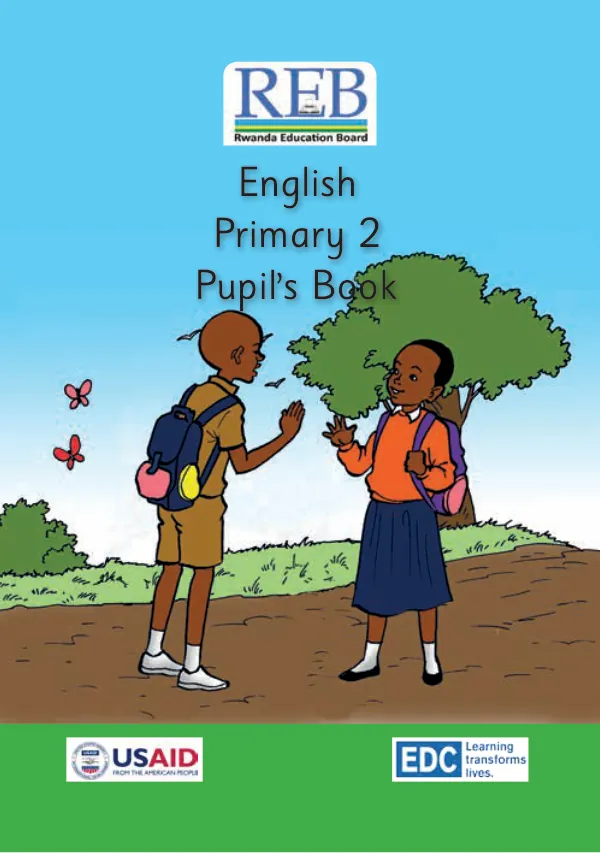
English Primary 2, Pupil’s Book
Greetings, introductions, and talking about school are essential skills for primary school students to develop.
2015 · 188 pages
Sign in to readA free account is required to download.
Abstract
The English Primary 2 Pupil's Book, published by the Rwanda Education Board, aims to enhance the English language culture among primary school children during their lower level of primary education. The book is designed to help learners acquire the fundamental English language skills, including reading, writing, speaking, and speaking, through progressive exercises and progressive vocabulary. The book is divided into nine units, each focusing on a specific theme. Unit 1, Greetings, introductions, and talking about school, introduces students to basic greetings, introductions, and conversations about school. The unit includes dialogues, vocabulary, and exercises to help students practice their language skills. For example, students learn to greet each other with "Good morning," "Good afternoon," and "Good evening." They also learn to introduce themselves and ask about others' names and where they live. The alphabet song is an essential tool for teaching the alphabet, and the book includes a version of the song that students can sing along to. The song helps students to remember the sequence of the alphabet and to associate each letter with its corresponding sound. The book also includes a list of the alphabet, with each letter accompanied by a word that starts with that letter. In addition to the alphabet song, the book includes a list of vocabulary related to greetings, introductions, and talking about school. Students learn to use vocabulary such as "hello," "hello," "goodbye," and "goodbye." They also learn to use phrases such as "How are you?" and "I'm fine, thank you." The book includes exercises and dialogues to help students practice their language skills and to develop their confidence in using English in everyday situations. The book is designed to be used in conjunction with a teacher or instructor, who can provide guidance and support to students as they work through the exercises and dialogues. The book is also designed to be used in a self-study setting, where students can work through the exercises and dialogues on their own. The book includes a range of exercises and dialogues, from simple to more complex, to cater to different learning styles and abilities. Overall, the English Primary 2 Pupil's Book is a valuable resource for teaching English language skills to primary school students. The book provides a comprehensive and engaging way to teach the alphabet, vocabulary, and vocabulary related to greetings, introductions, and talking about school. The book is designed to be used in conjunction with a teacher or instructor, and it is also suitable for self-study. The book is divided into nine units, each focusing on a specific theme. Unit 2, Sports, introduces students to vocabulary related to sports and physical activities. The unit includes dialogues, vocabulary, and exercises to help students practice their language skills. For example, students learn to use vocabulary such as "ball," "basket," and "net." They also learn to use phrases such as "We like to play" and "I like to play soccer." Unit 3, What time is it?, introduces students to vocabulary related to time and schedules. The unit includes dialogues, vocabulary, and exercises to help students practice their language skills. For example, students learn to use vocabulary such as "clock," "watch," and "hour." They also learn to use phrases such as "What time is it?" and "It's 3 o'clock." Unit 4, Food Stuffs, introduces students to vocabulary related to food and drinks. The unit includes dialogues, vocabulary, and exercises to help students practice their language skills. For example, students learn to use vocabulary such as "apple," "banana," and "orange." They also learn to use phrases such as "I like to eat an apple" and "I like to drink juice." Unit 5, Storytelling, introduces students to vocabulary related to storytelling and narratives. The unit includes dialogues, vocabulary, and exercises to help students practice their language skills. For example, students learn to use vocabulary such as "story," "narrative," and "character." They also learn to use phrases such as "I like to tell stories" and "I like to listen to stories." Unit 6, Family members, introduces students to vocabulary related to family members and relationships. The unit includes dialogues, vocabulary, and exercises to help students practice their language skills. For example, students learn to use vocabulary such as "mother," "mother," "father," and "father." They also learn to use phrases such as "My mother is a teacher" and "My father is a doctor." Unit 7, Weather, introduces students to vocabulary related to weather and climate. The unit includes dialogues, vocabulary, and exercises to help students practice their language skills. For example, students learn to use vocabulary such as "sun," "rain," and "cloud." They also learn to use phrases such as "It's sunny today" and "It's raining today." Unit 8, Animals, Birds, and In
Related documents