USAID DEC
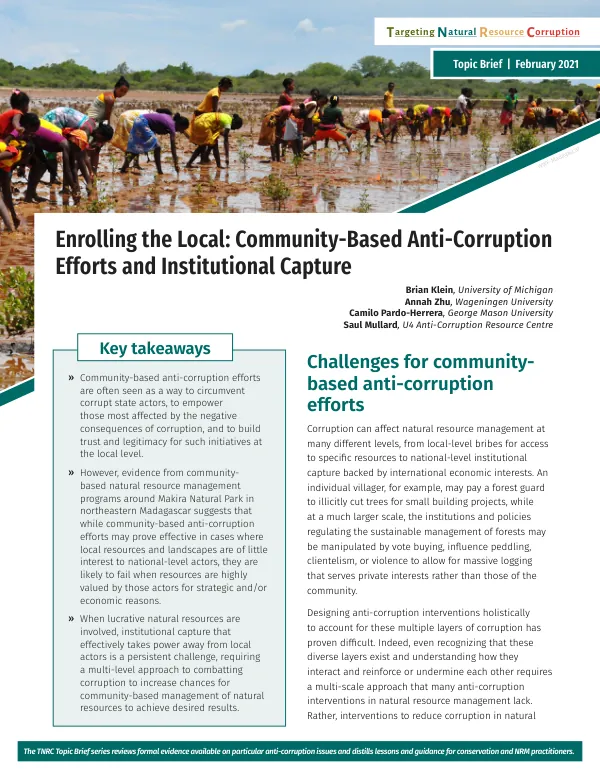
Enrolling the Local: Community-Based Anti-Corruption Efforts and Institutional Capture
Sign inGEORGE MASON UNIVERSITY
Enrolling the Local: Community-Based Anti-Corruption Efforts and Institutional Capture
Community-based anti-corruption efforts in natural resource management aim to empower local communities to monitor and prevent corrupt practices.
2021 · 11 pages
Sign in to readA free account is required to download.
Abstract
These initiatives often involve formalizing communities' rights to use or own specific areas of land and its resources, establishing schemes for managing those resources, and creating channels for individual community members to report suspicious or illicit activities. The rationale behind local participation in anti-corruption initiatives is rooted in the belief that it allows anti-corruption efforts to circumvent corrupt state actors, empowers those most affected by corrupt practices to openly and collectively name and contest it, and builds trust and provides local legitimacy to on-the-ground anti-corruption efforts. The need to sidestep government channels and appeal directly to citizens and civil society to achieve appreciable reductions in corruption is based on a view of politicians and other government officials as having the most to gain from corrupt practices and thus the least incentive to fight against them. Anti-corruption programs cannot rely on (potentially corrupt) state actors to undertake reforms that would ostensibly reduce their own opportunities to secure access to bribes and other material gains. The solution is to focus on empowering citizens and civil society organizations through local institutional reconfigurations that increase social accountability, while placing limits on the power of state actors. Institutional capture, a process by which institutions meant to advance the public interest are "captured" and instead made to serve the interests of certain groups or individuals, is a persistent challenge in natural resource management. When lucrative natural resources are involved, institutional capture that effectively takes power away from local actors is a significant obstacle to community-based management of natural resources. A multi-level approach to combatting corruption is necessary to increase chances for community-based management of natural resources to achieve desired results. A case study from northeastern Madagascar examines community-based anti-corruption efforts in natural resource management. The study highlights the challenges posed by the intersection of community-based initiatives with national-level dynamics of institutional capture. The findings suggest that community-based anti-corruption efforts may prove effective in cases where local resources and landscapes are of little interest to national-level actors, but are likely to fail when resources are highly valued by those actors for strategic and/or economic reasons. The study concludes that multi-level anti-corruption interventions might offer a promising way forward for reducing corruption in natural resource management for certain high-value landscapes or resources that might be subject to challenges connected to institutional capture. This approach involves designing anti-corruption interventions holistically to account for multiple layers of corruption, including local-level bribes and national-level institutional capture. By empowering citizens and civil society organizations through local institutional reconfigurations that increase social accountability, while placing limits on the power of state actors, community-based anti-corruption efforts can help to mitigate the effects of institutional capture and promote more effective management of natural resources.
Related documents