FONDO ACCIÓN
Environment Peace Initiative for Colombia (EPIC) REPORT Q3FY2015
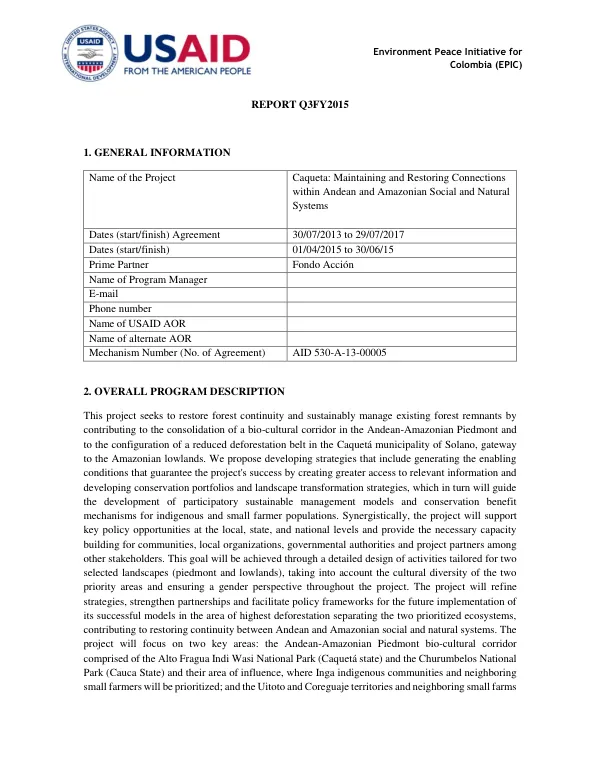
The Caqueta: Maintaining and Restoring Connections within Andean and Amazonian Social and Natural Systems project, also known as the Environment Peace Initiative for Colombia (EPIC), aims to restore forest continuity and sustainably manage existing forest remnants in the Andean-Amazonian Piedmont and Caquetá municipality of Solano.
2015 · 7 pages
Sign in to readA free account is required to download.
Abstract
The project seeks to consolidate a bio-cultural corridor and configure a reduced deforestation belt in the region. To achieve this goal, EPIC proposes developing strategies that include generating enabling conditions, creating access to relevant information, and developing conservation portfolios and landscape transformation strategies. The project focuses on two key areas: the Andean-Amazonian Piedmont bio-cultural corridor, comprising the Alto Fragua Indi Wasi National Park and the Churumbelos National Park, and the Uitoto and Coreguaje territories and neighboring small farms in Caquetá's municipality of Solano. EPIC will focus on four key components: Enabling conditions, Landscape transformation through sustainable management and conservation of natural resources, Local policy transformation, and Capacity building. In the third quarter of FY2015, EPIC made significant progress in Component 1, Selected Landscapes Managed Sustainably. The project team completed the Ecosystem Analysis and made adjustments to connectivity scenarios and maps. Additionally, 13 Village Community Agreements were signed, and 60 new property Land Management Plans (LMPs) were elaborated, covering an area of 1986ha. The project also initiated field activities at village and farm level in areas prioritized during Q2, including Las Mercedes, Hericha, and Mononguete Campesino Locations. In Component 2, Key Elements of Natural Resources Governance, EPIC carried out two Food Sovereignty for Indigenous people modules, progressing on constructing the Food Sovereignty Policy Guideline Document. The project also successfully carried out a workshop and policy dialogue on Cattle Ranching, Sustainability, and Deforestation Reduction, attended by more than 100 participants. Additionally, 14 workshops were carried out, reaching 277 participants, covering topics related to community-based research and monitoring, land planning, project design, and strategic organizational planning. EPIC expects to achieve Component 1 yearly targets in accordance with the plan, based on the progress reported and results attained during Q3. The project's intervention efforts were halted in four villages and initiated in two, due to security reasons, but this adjustment does not affect the project's total targets or the agreement related to village distribution.