FONDO ACCIÓN
Environment Peace Initiative for Colombia (EPIC) REPORT Q4FY2015
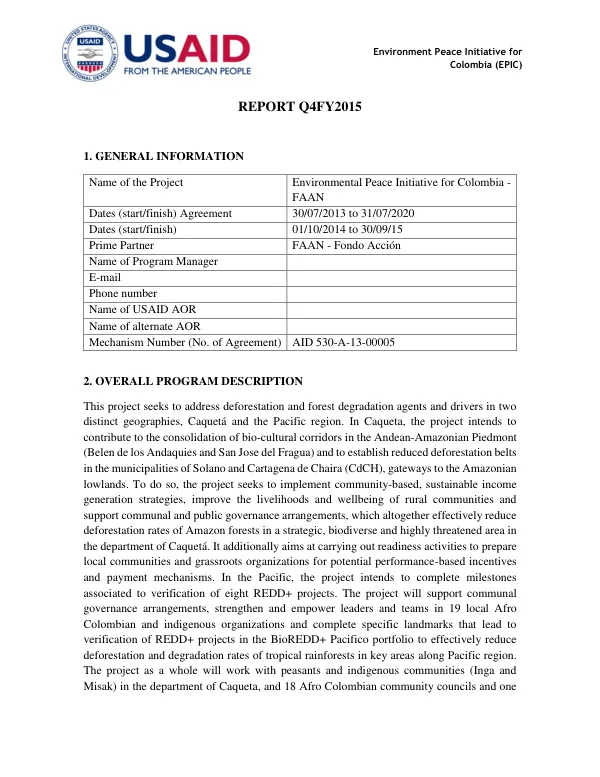
The Environmental Peace Initiative for Colombia (EPIC) project, implemented by FAAN, aims to address deforestation and forest degradation in the Caquetá and Pacific regions.
2015 · 10 pages
Sign in to readA free account is required to download.
Abstract
In Caquetá, the project seeks to consolidate bio-cultural corridors and establish reduced deforestation belts in the municipalities of Solano and Cartagena de Chaira. To achieve this, the project implements community-based, sustainable income generation strategies, improves the livelihoods and wellbeing of rural communities, and supports communal and public governance arrangements. In the Pacific region, the project focuses on completing milestones associated with the verification of eight REDD+ projects. The project supports communal governance arrangements, strengthens and empowers leaders and teams in 19 local Afro Colombian and indigenous organizations, and completes specific landmarks that lead to verification of REDD+ projects in the BioREDD+ Pacifico portfolio. The project works with peasants and indigenous communities in the department of Caquetá, and 18 Afro Colombian community councils and one indigenous reserve in the Pacific region. The project focuses on three key strategies: promoting alternative, profitable, environmentally-sound, low-carbon economic options, food sovereignty, and sustainable livelihoods for rural and forest-dwelling communities; strengthening and empowering local civil society and local/regional governments; and creating enabling conditions for performance-based incentive and payment mechanisms. The project's approach is based on community participation, local planning, and the development of sustainable livelihoods. In Caquetá, the project has made significant progress in implementing landscape transformation plans, completing village landscape transformation agreements, and initiating local planning exercises. The project has also established 203 family projects in 13 villages and 3 indigenous reserves, which focus on water protection, agroforestry, food sovereignty, and sustainable cattle ranching. In the Pacific region, the project has initiated a local commercialization model for Cacay, selling community-collected production to Kahai S.A.S. The project has also developed a participatory monitoring process in the piedmont to empower local indigenous groups and small farmers to assess the effectiveness of landscape transformation strategies. The monitoring process involves the conformation of two monitoring groups, the completion of six monitoring field trips and trainings, and the systematization of the first batch of results. The project has also initiated a local research on fisheries as part of its community-based research strategy. Despite the progress made, the project has faced significant challenges, including social constraints and unrests in Solano, which have slowed down the project's progress. The project has patiently crafted local key relationships to address these challenges and has directed coordinating efforts to the Agriculture Secretariat in the absence of key contacts within Gobernación del Caqueta.