USAID DEC
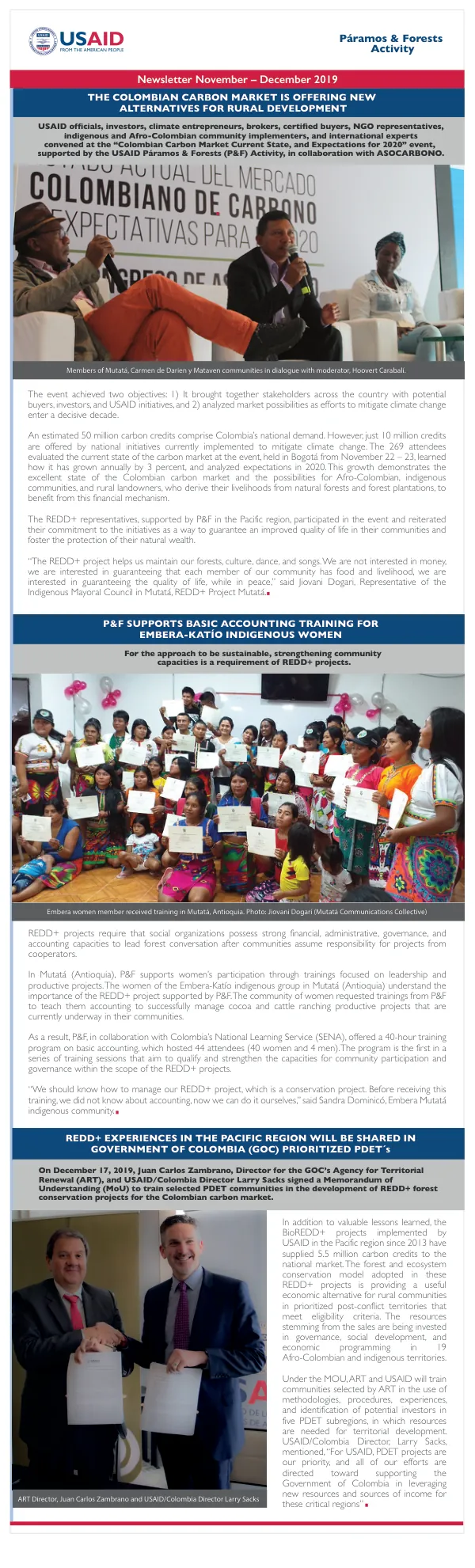
USAID Convenes Local and International Leaders to Discuss the State of the Carbon Market in Colombia
Sign inCONSERVATION INTERNATIONAL FOUNDATION
USAID Convenes Local and International Leaders to Discuss the State of the Carbon Market in Colombia
The Colombian government expressed support for the carbon market and reaffirmed its commitment to upholding the Paris Climate Agreement's greenhouse gas emissions reduction target of 20% by 2030.
2018 · 1 pages
Sign in to readA free account is required to download.
Abstract
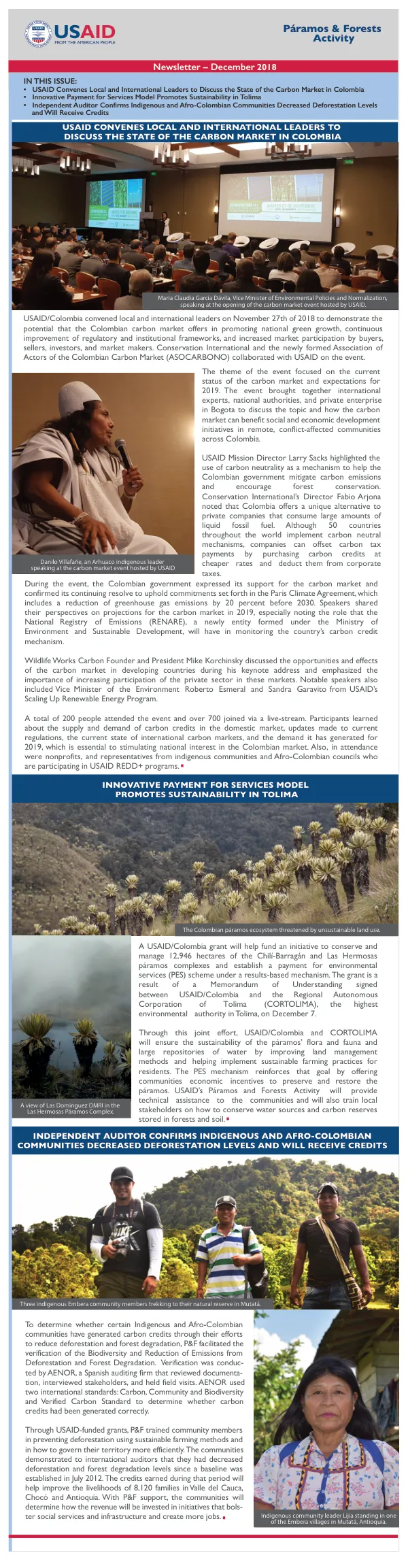
The National Registry of Emissions (RENARE), a newly formed entity under the Ministry of Environment and Sustainable Development, will play a crucial role in monitoring the country's carbon credit mechanism. The carbon market in Colombia is expected to grow, with the National Registry of Emissions (RENARE) set to verify the country's carbon credits. Wildlife Works Carbon Founder and CEO Mike Korchinsky emphasized the importance of increasing private sector participation in the market. Notable speakers at the event included Vice Minister of Environment Roberto Esmeral and Sandra Garavito from USAID's Scaling Up Renewable Energy Program. The event, which was attended by over 200 people and live-streamed to over 700 viewers, focused on the supply and demand of carbon credits in the domestic market. Updates on regulations and the state of international carbon markets were also discussed. Representatives from indigenous communities and Afro-Colombian groups, who are participating in USAID REDD+ programs, were in attendance. Páramos and Forests, a USAID-funded initiative, aims to conserve and restore 12,946 hectares of the Chilí-Barragán and Las Hermosas páramos. The project will establish a payment for ecosystem services (PES) scheme under a results-based approach. USAID and the Reserva Autónoma de Tolima (CORTOLIMA) signed a Memorandum of Understanding to ensure the sustainability of the páramos' flora and fauna. The PES mechanism will offer communities incentives to preserve and restore the páramos. USAID's Páramos and Forests Activity will provide technical assistance to the communities and train local stakeholders on sustainable land management and carbon reserve conservation. The project will also help implement sustainable farming practices for residents. AENOR, a Spanish auditing firm, verified the carbon credits generated by indigenous and Afro-Colombian communities through their efforts to reduce deforestation and forest degradation. The verification process used international standards, including the Carbon, Biodiversity and Verified Carbon Standard. Community members were trained in sustainable farming methods and territory governance, demonstrating a decrease in deforestation and forest degradation levels since 2012. The credits earned during this period will improve the livelihoods of 8,120 families in the regions of Valle del Cauca, Chocó, and Antioquia. The communities will determine how to invest the revenue in social services and job creation initiatives.
Related documents