USAID DEC
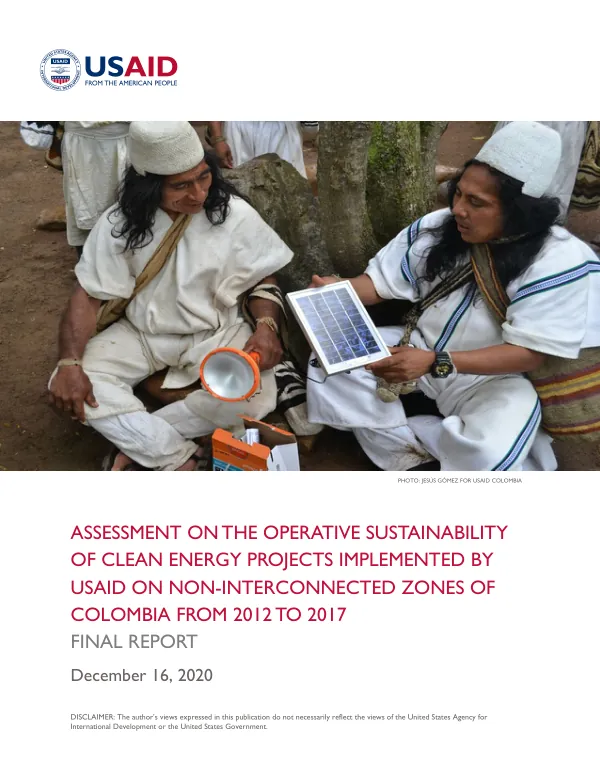
Assessment on the operative sustainability of clean energy projects implemented by USAID on non-interconnected zones of Colombia from 2012 to 2017: Final Report
Sign inPANAGORA GROUP, INC.
Assessment on the operative sustainability of clean energy projects implemented by USAID on non-interconnected zones of Colombia from 2012 to 2017: Final Report
The Colombia Clean Energy Program (CCEP) was implemented by the United States Agency for International Development (USAID) from 2012 to 2017 to promote the use of renewable energy in non-interconnected zones (NIZ) of Colombia.
2020 · 147 pages
Sign in to readA free account is required to download.
Abstract
The program aimed to increase access to electricity in rural areas, reduce greenhouse gas emissions, and promote economic development. A total of 17 renewable energy projects were implemented under the CCEP, including solar, wind, and hydroelectric power generation systems. The assessment on the operative sustainability of the CCEP projects was conducted by the Panagora Group, LLC, and submitted to USAID on December 16, 2020. The assessment aimed to evaluate the sustainability of the 17 projects, identify factors that enable or hinder their sustainability, and provide recommendations for future projects. The assessment found that the CCEP projects have achieved significant results in terms of increasing access to electricity in rural areas. The projects have also promoted economic development and reduced greenhouse gas emissions. However, the assessment also identified several challenges that hinder the sustainability of the projects, including high maintenance costs, lack of technical capacity, and limited access to financing. The assessment identified several factors that enable the sustainability of the CCEP projects, including the involvement of local communities in the project design and implementation, the use of mature technologies, and the provision of training and technical assistance to project administrators and users. The assessment also identified several factors that hinder the sustainability of the projects, including high maintenance costs, lack of technical capacity, and limited access to financing. The assessment made seven recommendations for future projects, including the need to improve the technical capacity of project administrators and users, increase access to financing, and reduce maintenance costs. The assessment also recommended the development of a sustainability framework for future projects and the establishment of a monitoring and evaluation system to track project performance. The CCEP projects were implemented in various regions of Colombia, including the departments of Antioquia, Caldas, and Quindío. The projects were designed to meet the specific needs of each community, and the assessment found that the projects have had a positive impact on the local economy and environment. The assessment used a mixed-methods approach, combining both qualitative and quantitative data collection and analysis methods. The assessment team conducted interviews with project administrators, users, and local community members, and collected data on project performance and sustainability. The assessment also used a consistency logical matrix to evaluate the sustainability of the projects. The assessment found that the CCEP projects have achieved significant results in terms of increasing access to electricity in rural areas, promoting economic development, and reducing greenhouse gas emissions. However, the assessment also identified several challenges that hinder the sustainability of the projects, including high maintenance costs, lack of technical capacity, and limited access to financing. The assessment made several recommendations for future projects, including the need to improve the technical capacity of project administrators and users, increase access to financing, and reduce maintenance costs.