USAID DEC
Environmental transition zone and rivers shape intraspecific population structure and genetic diversity of an Amazonian rain forest tree frog
Sign inUSAID DEC
Environmental transition zone and rivers shape intraspecific population structure and genetic diversity of an Amazonian rain forest tree frog
The study area, the Purus-Madeira interfluve (PMI), is a mostly flat region located in central Amazonia.
2018 · 20 pages
Sign in to readA free account is required to download.
Abstract
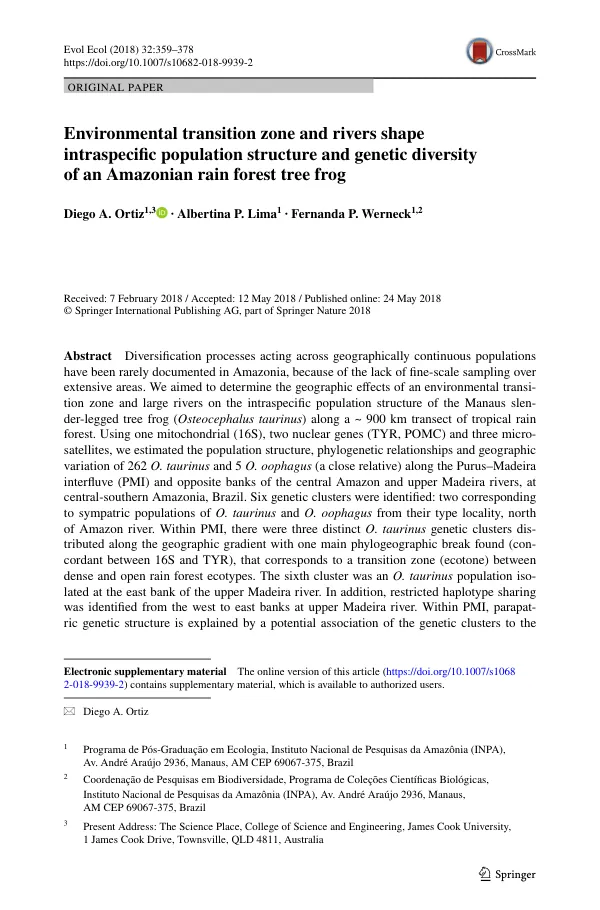
The PMI is characterized by a diverse range of habitats, including primary and secondary rain forests, and is home to a variety of plant and animal species. The region is bounded by the Purus and Madeira rivers, which are two of the largest rivers in the Amazon basin. The study focuses on the Manaus slender-legged tree frog (Osteocephalus taurinus), a species that is widely distributed throughout the Amazon region. The researchers collected genetic data from 262 individuals of O. taurinus and 5 individuals of a close relative, O. oophagus, from the PMI and opposite banks of the central Amazon and upper Madeira rivers. The researchers used mitochondrial and nuclear DNA markers to study the genetic structure of the populations. They found that the genetic data suggest a complex pattern of population structure, with six distinct genetic clusters. Two of the genetic clusters correspond to sympatric populations of O. taurinus and O. oophagus from the type locality, north of the Amazon river. Within the PMI, the researchers identified three distinct genetic clusters of O. taurinus, which are distributed along the geographic gradient. The genetic clusters are associated with different environmental conditions, such as dense and open rain forest ecotypes. The researchers also found a phylogeographic break, which corresponds to a transition zone between the two ecotypes. The study suggests that the genetic structure of the populations is influenced by the environmental conditions, such as the presence of large rivers and the diversity of habitats. The researchers propose that the gradient hypothesis, which suggests that populations differentiate following a gradient of environmental conditions, may be an important factor in shaping the genetic structure of the populations. The study also highlights the importance of considering the complex interactions between geography, ecology, and geography in understanding the distribution patterns of Amazonian biota. The researchers suggest that the riverine barrier hypothesis, which proposes that major Amazonian rivers act as barriers to gene flow between populations, may not be the only factor influencing the genetic structure of the populations. The study provides new insights into the population structure and genetic variation of the Manaus slender-legged tree frog in the Amazon region. The findings suggest that the genetic structure of the populations is influenced by a combination of environmental and geographical factors, and highlight the importance of considering the complex interactions between these factors in understanding the distribution patterns of Amazonian biota. The researchers also suggest that the study area, the PMI, is a unique opportunity to study the combination of geography, ecology, and geography on the speciation processes. The study highlights the importance of considering the complex interactions between these factors in understanding the distribution patterns of Amazonian biota. The study provides a detailed description of the study area, the PMI, and the methods used to collect and analyze the genetic data. The researchers used a combination of mitochondrial and nuclear DNA markers to study the genetic structure of the populations. The study highlights the importance of considering the complex interactions between geography, ecology, and geography in understanding the distribution patterns of Amazonian biota. The study suggests that the genetic structure of the populations is influenced by a combination of environmental and geographical factors. The researchers propose that the gradient hypothesis, which suggests that populations differentiate following a gradient of environmental conditions, may be an important factor in shaping the genetic structure of the populations. The study highlights the importance of considering the complex interactions between geography, ecology, and geography in understanding the distribution patterns of Amazonian biota. The researchers suggest that the gradient hypothesis, which proposes that populations differentiate following a gradient of environmental conditions, may be an important factor in shaping the genetic structure of the populations. The