PAKISTAN’S NATIONAL TRANSMISSION AND DESPATCH COMPANY LIMITED
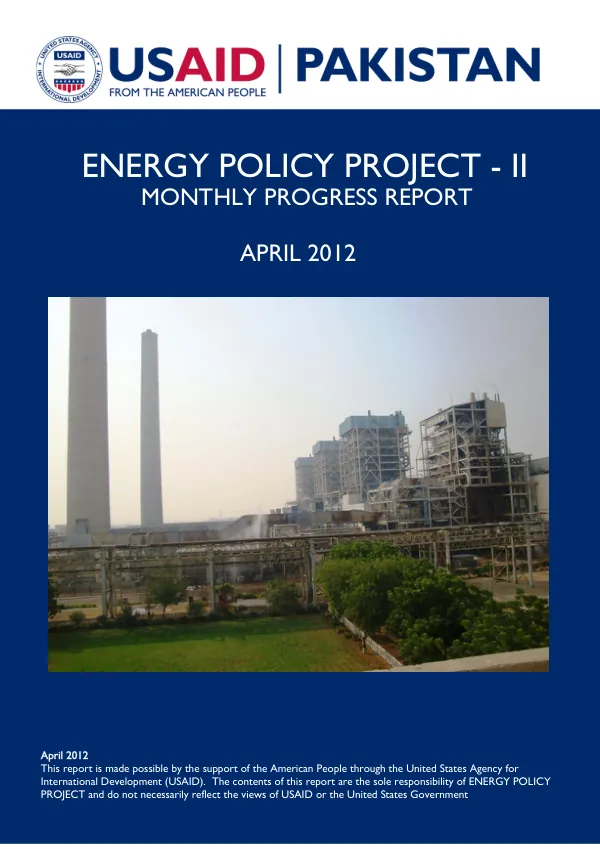
EPP Monthly Report April 2012
The Energy Policy Project (EPP) in Pakistan is a USAID-funded initiative aimed at supporting the country's power generation, transmission, and related policy reform activities.
2012 · 25 pages
Sign in to readA free account is required to download.
Abstract
The project's current key activities include providing monitoring and implementation support to six signature energy projects, announced by the Secretary of State, Hillary Clinton. These projects include four repair and maintenance projects and two multipurpose dam completion projects. The six signature energy projects are designed to add more than 863 MW to Pakistan's generation capacity. As of April 2012, a total of 429 MW have been added to Pakistan's grid. The projects include the rehabilitation of Tarbela hydropower plant, completion of two multipurpose dams, Satpara and Gomal Zam, and repair and maintenance of three existing thermal GENCO power plants, Muzaffargarh, Guddu, and Jamshoro. EPP is providing technical support to the Ministry of Water and Power (MWP) for identifying and selecting new generation and transmission projects. The project is also supporting generation and transmission-related studies, policy reform activities, and development of GENCO and NTDC business plans. Additionally, EPP is developing policies and procedures for the National Power Control Center and providing advisory services at MWP and the Planning Commission (Energy Wing), Ministry of Finance, etc. The project has a staffing level of 85% Pakistani and 15% international staff, with a presence in all provinces and Federally Administered Tribal Areas. The total USAID funding for the project is $134.121 million, with $14.893 million allocated for the FARAS project and $119.228 million for the EPP Phase II project. The project's progress is being monitored through the implementation of six Fixed Amount Reimbursable Agreement (FARA) projects. EPP is coordinating with the implementing partners to achieve timely progress and the processing of invoices for reimbursement to the GOP from USAID. The project has achieved a total of 118 MW capacity gain through the rehabilitation of Tarbela hydropower plant, with an additional 10 MW capacity gain expected to be achieved in May 2012. The rehabilitation of Tarbela hydropower plant under FARA includes the replacement of winding, installation of new seals for relief and bypass valves, and procurement of remaining equipment pumps, digital governors, and SCADA system. EPP has verified WAPDA claims for installation of spare seals and guides for relief and bypass valves on turbine side at units 1-10 and completion of training, and forwarded the claims to USAID Energy Office for approval and further processing. The project is also ensuring environmental compliance and implementation of the Environmental Management and Monitoring Plan (EMMP) through the engagement of an engineering firm. The firm conducted a site visit on April 5, 2012, and made observations and shared issues with the plant management to take necessary corrective actions. A follow-up visit is scheduled for next month, and an environmental audit report has been submitted to the USAID/ENR. The schedule of status for the Tarbela FARA is as follows: replacement of damaged generator stator windings with class F insulation windings for unit #4 is completed and 100% amount reimbursed, replacement of damaged generator stator windings with class F insulation windings for unit #3 is in process and expected to complete in May 2012 with 90% amount reimbursed, replacement of damaged generator stator windings with class F insulation windings for unit #1 is completed and 100% amount reimbursed, and upgrading of the SCADA system for units 1-14 is underway with a new SCADA system expected to be installed.
Related documents