USAID DEC
Building Human Resource Capacity for Medical Device Maintenance and management in Ethiopia
Sign inFEDERAL MINISTRY OF HEALTH
Building Human Resource Capacity for Medical Device Maintenance and management in Ethiopia
The HRH Project in Ethiopia aimed to increase the supply of qualified biomedical technicians and engineers to ensure the availability of working medical devices.
2019 · 4 pages
Sign in to readA free account is required to download.
Abstract
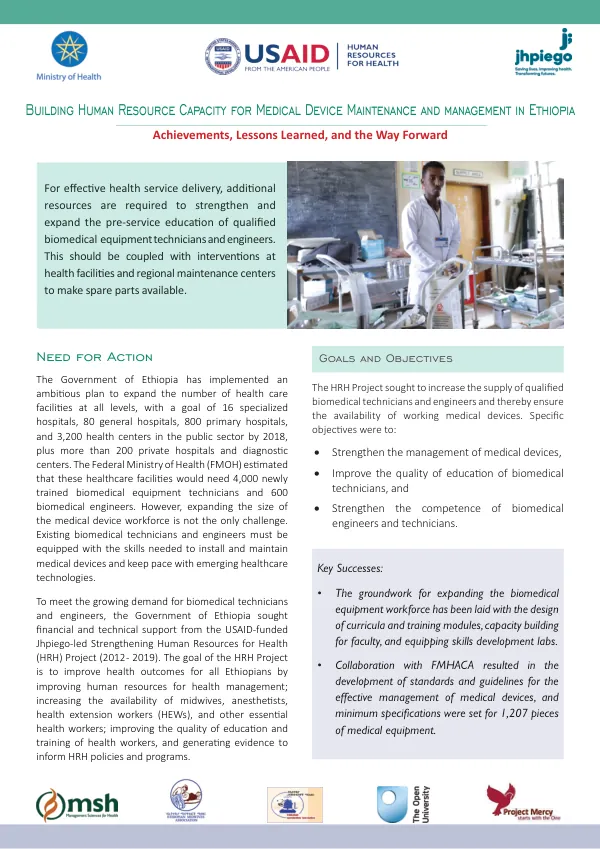
The project's specific objectives were to strengthen the management of medical devices, improve the quality of education of biomedical technicians, and strengthen the competence of biomedical engineers and technicians. The Government of Ethiopia has implemented an ambitious plan to expand the number of healthcare facilities, with a goal of 16 specialized hospitals, 80 general hospitals, 800 primary hospitals, and 3,200 health centers in the public sector by 2018. The Federal Ministry of Health estimated that these healthcare facilities would need 4,000 newly trained biomedical equipment technicians and 600 biomedical engineers. However, expanding the size of the medical device workforce is not the only challenge, as existing biomedical technicians and engineers must be equipped with the skills needed to install and maintain medical devices and keep pace with emerging healthcare technologies. The HRH Project received financial and technical support from the USAID-funded Jhpiego-led Strengthening Human Resources for Health (HRH) Project from 2012 to 2019. The project's goal was to improve health outcomes for all Ethiopians by improving human resources for health management, increasing the availability of midwives, anesthetists, health extension workers, and other essential health workers, improving the quality of education and training of health workers, and generating evidence to inform HRH policies and programs. Key successes of the HRH Project include the design of curricula and training modules, capacity building for faculty, and equipping skills development labs. Collaboration with the Food, Medicines and Health Care Administration and Control Authority (FMHACA) resulted in the development of standards and guidelines for the effective management of medical devices, and minimum specifications were set for 1,207 pieces of medical equipment. The project developed curricula for biomedical technician education and increased the number of programs. The HRH Project supported the Federal Ministry of Health to develop a curriculum for Level IV biomedical technician training and then led two workshops to develop seven training modules for this program. The curriculum was implemented by seven new training programs for Level IV biomedical technicians that were established at Technical and Vocational Education and Training (TVET) colleges as well as by the one existing program for biomedical technicians. The project also improved the quality of instruction in biomedical technician education programs by supporting the development of five training packages on operating room, maternal and child health, imaging, laboratory, and ophthalmic medical devices. These training packages were used during a series of technical updates for instructors at health education institutions and practitioners at hospitals, as well as to build the capacity of government regulators. In addition, the project offered technical support to skills development labs, identifying and setting minimum specifications for required medical devices. Biomedical engineers seconded to FMHACA by the HRH Project led the development of a national medical devices list, which was the first of its kind at FMHACA and at the national level. The project also collaborated with FMHACA to develop guidelines on the disposal, media advertisements, and market authorization of medical devices. The project built the capacity of FMHACA by training staff on the life cycle and regulation of medical devices, including experiences from other countries, and on the maintenance and management of medical devices and equipment. HRH Project staff also offered technical advice to FMHACA managers on an average of 10 cases per month related to medical device procurement, appropriateness, functionality, and specifications. The project equipped regional medical device maintenance centers by providing technical support for the distribution and installation of equipment purchased by the ministry and partner organizations and providing training for the biomedical engineers and technicians who staff the centers.
Related documents