USAID DEC
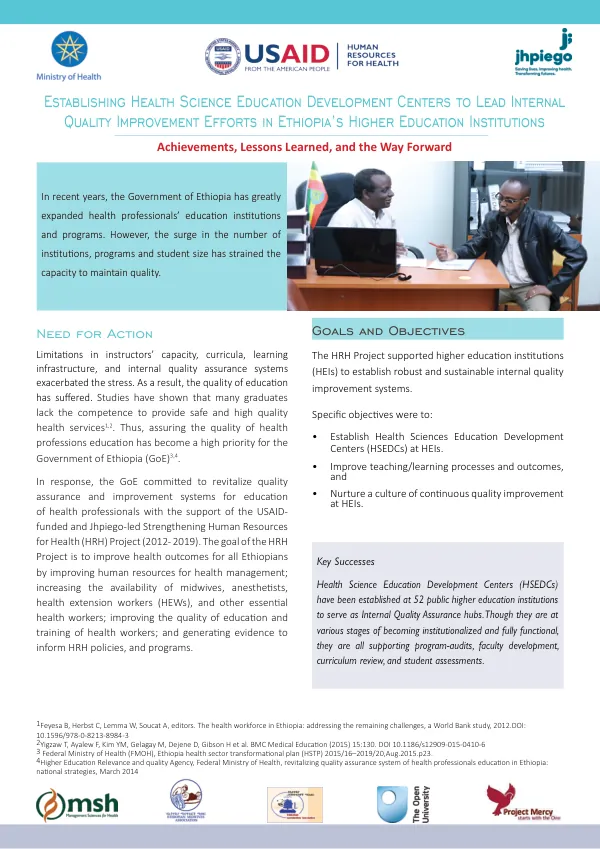
Towards Sustainability: The Health Science Education Development Center at Dilla University Provides Exemplary Leadership to Improve Quality of Education
Sign inFEDERAL MINISTRY OF HEALTH
Towards Sustainability: The Health Science Education Development Center at Dilla University Provides Exemplary Leadership to Improve Quality of Education
The Health Science Education Development Center at Dilla University plays a crucial role in improving the quality of education in the College of Medicine and Health Science Referral Hospital.
2019 · 1 pages
Sign in to readA free account is required to download.
Abstract
Dilla University is located in Dilla Town of Gedeo Zone in the Southern Nations, Nationalities, and Peoples Region of Ethiopia, approximately 375 kilometers from Addis Ababa, the capital city. Established in 1996 as Dilla College of Teachers' Education and Health Sciences, the institution underwent a transformation in 2006 to become a full-fledged university. The university currently operates three campuses, with plans for a fourth, and has six colleges, two institutes, and three schools offering over 47 undergraduate, 24 postgraduate, and one PhD programs to more than 31,000 students. Dilla University offers 11 undergraduate and four postgraduate programs in health sciences. Despite the university's growth, Ethiopia continues to face challenges in providing quality education due to a shortage of experienced faculty, outdated curricula, and inadequate infrastructure and learning resources. The USAID-funded Strengthening Human Resources for Health (HRH) Project collaborated with Dilla University to establish the Health Science Education Development Center (HSEDC) in 2013. The HSEDC was created to develop an effective educational quality assurance structure, and the center's capacity was strengthened to implement education quality interventions. The HRH Project supported the university in establishing anesthesia and midwifery skill labs, providing equipment and resources, and offering pedagogic trainings to academic staff. The HSEDC has made significant contributions to improving the quality of education at the university. The center has reviewed and standardized six curricula, developed and updated over 20 assessment tools, and conducted regular quality assessments for 10 academic programs using national standards. As a result, improvements have been observed in practical training in skills labs and clinical areas, student assessment practices, staff teaching skills, and curriculum implementation. Notably, 94% of anesthesia and 73% of midwifery students passed the recently introduced national licensure exam. The university leadership has recognized the HSEDC's efforts and has allocated an annual budget of approximately 12,000 USD to expand its interventions on campus. The HRH Project's support has been instrumental in convincing the university leadership to prioritize educational quality assurance efforts, ultimately aiming to produce competent health workers. The HSEDC's success has set a precedent for the university to allocate resources for educational quality improvement initiatives.
Related documents