FEDERAL MINISTRY OF HEALTH
Improving Human Resource Management Practices in Ethiopia’s Public Health Sector
The HRH Project aimed to improve human resource management practices in Ethiopia's public health sector.
2019 · 4 pages
Sign in to readA free account is required to download.
Abstract
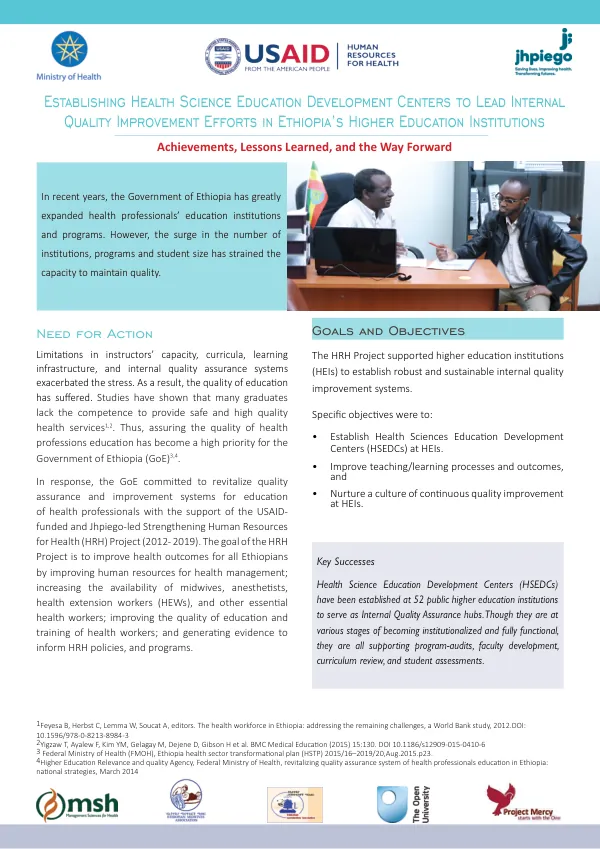
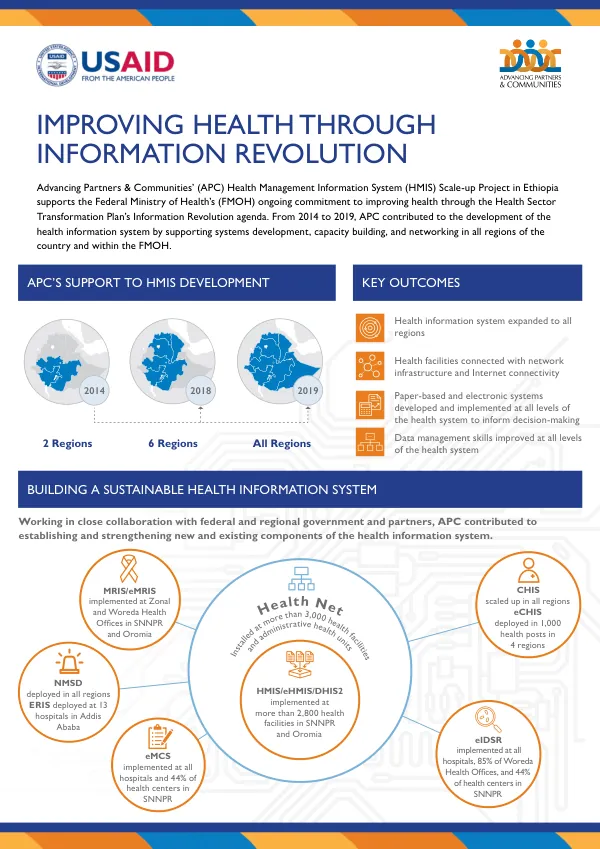
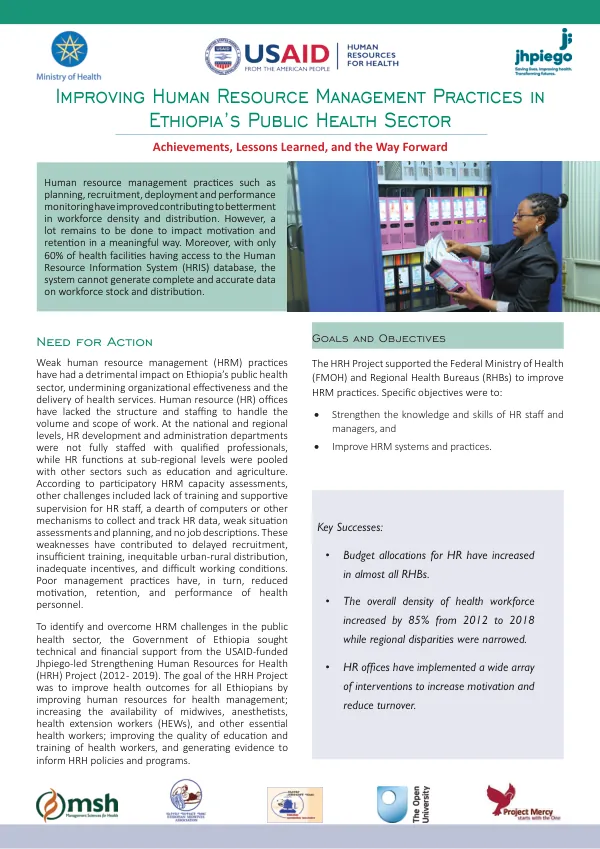
The project supported the Federal Ministry of Health (FMOH) and Regional Health Bureaus (RHBs) to strengthen HRM practices, with specific objectives to enhance the knowledge and skills of HR staff and managers, and to improve HRM systems and practices. Human resource management practices such as planning, recruitment, deployment, and performance monitoring have improved, contributing to better workforce density and distribution. However, challenges remain, including a lack of motivation and retention among health personnel. The Human Resource Information System (HRIS) database is not fully accessible, with only 60% of health facilities having access, hindering the generation of complete and accurate data on workforce stock and distribution. Weak human resource management practices have had a detrimental impact on Ethiopia's public health sector, undermining organizational effectiveness and the delivery of health services. HR offices have lacked the structure and staffing to handle the volume and scope of work, while HR development and administration departments were not fully staffed with qualified professionals. Participatory HRM capacity assessments identified additional challenges, including a lack of training and supportive supervision for HR staff, inadequate computers or mechanisms to collect and track HR data, weak situation assessments and planning, and no job descriptions. The Government of Ethiopia sought technical and financial support from the USAID-funded Jhpiego-led Strengthening Human Resources for Health (HRH) Project to identify and overcome HRM challenges in the public health sector. The HRH Project aimed to improve health outcomes for all Ethiopians by improving human resources for health management, increasing the availability of midwives, anesthetists, health extension workers, and other essential health workers, improving the quality of education and training of health workers, and generating evidence to inform HRH policies and programs. Key successes of the HRH Project include budget allocations for HR increasing in almost all RHBs, the overall density of health workforce increasing by 85% from 2012 to 2018, and HR offices implementing a wide array of interventions to increase motivation and reduce turnover. The project collaborated with the FMOH and RHBs to develop an in-service HRM training package for existing and newly recruited HR staff, integrate HRM indicators in supportive supervision checklists, and place an HRH Management Officer in each RHB to transfer knowledge and skills related to planning and budgeting, situation analysis, and performance review. The HRH Project also strengthened the implementation of the Balanced Score Card (BSC) performance management system, provided financial and technical support to RHBs to improve recruitment, selection, and deployment practices, and supported consultative workshops to design incentives and interventions to improve the work climate. The project worked with Tulane University and senior FMOH staff to create a fully functional HRIS, mobilize resources, install software, and train staff, and provided financial and technical support for data management in eight regions. Results and lessons learned from the HRH Project include HR functions becoming more visible and better funded, HR planning being increasingly integrated into the health sector planning cycle, and newly developed national and regional HRH strategic plans convincing regional and district governments to allocate more funds to hire, deploy, and remunerate health workers for improved coverage and quality of health care. However, most regions do not have a separate cost center for non-salary HR budgets, and budget shortages remain a problem at the zonal, woreda, and facility level.