USAID DEC
Establishment of Larval Zebrafish as an Animal Model to Investigate Trypanosoma cruzi Motility In Vivo
Sign inNORTH CAROLINA A&T STATE UNIVERSITY
Establishment of Larval Zebrafish as an Animal Model to Investigate Trypanosoma cruzi Motility In Vivo
Establishment of Larval Zebrafish as an Animal Model to Investigate Trypanosoma cruzi Motility In Vivo Chagas disease is a parasitic infection caused by Trypanosoma cruzi, which affects approximately 6 to 7 million people worldwide.
2017 · 10 pages
Sign in to readA free account is required to download.
Abstract
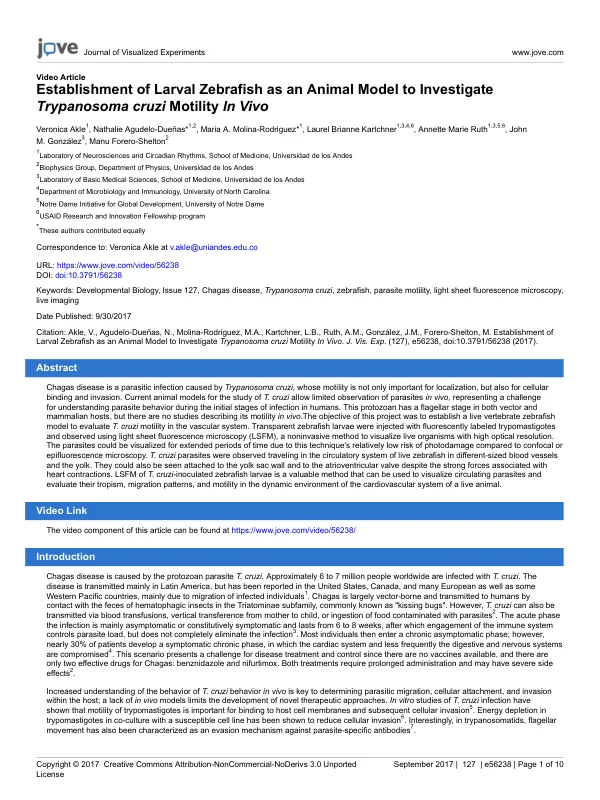
The disease is transmitted mainly in Latin America, but has also been reported in other regions due to migration of infected individuals. Chagas disease is largely vector-borne, transmitted to humans by contact with the feces of hematophagic insects in the Triatominae subfamily, commonly known as "kissing bugs". However, T. cruzi can also be transmitted via blood transfusions, vertical transference from mother to child, or ingestion of food contaminated with parasites. The acute phase of the infection is mainly asymptomatic or constitutively symptomatic and lasts from 6 to 8 weeks, after which engagement of the immune system controls parasite load, but does not completely eliminate the infection. Most individuals then enter a chronic asymptomatic phase; however, nearly 30% of patients develop a symptomatic chronic phase, in which the cardiac system and less frequently the digestive and nervous systems are compromised. This scenario presents a challenge for disease treatment and control since there are no vaccines available, and there are only two effective drugs for Chagas: benznidazole and nifurtimox. Both treatments require prolonged administration and may have severe side effects. Increased understanding of the behavior of T. cruzi in vivo is key to determining parasitic migration, cellular attachment, and invasion within the host. In vitro studies of T. cruzi infection have shown that motility of trypomastigotes is important for binding to host cell membranes and subsequent cellular invasion. Energy depletion in trypomastigotes in co-culture with a susceptible cell line has been shown to reduce cellular invasion. Interestingly, in trypanosomatids, flagellar movement has also been characterized as an evasion mechanism against parasite-specific antibodies. Zebrafish larvae are a powerful model to study host-pathogen interactions in vivo. They are small, inexpensive, and relatively easy to raise when compared with other established vertebrate models for Chagas disease. Zebrafish have innate and adaptive immune systems similar to humans, but their adaptive immune system begins to develop at 4 days post fertilization (dpf) and is not mature for another several weeks. During early development, when only macrophages are present, there is a large window for studying parasite behavior without immediate immune interference. To establish larval zebrafish as a viable non-infection model for understanding T. cruzi motility and related behavior in vivo, transparent zebrafish larvae were injected with fluorescently labeled trypomastigotes, the cellular form responsible for infection of humans. The movement of T. cruzi in the cardiovascular circulation of zebrafish was identified using light sheet fluorescence microscopy (LSFM). This technique allows for high resolution optical sections with significantly reduced photodamage, making it possible to observe the movement of parasites in the bloodstream in vivo. The Casper strain of zebrafish, a genetically modified strain with no pigmentation, was used in this protocol due to their valuable optical transparency in all developmental stages. Fish were manipulated using optimal care conditions for the species, in a 14 h light-10 h dark cycle, at 28 ± 1 °C, in a pH (7.0-7.4) controlled multi-tank recirculating water system. Animals were fed twice a day with live brine shrimp (Artemia salina) and enriched with rearing food. All protocols were approved by the Institutional Animal Care and Use Committee of Los Andes University (CICUAL). The preparation of egg water, tricaine stock solution, and 1.0% low melting point agarose were critical steps in the protocol. Egg water was prepared by dissolving 0.6 g/L aquarium salt in reverse osmosis (RO) or deionized (DI) water and adding 0.01 mg/L methylene blue to the solution. The measured conductivity should be of 400-500 µS/cm and pH level at 7.2-7.9. To lower the pH, aerate the egg water for a few hours. The tricaine stock solution was prepared by dissolving 400 mg tricaine (MS-222) in 97.9 mL distilled water (ddH2O) and adjusting the pH to 7.0 using 2.1 mL 1M Tris (pH 9.0). The 1.0% low melting point agarose was dissolved in egg water to a final concentration of 1.0%. The objective of this methodology is to establish larval zebrafish as a viable non-infection model for understanding T. cruzi motility and related behavior in vivo. The use of LSFM allows for high resolution optical sections with significantly reduced photodamage, making it possible to