USAID DEC
International Experiences of Participatory and Socially Inclusive Renewable Energy Projects
Sign inPALLADIUM INTERNATIONAL, LLC
International Experiences of Participatory and Socially Inclusive Renewable Energy Projects
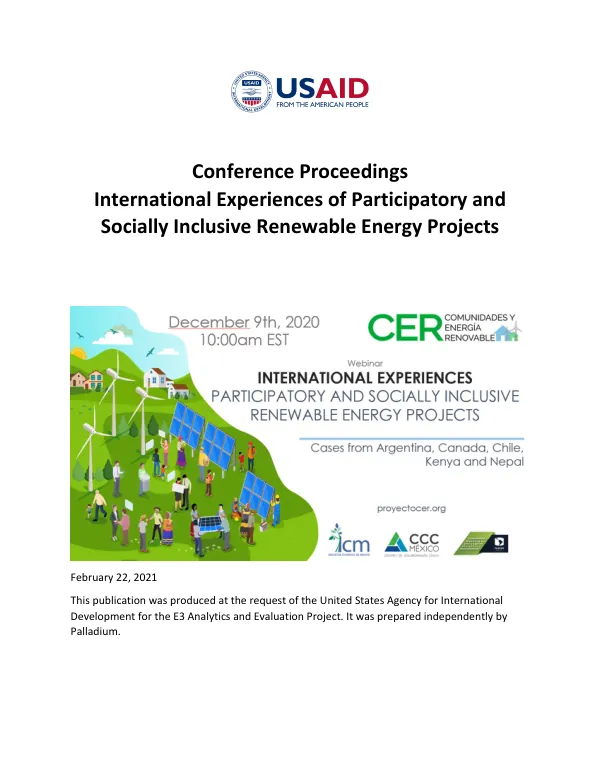
The Climate Initiative of Mexico (ICM) hosted a global online conference on December 9, 2020, with the goal of sharing international experiences that would contribute to the development of more participatory, inclusive, and transparent renewable energy projects in Mexico.
2021 · 25 pages
Sign in to readA free account is required to download.
Abstract
The conference was held within the framework of the Communities and Renewable Energy (CER) project, which was implemented in Mexico from 2017 to 2020 by ICM and its partners, the Center for Civic Collaboration (CCC) and the Latin American Faculty of Social Sciences’ (FLACSO Mexico). The CER project received financial support from the United States Agency for International Development Mission in Mexico. The two-and-a-half-hour webinar featured nine practitioners from five countries (Argentina, Chile, Kenya, Mexico, and Nepal) and one regional program (Equity Option). The panelists discussed best practices, new public policies, and tools that emerged from implementing such projects. The conference aimed to examine the following objectives: the involvement of the local population in the planning and development of renewable energy projects, including a benefits-sharing component; the contribution of benefit-sharing schemes in renewable energy projects to local social wellbeing; the key aspects that enabled the development of socially inclusive energy projects; and the barriers to such development. The conference also sought to identify strategies, methodologies, tools, and models that have been tested and found successful in achieving implementation. A total of 186 people attended the conference, with the largest number of attendees from Mexico (51%) and the United States (27%). The attendees represented a range of backgrounds, with 42% working in the private sector, 16% in academia, 16% in non-profit organizations, and 15% in government. The conference featured six case studies from different countries, each presenting a project that was designed and managed by the presenter. The case studies discussed the context, problem, approach, and new learning and promising practices of each project. The projects focused on expanding the social inclusion of local communities in the benefits of renewable energy. The CER project identified three major challenges that were addressed through the project: the prioritization of technical, economic, and political aspects over social, environmental, and cultural dimensions in planning energy sector infrastructure projects; the insufficiency of existing mechanisms and tools to guarantee fair access to and use of resources; and the lack of significant participation of local communities in decision-making processes. The CER project aimed to maximize local participation and benefits from renewable energy by promoting best practices and deepening the understanding of the alignment between environmental, economic, and social perspectives. The project's approach was based on the following assumptions: that projects should represent opportunities for local development and ensure the creation of value for all; that the local population's and communities' role should change into being partners and their consent should be obtained to move forward; and that projects should be managed in a way that includes various ownership structures and various ownership structures. The CER project developed several tools and strategies to address the challenges identified, including a benefits-sharing component, a community engagement framework, and a framework for assessing the social impact of renewable energy projects. The project also established partnerships with local communities, civil society organizations, and government agencies to promote the development of socially inclusive renewable energy projects. The conference provided a platform for sharing experiences and lessons learned from the CER project and other similar projects around the world. The conference aimed to contribute to the development of more participatory, inclusive, and transparent renewable energy projects in Mexico and beyond.
Related documents