ICAP AT COLUMBIA UNIVERSITY
Estimating child separation in emergencies: Results from North Kivu
Child separation in emergencies is a significant concern, as children who are separated from their families and usual caregivers face numerous risks to their health and well-being.
2016 · 9 pages
Sign in to readA free account is required to download.
Abstract
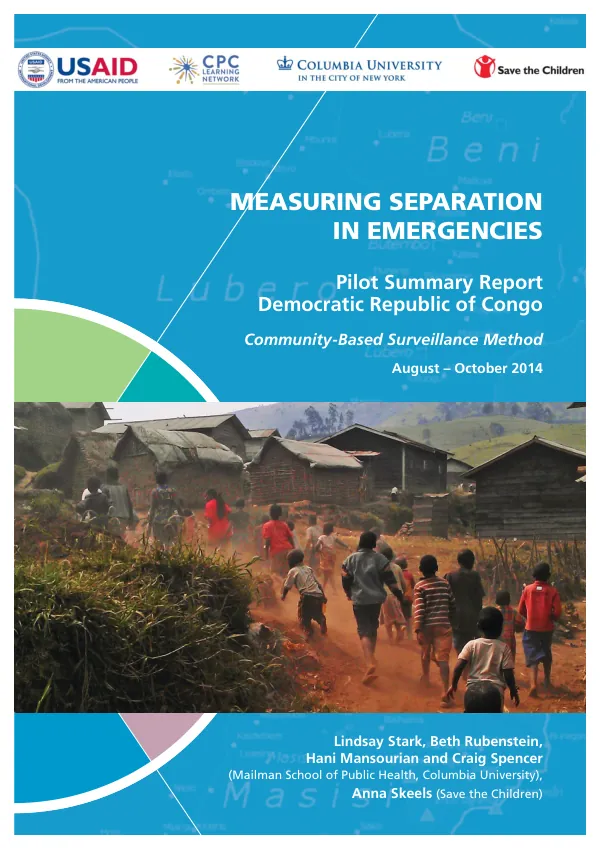
This study presents findings from the first known population-based estimation of separation in an emergency setting. The research aimed to inform programming, policies, and funding for affected populations. A household survey was conducted in the Democratic Republic of the Congo to estimate separation subsequent to an attack by the M23 militia group. Separation was tracked in terms of children arriving into the household after the M23 attacks and children who had departed from the household after the recall event without their parent or usual caregiver. The survey included 522 households, with a sample of 2,197 children living in the respondents' homes at the time of data collection. The results showed that 8.47% (n = 186) of the children were separated children who had newly arrived in the household since the M23 attack. In the sample of 2,034 children living in the respondents' homes prior to the M23 attack, 5.31% (n = 108) of the children had since departed from the household, resulting in separation from their parents or usual caregivers. The characteristics of children who arrived and children who departed diverged in terms of age, reasons for separation, and frequency of unaccompaniment. The findings indicate the potential for population-based estimation of separation to be replicated in emergency settings to inform funding appeals and programmatic response. The study highlights the need for rigorous data on the scale and circumstances of separation in emergencies to inform effective programming and policies for affected populations. The humanitarian community has developed a myriad of policies and programs aimed at mitigating the vulnerabilities facing unaccompanied and separated children. However, the measurement of unaccompanied and separated children has not achieved the same advances as policies and programming. The construct of separation encompasses many cultural and contextual nuances, and existing inter-agency measurement tools have limitations in capturing the complexity of separation. The study's findings suggest that a one-size-fits-all approach to estimating the rate of separated children is unrealistic, given the diverse circumstances of different emergencies. The existing estimation strategies, such as the "rule of thumb" and the calculation of the rate of separated children amongst refugees and asylum seekers in camp settings, have limitations and are not representative of the majority of the affected population. The lack of rigorous data on the scale and circumstances of separation in emergencies impedes efforts to fund, design, and implement effective programming and policies for affected populations. The Assessment and Measurement Task-Force of the Global Child Protection Working Group initiated an inter-agency project to devise appropriate methodologies to accompany existing approaches for measuring separation in emergencies. The project aimed to develop a survey tool to provide a population-based estimation of the point prevalence and basic characteristics of unaccompanied and separated children in a defined area, affected by the same emergency. The tool was piloted in the Nyiragongo and Goma territories in North Kivu, Democratic Republic of the Congo, in July and August 2014. The study's findings highlight the need for rigorous data on the scale and circumstances of separation in emergencies to inform effective programming and policies for affected populations.
Related documents