USAID DEC
Estrategia de intervención en función del Diagnóstico y Análisis Social, Económico, Ambiental y de Biodiversidad, y Sistema de Monitoreo de Indicadores Esenciales para medir el impacto de las actividades de mitigación en la zona de demostración del Proyecto NZD
Sign inAMAZON CONSERVATION TEAM
Estrategia de intervención en función del Diagnóstico y Análisis Social, Económico, Ambiental y de Biodiversidad, y Sistema de Monitoreo de Indicadores Esenciales para medir el impacto de las actividades de mitigación en la zona de demostración del Proyecto NZD
The Net Zero Deforestation (NZD) project in Sucumbíos, Ecuador, aims to mitigate deforestation and promote sustainable land use practices.
2014 · 90 pages
Sign in to readA free account is required to download.
Abstract
The project is implemented by a consortium of organizations, including The Nature Conservancy, Amazon Conservation Team, and the Government of Sucumbíos. The project is funded by the United States Agency for International Development (USAID) and is part of the broader effort to reduce greenhouse gas emissions in the Amazon region. The project's intervention strategy is based on a comprehensive diagnosis and analysis of the social, economic, environmental, and biodiversity aspects of the region. The diagnosis was conducted by EcoCiencia-GeoIs, a consulting firm that specializes in environmental and social impact assessments. The team conducted fieldwork and gathered data from local communities, government agencies, and other stakeholders. The diagnosis revealed that the region is characterized by a complex set of relationships between social, economic, and environmental factors. The population is predominantly mestizo-colonial, with a significant proportion of indigenous Cofán communities. The region has a long history of deforestation, driven by the extraction of timber, oil, and minerals. This has led to the degradation of forests and the loss of biodiversity. The diagnosis also highlighted the importance of services provided by the forest, including water, timber, and non-timber forest products. The local population has a strong cultural attachment to the forest and its resources, and many communities are interested in participating in programs that promote sustainable forest management and payment for ecosystem services. The project's intervention strategy is based on three main components: (1) sustainable forest management, (2) payment for ecosystem services, and (3) community engagement and participation. The project aims to promote the adoption of sustainable forest management practices among local communities, including the use of agroforestry and permaculture techniques. The project also aims to establish a payment mechanism for ecosystem services, which will provide incentives for communities to conserve and restore forests. The project's monitoring and evaluation system is designed to track the impact of the interventions on deforestation rates, forest cover, and biodiversity. The system will also monitor the effectiveness of the payment mechanism and the level of community engagement and participation. The project's results are expected to contribute to the reduction of greenhouse gas emissions in the Amazon region and to promote sustainable land use practices among local communities. The project's success will depend on the effective implementation of the intervention strategy and the level of community engagement and participation. The project's geographic focus is on the province of Sucumbíos, Ecuador, which is one of the most biodiverse regions in the Amazon. The project's timeframes are not specified, but the project is expected to run for several years, with a focus on the short-term (2014-2016) and medium-term (2017-2020) impacts of the interventions. The project's recommendations are based on the diagnosis and analysis of the social, economic, environmental, and biodiversity aspects of the region. The recommendations include the establishment of a payment mechanism for ecosystem services, the promotion of sustainable forest management practices, and the engagement of local communities in the project's decision-making process.
Related documents
Documents in this collection
 2013
2013USAID DEC
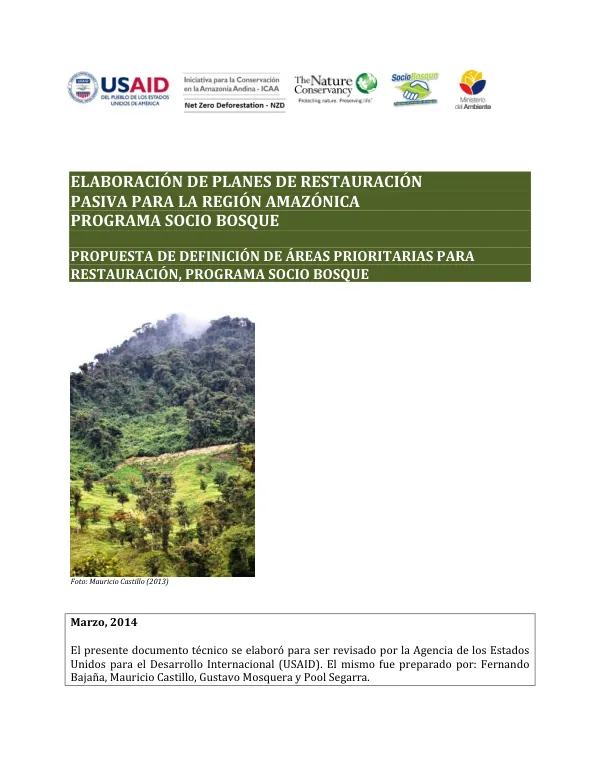
Segundo Informe de Propuesta para Definición de Áreas Prioritarias para Restauración, Programa Socio Bosque
Open record 2014
2014USAID DEC