USAID DEC
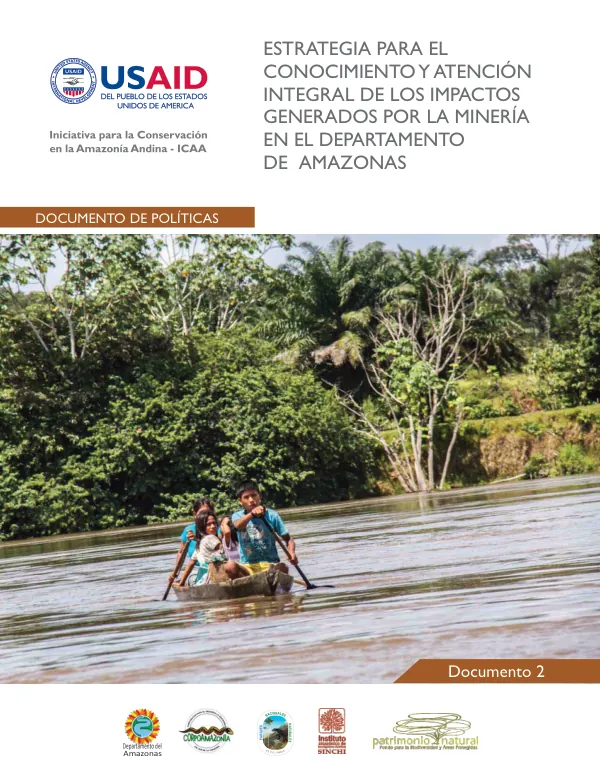
Estrategia para el Conocimiento y Atención Integral de los Impactos Generados por la Minería en el Departamento de Amazonas
Sign inCONSERVATION STRATEGY FUND
Estrategia para el Conocimiento y Atención Integral de los Impactos Generados por la Minería en el Departamento de Amazonas
The Amazonas Department in Colombia is home to various mining activities, primarily illegal gold mining, which affects management and border areas of great environmental and cultural importance.
2016 · 48 pages
Sign in to readA free account is required to download.
Abstract
These areas play a key role in the food security of local populations. The main effects generated by this activity are related to the health and life of indigenous peoples, the nation's natural and cultural heritage, the cultural integrity, traditional management, and local governance of the territory of indigenous communities, and the establishment of financial sustainability strategies for the conservation and sustainable use of land. The use of mercury in gold extraction deserves special attention. An impact identification pilot exercise of mining activities found that the inhabitants of several indigenous communities in the Caquetá River have the highest values of mercury in hair reported for Colombia, which are extremely high when compared to international human health protection standards. These values, which are strongly believed to be directly related to fish consumption, may cause neurological, sensory, and reproductive diseases. This means that by not taking the necessary corrective measures, the survival of this population would be put at high risk. The Amazonas Department is a region of incalculable value ecologically and culturally for Colombia and the world. It contains more than 65% of the country's forests, representing a total of 170 types of ecosystems that reflect its high diversity of manifestations physical and biological. The region includes six complete departments (Amazonas, Caquetá, Guainía, Guaviare, Putumayo, and Vaupés) and four partially (Cauca, Meta, Nariño, and Vichada), 58 municipalities (41 completely and 17 partially), and 20 departmental corregimientos. These last ones are located in the departments of Amazonas, Guainía, and Vaupés, occupying 180,539 km2 (37.4% of the region). The Amazonas Department is home to 1.2 million people, with a highly diverse population that includes indigenous communities, campesinos, large landowners, and urban residents. The presence of the Army is considerable, as well as that of armed groups. In 2012, nearly 86% of the total deforestation in the region occurred in the departments of Caquetá (41%), Meta (18.7%), Guaviare (13.2%), and Putumayo (13.2%). The region is also characterized by its high biodiversity, with 10% of the planet's known species, and its importance in regulating regional and global water and climate, contributing significantly to global climate change adaptation and mitigation. The Amazonas Department is inhabited by 62 of the 85 indigenous peoples identified in the country, as well as campesino and colon populations that depend on its resources for their social, economic, and spiritual sustenance. Its position at the northwest end of the large watershed gives it hydrographic importance, as it is the source of several rivers that flow into the Amazon River. The region's high value and importance are also due to its unique cultural and ecological characteristics, which make it a priority area for conservation and sustainable development.
Related documents