USAID
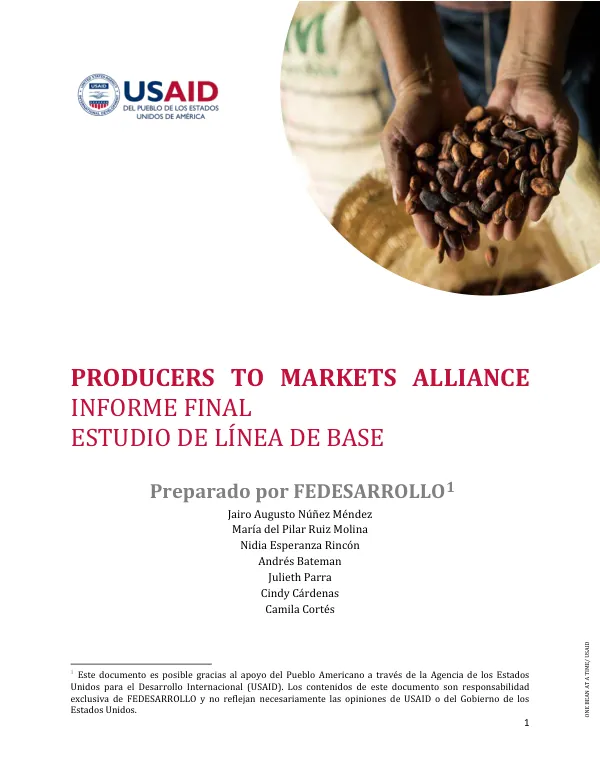
Estudio de Línea de Base del Programa Producers to Markets Alliance –PMA-
The Producers to Markets Alliance (PMA) is a program aimed at improving the livelihoods of small-scale farmers in Colombia.
2018 · 140 pages
Sign in to readA free account is required to download.
Abstract
The program focuses on five key agricultural chains: cacao, coffee, rubber, milk, and fruits and vegetables. A baseline study was conducted to assess the current situation of these chains and identify areas for improvement. The study involved a quantitative analysis of 94 surveys of producer associations, 653 surveys of 7,363 associated producers, and 34 surveys of municipalities included in the program. Additionally, a qualitative analysis was conducted through 60 in-depth interviews with municipal officials, association presidents, and field technicians, as well as 15 focus groups with producers. The data was analyzed using mixed methods, including Qualitative Comparative Analysis (QCA). The baseline study found that 59% of production in the PMA chains is commercialized through associations, and 47% of producers received technical assistance in 2016, with 29% receiving assistance from their respective association. The study also found that 34% of producers reported that membership in an association facilitated their access to financial services. The study highlights the importance of associations in improving the livelihoods of small-scale farmers. Associations provide access to production and marketing resources, technical assistance, and financial services, which enables farmers to improve their productivity and income. The study also found that associations generate economies of scale, increasing the bargaining power of farmers to sell their products and negotiate investments. The study notes that the majority of associated producers are men, with 70% of the total. However, 12% of associated producers are indigenous and 12% are Afro-Colombian. The study also found that the age of associations varies, with those in the rubber and coffee chains being the oldest, with 12 years of existence. The study concludes that the PMA program has the potential to improve the livelihoods of small-scale farmers in Colombia by strengthening their associations and improving their access to production and marketing resources. The program's focus on five key agricultural chains and its emphasis on association development make it a promising initiative for improving the lives of rural communities. The study's findings are presented in a series of indicators that measure the performance of associations, producers, and municipalities. These indicators are presented in three annexes, which provide a comprehensive overview of the baseline study's results. In terms of access to production and marketing resources, the study found that 59% of production in the PMA chains is commercialized through associations. This suggests that associations play a crucial role in facilitating the commercialization of small-scale farmers' products. The study also found that 47% of producers received technical assistance in 2016, with 29% receiving assistance from their respective association. This indicates that associations are providing important support to producers in terms of technical assistance. In terms of access to financial services, the study found that 34% of producers reported that membership in an association facilitated their access to financial services. This suggests that associations are playing a key role in improving producers' access to financial resources. Overall, the study's findings highlight the importance of associations in improving the livelihoods of small-scale farmers in Colombia. The PMA program's focus on strengthening associations and improving producers' access to production and marketing resources makes it a promising initiative for improving the lives of rural communities. The study's results are presented in a series of indicators that measure the performance of associations, producers, and municipalities. These indicators provide a comprehensive overview of the baseline study's results and highlight the importance of associations in improving the livelihoods of small-scale farmers in Colombia. The study's findings have important implications for policymakers and development practitioners working in the agricultural sector in Colombia. The study's results suggest that strengthening associations and improving producers' access to production and marketing resources is critical for improving the livelihoods of small-scale farmers. The study's methodology involved a combination of quantitative and qualitative data collection and analysis methods. The study used a mixed-methods approach, which involved the collection and analysis of both numerical and non-numerical data. The study's findings have important implications for policymakers and development practitioners working
Related documents