FAO
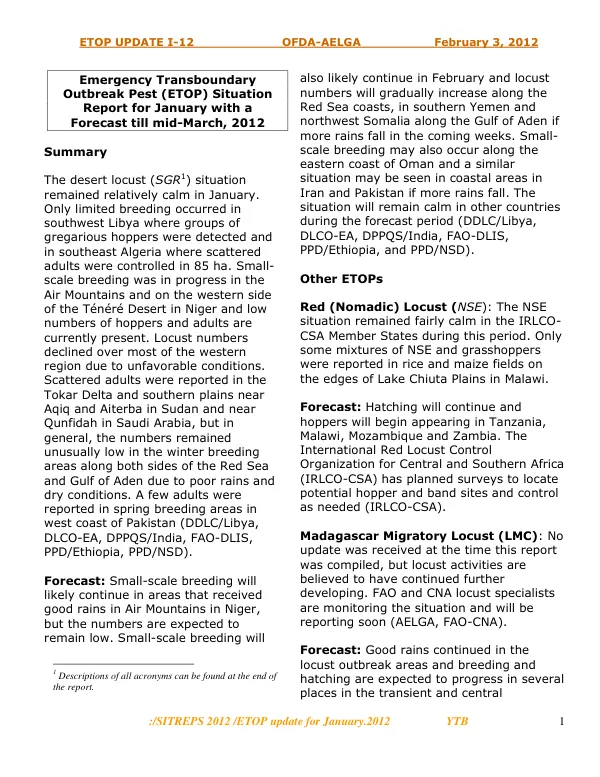
ETOP Situation Report for January with a Forecast till mid-March, 2012
The desert locust (SGR1) situation remained relatively calm in January, with only limited breeding occurring in southwest Libya and southeast Algeria.
2012 · 9 pages
Sign in to readA free account is required to download.
Abstract
In southwest Libya, groups of gregarious hoppers were detected, and in southeast Algeria, scattered adults were controlled in 85 ha. Small-scale breeding was in progress in the Air Mountains and on the western side of the Ténéré Desert in Niger, with low numbers of hoppers and adults present. Locust numbers declined over most of the western region due to unfavorable conditions. Scattered adults were reported in the Tokar Delta and southern plains near Aqiq and Aiterba in Sudan and near Qunfidah in Saudi Arabia, but the numbers remained unusually low in the winter breeding areas along both sides of the Red Sea and Gulf of Aden due to poor rains and dry conditions. A few adults were reported in spring breeding areas in the west coast of Pakistan. The situation will remain calm in other countries during the forecast period. Small-scale breeding is expected to continue in areas that received good rains in the Air Mountains in Niger, but the numbers are expected to remain low. Small-scale breeding will also likely continue in February and locust numbers will gradually increase along the Red Sea coasts, in southern Yemen and northwest Somalia along the Gulf of Aden if more rains fall in the coming weeks. Small-scale breeding may also occur along the eastern coast of Oman and a similar situation may be seen in coastal areas in Iran and Pakistan if more rains fall. The Red (Nomadic) Locust (NSE) situation remained fairly calm in the IRLCO-CSA Member States during this period, with only some mixtures of NSE and grasshoppers reported in rice and maize fields on the edges of Lake Chiuta Plains in Malawi. Hatching will continue and hoppers will begin appearing in Tanzania, Malawi, Mozambique, and Zambia. The International Red Locust Control Organization for Central and Southern Africa (IRLCO-CSA) has planned surveys to locate potential hopper and band sites and control as needed. The African Armyworm (AAW) outbreaks were reported in January in Ruvuma Region in Tanzania and Mashonaland West Province in Zimbabwe. Control operations were carried out by affected farmers with technical and material support from the Ministries of Agriculture in the respective countries. AAW will likely affect late-planted cereal crops in Malawi, Zambia, and Zimbabwe during the forecast period. Trap operators are advised to continue monitoring and reporting moth catches to crop protection staff and assist with interventions. Community forecasters are encouraged to participate in monitoring, forecasting, and alerting farmers to the extent possible. The Quelea (QQU) birds were not reported on crops in January in any of the IRLCO-CSA Member States. QQU birds will become problematic to small grain crop growers in Tanzania, Kenya, Mozambique, and Zimbabwe. OFDA/AELGA will continue closely monitoring ETOP situations in all regions and issue updates and advisories as often as necessary. The Sahel West Africa frontline countries, namely Chad, Mali, Mauritania, and Niger, have established autonomous national locust control units (CNLA) responsible for DL activities. Funds provided by the African Development Bank, USAID, the World Bank, France, FAO, host-governments, neighboring countries, and others enabled the FCs to equip CNLAs with necessary tools, materials, and infrastructure as well as help train staff to prevent and respond to SGR outbreaks and avoid the threats they pose to food security and livelihoods of vulnerable communities. OFDA continues its initiatives in pesticide risk reduction through stewardship network (PRRSN) programs to ensure safety of vulnerable people and protect their assets and the shared environment against pesticide pollution. OFDA is supporting a program to strengthen national and regional capacities in Central Asia and the Caucasus (CAC) through FAO to coordinate locust monitoring, reporting, prevention, and mitigation efforts and abate the threats they pose to food security and livelihoods of vulnerable communities. Most of the winter breeding areas in Northwest and North Africa remained fairly dry and cool or cold in January. Light rains were recorded during mid-January along the southern Red Sea coast of NSD and the winter breeding areas in SW Asia remained fairly dry except southeast of Iran. Tropical depressions and tropical cyclone activities in the Mozambique Channel and cyclone Funso brought very heavy rainfall and flooding in parts of Mozambique and low-lying areas of Nsanje District, southern Malawi during the 3rd dekad of the month.