NORC AT THE UNIVERSITY OF CHICAGO
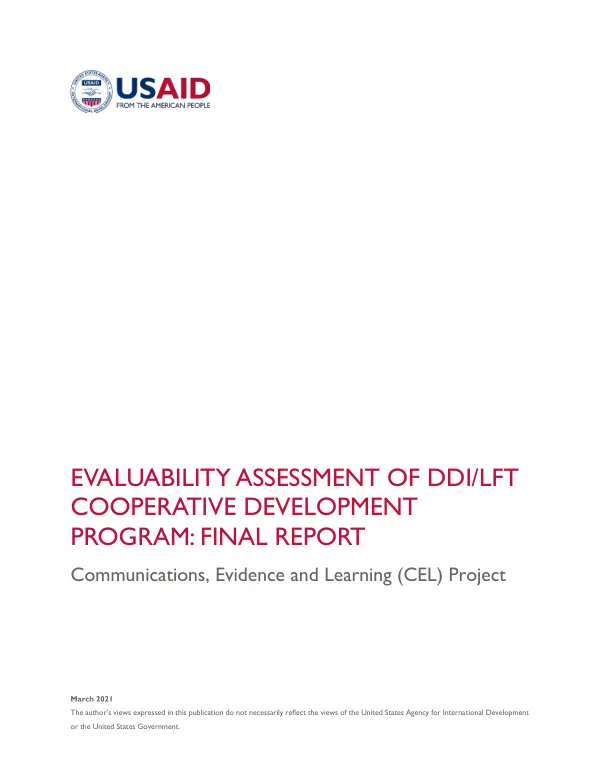
EVALUABILITY ASSESSMENT OF DDI/LFT COOPERATIVE DEVELOPMENT PROGRAM: FINAL REPORT
The Cooperative Development Program (CDP) is a USAID initiative focused on building the capacity of cooperatives and improving the legal and regulatory environments in which they operate.
2021 · 82 pages
Sign in to readA free account is required to download.
Abstract
The program aims to strengthen local institutions and systems, leading to more prosperous and self-reliant communities. CDP's theory of change is based on three intermediate results (IRs): IR1, IR2, and IR3, which are intended to lead to the project's purpose. CDP's activities are designed to work together to achieve the project's outcomes. The program's Monitoring, Evaluation, and Learning (MEL) plan includes regular meetings for CDO partners to collaborate and learn from one another. This structure suggests that a whole-of-project evaluation (WOPE) approach is suitable for CDP. USAID's priority learning interests for CDP include understanding the program's influence on the larger development community, factors contributing to or preventing collaboration and coordination among CDOs, and factors contributing to the achievement or not of anticipated outcomes. These interests are feasible to address through a WOPE approach. The table below ranks USAID's priority learning interests for CDP according to the feasibility of addressing them through a WOPE approach. The most feasible learning priorities include CDP's influence on the larger development community, factors that contributed to or prevented collaboration and coordination among CDOs, and factors that contribute to the achievement or not of anticipated outcomes. Feasibility of addressing USAID's learning priorities with a WOPE approach Learning Priority Feasibility CDP's influence on the larger development community Feasible Factors that contributed to or prevented collaboration and coordination among CDOs funded by the CDP Feasible Factors that contribute to the achievement or not of anticipated outcomes Feasible CDP's financial return on investment Feasible Progress toward the project purpose Feasible Measured and perceived improvements in cooperative governance and performance Feasible Strategies for improving the legal framework and resource environment for cooperatives Somewhat Feasible CDP's impact on behavior and mindset change Somewhat Feasible CDP's sustainability and long-term impact Least The Evaluability Assessment (EA) team recommends that a WOPE approach be used to evaluate CDP. This approach will allow for a comprehensive evaluation of the program's activities, outcomes, and impact. The EA team also recommends that partner activity mid-term evaluations (MTEs) be used to inform and supplement the WOPE. Illustrative evaluation methods and analytical approaches that are best suited to answering the evaluation questions proposed under question 3 include performance evaluation, outcome harvesting, and survey methods. These methods will allow for a thorough evaluation of CDP's activities and outcomes. Overall, the evaluability of CDP through a WOPE is high. The program's clear theory of change, demonstrated instances of synergy among activities, and regular meetings for CDO partners make it an ideal candidate for a WOPE approach.
Related documents