JOHNS HOPKINS UNIVERSITY
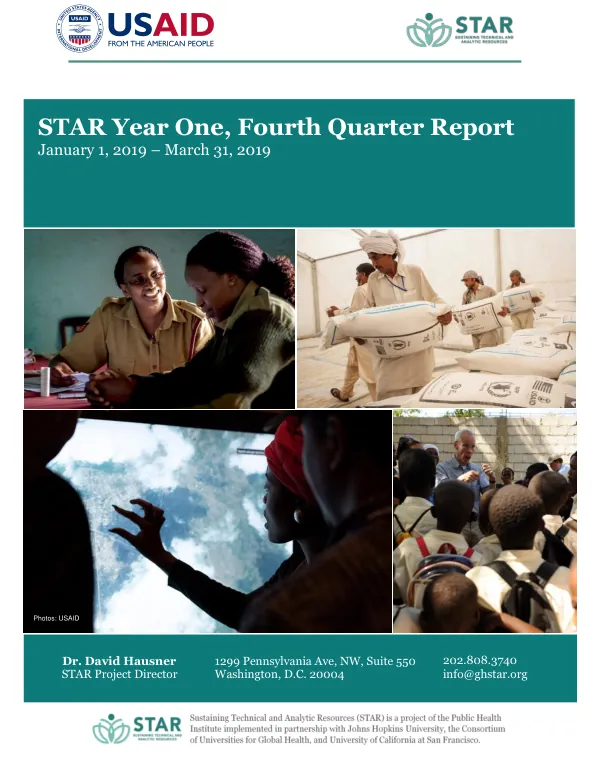
STAR Year One, Fourth Quarter Report
The STAR project team has made significant progress in building awareness of the project and its unique features, including coaching, mentorship, and coursework, capacity building in low- and middle-income countries (LMICs) to improve global health programming.
2019 · 24 pages
Sign in to readA free account is required to download.
Abstract
The program also supports institutions in LMICs and high-income countries to collaborate and share knowledge in finding solutions to global health problems. Presentations, conferences, in-person meetings, and social media have expanded STAR's reach to a broad group of stakeholders, including USAID's Bureau for Global Health and Missions. The work has built a foundation for successful implementation of the project's capacity-building and knowledge-sharing objectives. The project team has also expanded its capabilities and performance in areas such as recruitment, outreach, performance management, and learning. The team has transitioned individuals in Fellowships to the STAR program and recruited new Fellowship participants to fill vacancies. In total, 13 participants were in the STAR program at the end of Q4, and the team is recruiting for positions in three countries. Key activities during the fourth period of the project include: * Recruitment and Outreach (RO): The RO team recruited for 14 active and two pending Fellowship positions, as well as for 28 active and 13 pending Intern positions, all in the U.S. and in LMICs. Staff attended six global outreach conferences in the U.S. * Performance Management (PM): The PM team continued to develop and refine strategies for onboarding participants and supporting STAR Interns and Foreign Service National (FSN) Fellows at USAID/Washington. The team also conducted an orientation in January 2019 for an initial cohort of 10 STAR participants. * Academic Partnerships (AP): The AP team worked to further refine Academic Partnerships and Knowledge-Sharing Systems (KSS) strategies and enhance the implementation plan for the Collaboration Laboratory (CoLab). The team drafted a literature review of research on existing academic partnership models and developed a Partnership Assessment Tool and a Capacity Assessment Tool. * Communications (Comms): The Comms team developed STAR project information for targeted audiences, including the initial launch of the STAR website on January 7, promotional postcards, a pull-up display for conference events, and the first episode of the "STAR Stories" podcast. * Learning (LRN): The LRN team developed the initial STAR Global Health Framework, integrating the Theory of Change and group mentorship with competencies and milestones. The team also held a second retreat as a design review and project task session. * Technical Advisory Group (TAG): The Technical Advisory Group (TAG) held its first meeting following the 2019 CUGH Annual Conference. Twenty-one (21) members, STAR consortium partners, and PHI leadership attended the meeting. * Global Operations (GO): Global Operations continued to finalize participant policies, forms, and tools as the team prepared to onboard Fellows and the summer cohort. Implementation of Global Services as STAR's hiring platform was launched, and two local national hires were made in Uganda and Zimbabwe. The STAR project has also made progress in its intermediate results, including: * IR 1: Strengthened capacity of diverse American and LMIC health professionals at all levels to make contributions to global health. Outreach participated in eight domestic events to promote and build awareness of the STAR Project, and the Communications team developed promotional postcards to distribute at conferences and to project partners. * IR 2: Enhanced collaboration and knowledge-sharing among STAR partners and stakeholders. The AP team worked to refine Academic Partnerships and KSS strategies, and the LRN team developed the STAR Global Health Framework. * IR 3: Improved performance management and learning processes. The PM team continued to develop and refine strategies for onboarding participants and supporting STAR Interns and FSN Fellows. * IR 4: Increased capacity of STAR partners to implement and sustain global health programs. The GO team finalized participant policies, forms, and tools, and the IMARS platform was developed to support the STAR project. The STAR project has made significant progress in its first year, and the team is well-positioned to achieve its planned objectives in the next performance period.
Related documents