ENVIRONMENTAL INCENTIVES, LLC
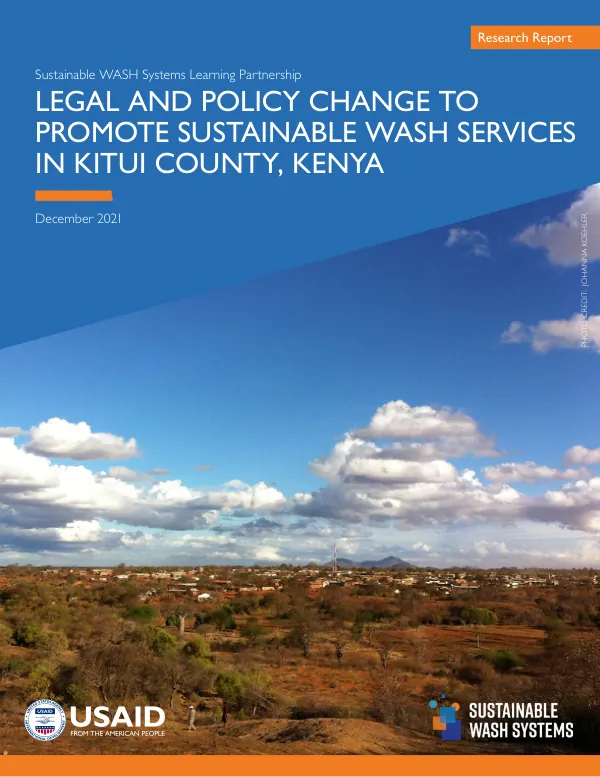
Legal and Policy Change to Promote Sustainable WASH Services in Kitui County, Kenya
The rural water sector in Kenya is undergoing significant institutional change following national governance reform in the 2010 Constitution.
2021 · 19 pages
Sign in to readA free account is required to download.
Abstract
Focusing on Kitui County, Kenya, a project location for the United States Agency for International Development (USAID) Sustainable WASH Systems Learning Partnership (SWS), this report outlines the direction of policy change over the past 10 years and reflects on ways in which public, private, and civil society actors are contributing to the evolution of a county water policy that supports sustainable water, sanitation, and hygiene (WASH) service delivery. The Constitution of Kenya 2010 made significant changes to governance structures, introducing counties as a devolved level of government with specific mandates. These mandates included responsibility for water and sanitation services, stormwater drainage, soil and water conservation, and the responsibility to ensure public participation in public affairs. The devolution of water services to the 47 county governments has posed a major challenge for policymakers as they work to establish county policies and legislation consistent with the national policies and legislation emerging from the new Constitution. Table 1 illustrates a range of political dynamics that interfere with the building of new county-level institutions. National-county policy dynamics refer to the need for county budget allocations, especially for the rural water sector and for water services in institutions such as schools and health care facilities, to be defined at the county level. Intra-county political dynamics involve divergent agendas between Members of County Assembly (MCAs) and the County Executive Committee Members (CEC), who are partly motivated by election cycles and community support, and the interests of the bureaucratic elite. Community practice dynamics refer to the emergence of voting blocs in alignment with community income generation and political support, which can influence adoption or rejection of new approaches to water service delivery. Donor practice dynamics involve external investments in development projects and research that create implicit pressure for change and impact, which may not always align with the strategic priorities of the county government. Policy Change in the Kitui County Water Sector The Kitui County Water Sector has undergone significant policy changes over the past 10 years. The national Water Act of 2016 clarifies some aspects of service provision and the structure of the new subnational institutions, but county budget allocations remain ambiguous and need to be defined at the county level. The County Executive Committee has taken steps to establish a county water policy that supports sustainable WASH service delivery, including the development of a water policy and bill. The FundiFix Model in Action The FundiFix model is a community-led approach to water service delivery that has been implemented in Kitui County. The model involves the establishment of a Water Action Group (WAG) that brings together community members, local government officials, and other stakeholders to identify and address water-related challenges. The WAG has been instrumental in promoting public participation in water service delivery and has helped to build a sense of ownership and responsibility among community members. The Kitui WASH Forum The Kitui WASH Forum is a platform that brings together stakeholders from the public, private, and civil society sectors to discuss and address WASH-related issues. The forum has been instrumental in promoting collaboration and coordination among stakeholders and has helped to identify areas of convergence and divergence in WASH policy and practice. Water Services Audits and Database Development The Kitui County Government has conducted water services audits to assess the functionality of water sources and the quality of water services. The audits have identified areas of improvement and have helped to inform the development of a county water policy that supports sustainable WASH service delivery. A database has been developed to track water services and to monitor progress towards achieving WASH-related targets. Key Institutional Changes in the Kitui County Water Sector The Kitui County Water Sector has undergone significant institutional changes over the past 10 years. The County Executive Committee has established a county water policy and bill, and a Water Action Group has been established to promote public participation in water service delivery. The Kitui WASH Forum has been established to promote collaboration and coordination among stakeholders, and a database has been developed to track water services and to monitor progress towards achieving WASH-related targets. Kitui Water Policy and Bill Development Process The development of the Kitui Water Policy and Bill has been a collaborative effort involving the County Executive Committee, the Water Action Group, and other stakeholders. The policy and bill have been informed by the results of water services audits and have been designed to support sustainable WASH service delivery. The policy and bill have been endorsed by the County Assembly and are currently being implemented. Key Contributions in the Kitui Water Bill and Policy The Kitui Water Bill and Policy have made significant contributions to the evolution of a county water policy that supports sustainable WASH service delivery. The policy and bill have promoted public participation in water service delivery, have established a Water Action Group to promote community-led approaches to water service delivery, and have developed a database to track water services and to monitor progress towards achieving WASH-related targets. Unresolved Policy Questions Despite the progress made in the development of the Kitui Water Policy and Bill, there are still unresolved policy questions that