USAID DEC
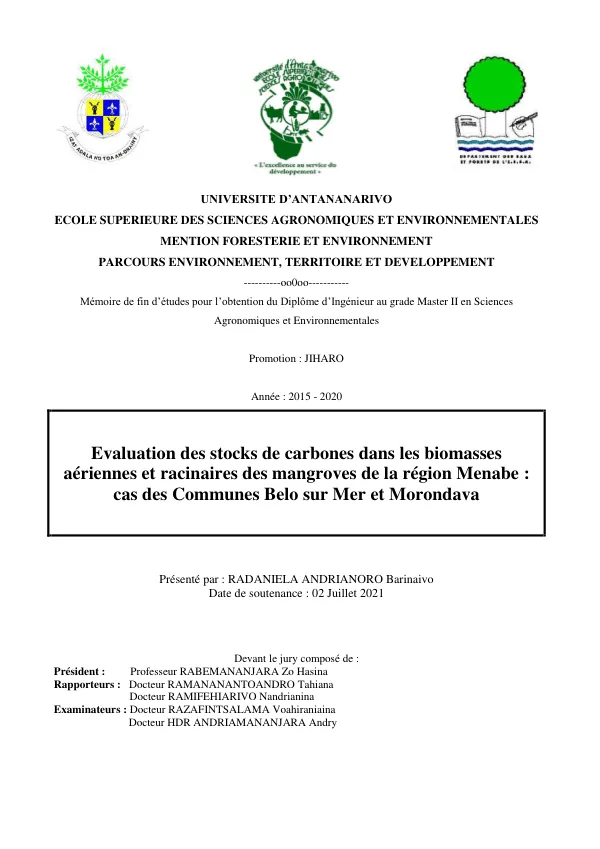
Evaluation des stocks de carbones dans les biomasses aériennes et racinaires des mangroves de la région Menabe : cas des Communes Belo sur Mer et Morondava
Sign inUSAID DEC
Evaluation des stocks de carbones dans les biomasses aériennes et racinaires des mangroves de la région Menabe : cas des Communes Belo sur Mer et Morondava
The region of Menabe in Madagascar contains one of the largest areas of mangrove forests in the country.
2021 · 81 pages
Sign in to readA free account is required to download.
Abstract
The surrounding populations can benefit from the ecosystem goods and services provided by these forests, including their high carbon storage capacity in biomass and soil. This capacity makes them a significant contributor to climate change mitigation and the carbon market. However, the mangrove forests in Menabe are facing high levels of degradation due to human activities, primarily the abusive exploitation of forests. The integration of the mangrove ecosystem into the Reducing Emissions from Deforestation and Forest Degradation (REDD+) program is essential for achieving a balanced approach to management and optimal exploitation of the forest. In this context, evaluating the biomass carbon stock is crucial, as it will serve as a basis for implementing a conservation project through the sale of carbon credits. This study aims to find the most efficient way to estimate the aboveground and belowground biomass quantity and carbon stock in mangrove forests and understand the effects of their degradation on this stock. The study used the protocol proposed by Kauffmann and Donato in 2012 for the inventory. Six out of the eight species present in Madagascar were found in Menabe, with Rhizophora mucronata and Ceriops tagal being the most widespread. The aboveground biomass was calculated using allometric equations, and the belowground biomass was calculated using the correction factor method. The results showed that the carbon stock in aboveground biomass of degraded and intact forests presented a statistically significant difference at the 95% level, while the difference was not significant in belowground biomass. The mean carbon stock in aboveground and belowground biomass was 52.48 MgC/ha, which is significantly lower than the results of the national inventory conducted by the DGEF in 2019. The mean root-shoot ratio was 0.55, which is lower than the global average and varies from site to site due to different factors, particularly forest degradation. The study highlights the importance of evaluating the biomass carbon stock in mangrove forests, particularly in the context of REDD+ program. The results of this study can be used to inform conservation efforts and develop strategies for sustainable management of mangrove forests in Menabe. The study also emphasizes the need for further research on the effects of forest degradation on carbon stock and the development of efficient methods for estimating biomass carbon stock in mangrove forests. The region of Menabe is characterized by a diverse range of mangrove species, with six out of eight species present in Madagascar found in the area. The most widespread species are Rhizophora mucronata and Ceriops tagal. The study found that the carbon stock in aboveground biomass of degraded and intact forests presented a statistically significant difference at the 95% level, while the difference was not significant in belowground biomass. The mean carbon stock in aboveground and belowground biomass was 52.48 MgC/ha, which is significantly lower than the results of the national inventory conducted by the DGEF in 2019. The study's findings have implications for the conservation and management of mangrove forests in Menabe. The results suggest that the forest degradation has a significant impact on the carbon stock in aboveground biomass, but not in belowground biomass. This highlights the need for targeted conservation efforts that focus on restoring degraded forests and promoting sustainable management practices. The study also emphasizes the importance of evaluating the biomass carbon stock in mangrove forests, particularly in the context of REDD+ program. The study's methodology involved using the protocol proposed by Kauffmann and Donato in 2012 for the inventory. The aboveground biomass was calculated using allometric equations, and the belowground biomass was calculated using the correction factor method. The results of the study can be used to inform conservation efforts and develop strategies for sustainable management of mangrove forests in Menabe. The study also highlights the need for further research on the effects of forest degradation on carbon stock and the development of efficient methods for estimating biomass carbon stock in mangrove forests.
Related documents
Documents in this collection
 2021
2021USAID DEC
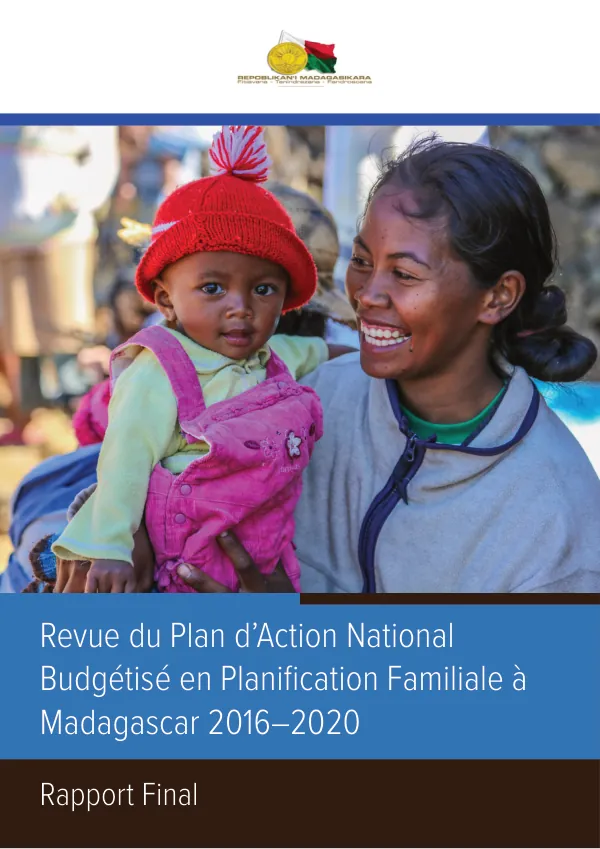
Revue du Plan d’Action National Budgétisé en Planification Familiale à Madagascar 2016–2020 : Rapport Final
Open record 2021
2021USAID DEC