USAID DEC
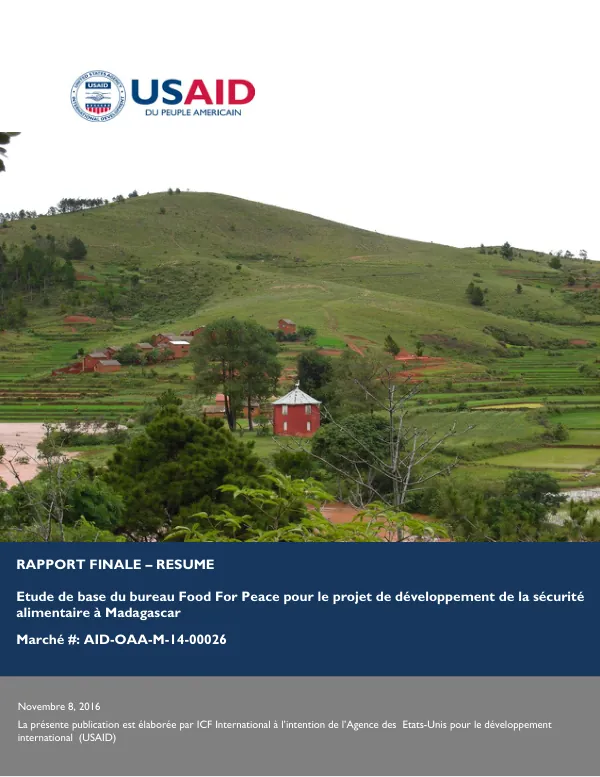
Final Report: Baseline Study of Food For Peace Development Food Assistance Projects in Madagascar
Sign inADVENTIST DEVELOPMENT AND RELIEF AGENCY INTERNATIONAL
Final Report: Baseline Study of Food For Peace Development Food Assistance Projects in Madagascar
The Food for Peace Development Food Assistance Projects in Madagascar were initiated by the USAID Office of Food for Peace in 2014.
2016 · 9 pages
Sign in to readA free account is required to download.
Abstract
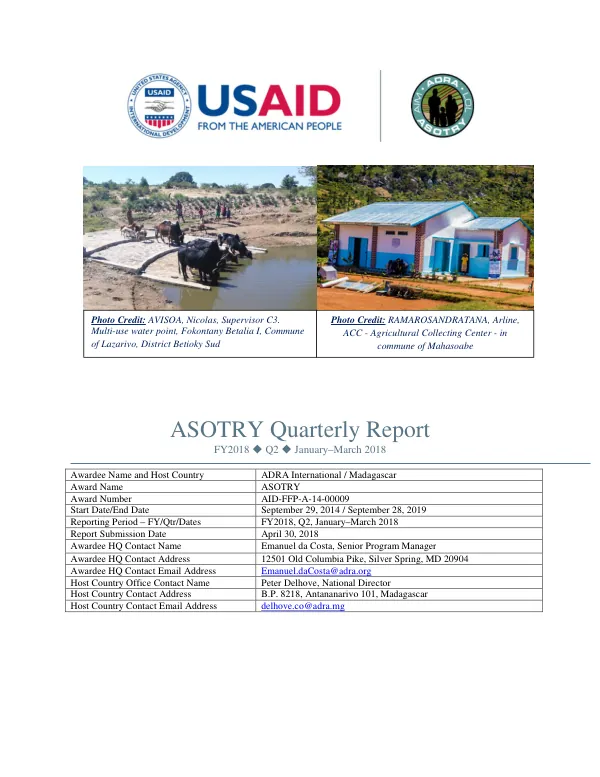
Two new agreements were signed for projects aimed at improving food security in Madagascar, namely the Asotry project and the Fararano project. The Asotry project, implemented by the Adventist Development and Relief Agency (ADRA) and its partners, aims to improve nutrition, agricultural productivity, and household resilience through the elimination of underlying causes of food insecurity. The project consists of three components: nutrition for women of childbearing age and children under two years, strengthening knowledge, improving agricultural techniques and technologies, and promoting crop diversification. The Fararano project, implemented by Catholic Relief Services (CRS) and its partners, aims to reduce food insecurity and chronic undernutrition and increase resilience in the Atsimo Andrefana, Atsinanana, and Vatovavy Fitovinany regions. The project has three objectives: to prevent undernutrition, especially during the first 1,000 days of life, and improve nutritional status among children under five years old; to increase and diversify agricultural production and household livelihoods; and to increase community resilience to shocks and reduce natural resource degradation. The USAID Office of Food for Peace contracted ICF International to conduct an independent baseline study of these development food assistance projects. The study, conducted in 2015, is the first phase of a cycle of pre- and post-project evaluations. The baseline study includes a representative household survey to collect data for FFP key indicators and project-specific indicators, as well as a qualitative study to collect additional data providing context, richness, and magnitude to the household survey results. The study focuses on eight domains: household characteristics, hunger in households, dietary diversity, and coping strategies; poverty levels; water, sanitation, and hygiene (WASH); agriculture; maternal and child health and nutrition; and gender equality. The study found that 27.7% of households in the combined project zones suffer from moderate or severe hunger. The reasons for hunger are related to difficulties in producing enough food and lack of money to purchase it. The dietary diversity score indicates that, on average, households have access to and consumed 4 out of 12 food groups over the past 24 hours. The study also found that the majority of household heads have not received formal education or have not exceeded elementary school level, indicating low literacy and basic math skills. The study's findings will be used to establish a baseline for FFP key indicators and project-specific indicators for comparison with the final evaluation, as well as to provide information for program targeting and design. The study's results are based on data collected from 2,580 households per project, with a total of 5,160 households. The household survey was conducted in May, at the beginning of the harvest season, using a multi-stage cluster sampling design to provide a statistically representative sample of the project zones. The questionnaire was developed through a series of consultations with FFP, FANTA III, FFP awardees, and USAID/Madagascar. The qualitative study was conducted in September, a period of transition, and involved 8 focus groups, 16 program-level interviews, and 40 household-level interviews. The study's findings highlight the need for targeted interventions to address food insecurity, poverty, and limited access to basic services such as WASH and healthcare. The study's results will inform the design and implementation of the Asotry and Fararano projects, as well as future FFP programs in Madagascar.
Related documents