USAID DEC
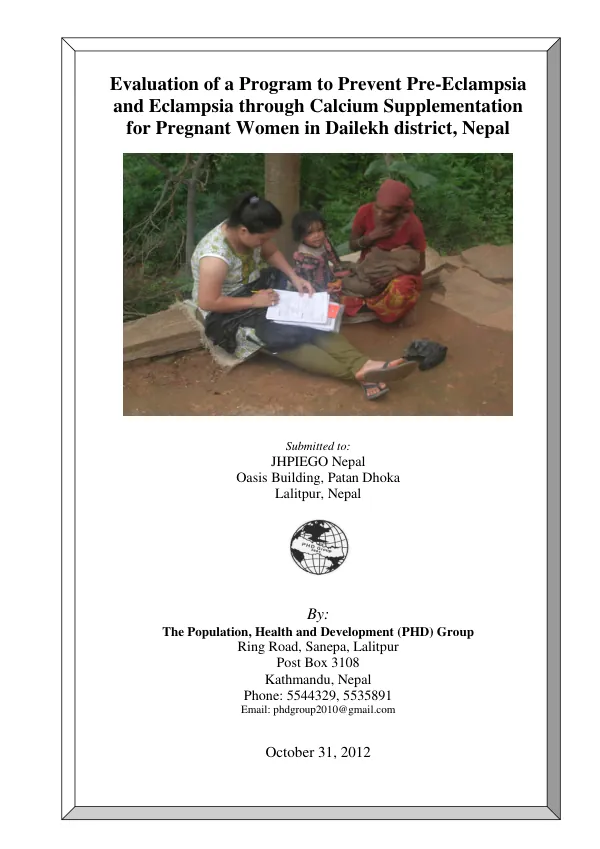
Evaluation of a Program to Prevent Pre-Eclampsia and Eclampsia through Calcium Supplementation for Pregnant Women in Dailekh district, Nepal
Sign inDEPARTMENT OF HEALTH AND HUMAN SERVICES
Evaluation of a Program to Prevent Pre-Eclampsia and Eclampsia through Calcium Supplementation for Pregnant Women in Dailekh district, Nepal
The calcium pilot program was implemented by the Family Health Division in Dailekh district, Nepal, with technical and financial support from the Maternal and Child Health Integrated Program (MCHIP), led by Jhpiego.
2012 · 59 pages
Sign in to readA free account is required to download.
Abstract
The program aimed to provide calcium supplements to pregnant women for the prevention of Pre-Eclampsia (PE/E) in Dailekh district for one year, ending in September 2013. Dailekh district is located in the mid-western hills of Nepal and has a population of approximately 63,073 women of reproductive age (15-49). The evaluation study used a cluster sampling method to identify respondents, with 62 clusters chosen based on probability proportional to population size. From each cluster, 20 recently delivered women (RDW) were randomly chosen for interview. In addition, 109 health care providers and 112 Female Community Health Volunteers (FCHVs) were administered separate questionnaires to assess their knowledge on calcium use and their experience of implementing the pilot calcium program. The total sample size was 1,240 RDW. The median age of mothers participating in the survey was 23 years, with 18 percent of the RDW under 20 years of age, 76 percent between 20-34 years of age, and 6 percent between 35-49 years of age. Thirty-nine percent of the respondents were illiterate, 14 percent had completed School Leaving Certificate (SLC) or more, and 47 percent had completed primary or secondary education. The endline survey showed that 95 percent of mothers giving birth in the last 6 months reported attending at least one Antenatal Care (ANC) clinic during their last pregnancy, which is higher than the national average (85%) shown by the Nepal Demographic and Health Survey (NDHS) 2011. The median duration of pregnancy at the first ANC visit for those with ANC was 4 months, regardless of residence. In Dailekh, 71 percent of pregnant women made 4 or more ANC visits during their entire pregnancy, with more urban women (90%) having had four or more ANC visits than rural women (69%). Among those mothers who did not go for ANC, over half (55%) said that the health facility was too far, followed by the reason "it is not necessary" (45%), "not customary" (33%), "no good service" (19%), and 9 percent each said they "did not know" and "too expensive". Of the total respondents, 95 percent received iron tablets, with 99 percent getting advice on iron tablets and 95 percent receiving iron tablets from a health worker or FCHVs. Ninety-eight percent of respondents had their blood pressure taken, with 97 percent and 94 percent of women having urine taken for testing and having a plan to deliver at a certain place, respectively. Among women who had blood pressure measured at every ANC visit, 25 percent were identified as having high blood pressure. There were substantial variations by background characteristics, with young women, rural women, women with primary and some secondary education, and Janjati and Dalit women found having high blood pressure during pregnancy. Of those women who had their urine sample taken at first ANC visit, 70 percent had their urine taken for testing at every ANC visit, and of them 21 percent were found having problem (protein in urine) in urine. Older women, rural women, women with primary and no education, and women belonging to Bahun/ Sanyasi high castes and Dalit caste were more likely than their counterparts to have problem (protein in urine) in urine. Compared to the national rate of 63 percent deliveries that took place at home in the five years preceding the NDHS 2011, the proportion of home deliveries reported by RDW in Dailekh is 32 percent only.