USAID DEC
Evidence to Action for Strengthened Reproductive Health for Women and Girls (E2A) Nigeria Quarterly Report January 1 to March 31, 2019
Sign inPATHFINDER INTERNATIONAL
Evidence to Action for Strengthened Reproductive Health for Women and Girls (E2A) Nigeria Quarterly Report January 1 to March 31, 2019
The project, Strengthening the Response to Gender Based Violence in Nigeria, aims to strengthen the response to GBV by building the capacity of sub-grantee Sexual Assault Referral Centers (SARCs) to provide essential health services to GBV survivors.
2019 · 19 pages
Sign in to readA free account is required to download.
Abstract
The project is implemented by Pathfinder International and has a life span of April 1, 2018 to September 30, 2019. The project's overarching objective is to strengthen the response to GBV by building the capacity of SARCs to provide essential health services to GBV survivors and solicit, manage, and administer additional funds, thereby contributing to organizational sustainability after USAID support ends. The project has three main objectives: (1) to support and strengthen the capacity of SARCs to provide essential health services to GBV survivors; (2) to strengthen the capacity of SARCs to solicit, manage, and administer additional funds, thereby contributing to organizational sustainability after USAID support ends; and (3) to improve the collection, analysis, and use of data to better understand Gender Based Violence in Nigeria and to guide future prevention and response programming. During the reporting quarter (January to March 2019), a total of 610 clients visited the SARCs. The addition of 3 new SARCs, namely Adamawa, Lagos Mirabel Centre, and Yobe, contributed to an increase in the number of clients receiving GBV services at the SARCs. The data collection for the reporting quarter showed an increase in the number of people provided GBV services, with a total of 738 people reached by a USG-funded intervention providing GBV services. The indicators for the reporting quarter showed an increase in the number of GBV clients who reported to the SARCs for GBV services, with a total of 610 clients. The percentage of GBV clients who reported to the SARC within 24 hours decreased by 4%, while the number of GBV clients who reported to the SARC within 24 hours increased by 35%. The percentage of GBV clients who reported to the SARC and received counselling services increased by 3%, while the number of GBV clients who reported to the SARC and received counselling services increased by 45%. The data also showed an increase in the number of rape cases reported to the SARC, with a total of 436 cases. The percentage of rape cases provided with Post Exposure Prophylaxis (PEP) within 72 hours increased by 23%, while the number of rape cases provided with PEP within 72 hours increased by 62%. The percentage of clients who reported to the SARCs within 72 hours of incident decreased, while the percentage of rape clients aged 10 and above who received Emergency contraceptives within 5 days of incidence increased by 134%. The SARCs are more aware of the importance of counselling, and almost all clients reporting to the SARC are provided with counselling services. The addition of 3 new SARCs in Q2 contributed to an increase in the number of people provided GBV services in Q2. The SARCs are also using the Hotline/Telephone to provide counselling services to clients unable to come to the SARCs.
Related documents
Documents in this collection
 2018
2018USAID DEC
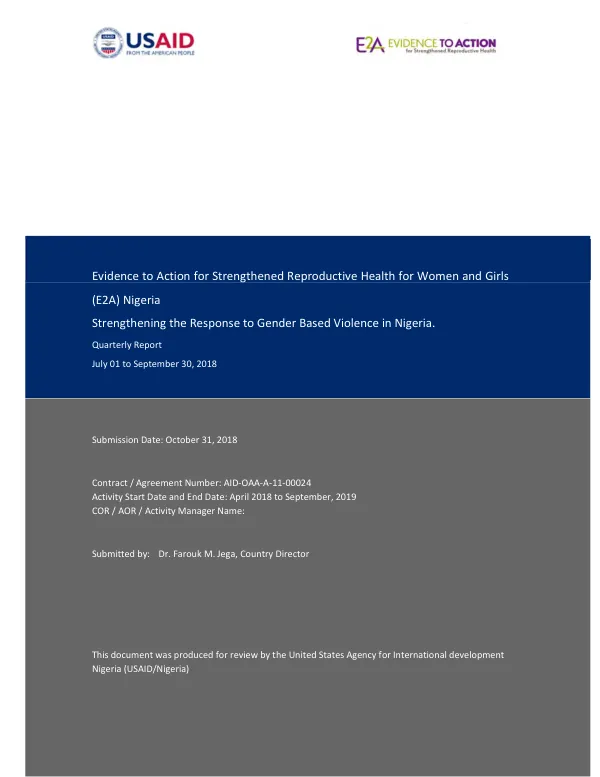
Evidence to Action for Strengthened Reproductive Health for Women and Girls (E2A) Nigeria: Strengthening the Response to Gender Based Violence in Nigeria. Quarterly Report for the Period April - June 2018
Open record 2016
2016USAID DEC