USAID DEC
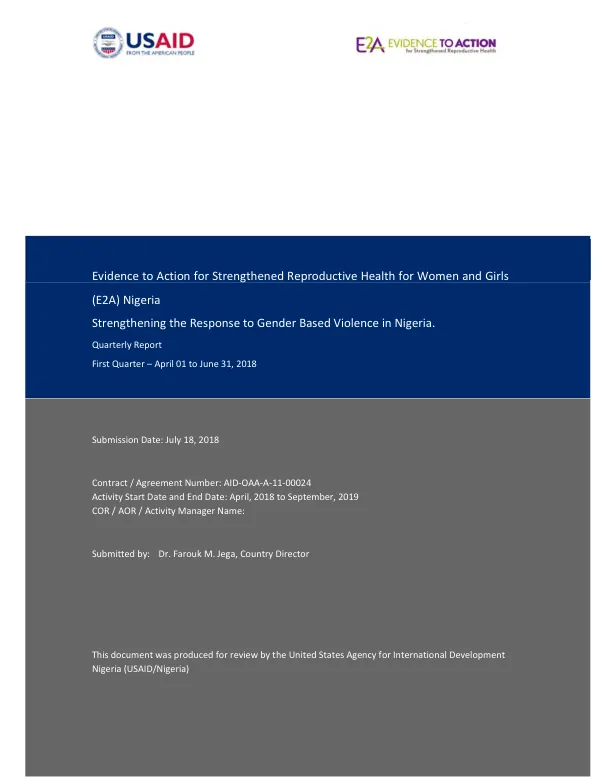
Evidence to Action for Strengthened Reproductive Health for Women and Girls (E2A) Nigeria: Strengthening the Response to Gender Based Violence in Nigeria. Quarterly Report for the Period April - June 2018
Sign inPATHFINDER INTERNATIONAL
Evidence to Action for Strengthened Reproductive Health for Women and Girls (E2A) Nigeria: Strengthening the Response to Gender Based Violence in Nigeria. Quarterly Report for the Period April - June 2018
Strengthening the Response to Gender-Based Violence in Nigeria is a project implemented by Pathfinder International, with funding from the United States Agency for International Development (USAID).
2018 · 17 pages
Sign in to readA free account is required to download.
Abstract
The project aims to strengthen the response to Gender-Based Violence (GBV) in Nigeria by building the capacity of Sexual Assault Referral Centers (SARCs) to provide essential health services to GBV survivors. The project also seeks to improve the collection, analysis, and use of data to better understand GBV in Nigeria and guide future prevention and response programming. The project has three objectives: to support and strengthen the capacity of SARCs to provide essential health services to GBV survivors; to strengthen the capacity of SARCs to solicit, manage, and administer additional funds, thereby contributing to organizational sustainability after USAID support ends; and to improve the collection, analysis, and use of data to better understand GBV in Nigeria and guide future prevention and response programming. During the first quarter of the project, which spanned from April 1 to June 31, 2018, the implementing partner, Pathfinder International, conducted a series of planning and coordination activities to lay the foundation for successful program implementation. These activities included joint meetings with USAID and the British Council-led Justice for All program to better understand how the SARCs worked and explore leverage opportunities. Key project personnel were recruited, and a project start-up meeting was held to define roles and responsibilities and drill down the work plan and assign more realistic timelines. An Organizational Capacity Assessment (OCA) was also conducted to measure the baseline capacity of the selected SARCs. The OCA was done in collaboration with the SARC staff and members of the SARC management committee, and an electronic OCA tool was deployed to capture scores and comments and display results at the end of the exercise. The assessment covered nine capacity areas, including strategic planning, program improvement, organization culture of sharing, monitoring and evaluation, governance, partnership, finance, sustainability, and human resources. The exercise was highly participatory, and the results were shared with the SARCs for discussion. The weakest and strongest areas were identified and discussed, and SARCs were advised to leverage their strengths to address perceived weaknesses. Advocacy and introductory visits were also carried out to the states where the SARCs are domiciled. The advocacy team made up of E2A/Pathfinder staff, SARC staff, and members of the management committee introduced E2A/Pathfinder and the project with USAID as the funder and made three specific advocacy asks, including the development of a budget line for SARCs. The project has made significant progress in its first quarter, with the implementation of planning and coordination activities, the conduct of an OCA, and the advocacy and introductory visits. The project is expected to continue making progress in the coming quarters, with a focus on strengthening the capacity of SARCs to provide essential health services to GBV survivors and improving the collection, analysis, and use of data to better understand GBV in Nigeria. The project's geographic coverage includes Akwa Ibom, Enugu, Jigawa, Kaduna, Kano, Niger, and Lagos, with a focus on supporting the SARCs in these states. The project's reporting period is from April 1 to June 30, 2018, and the submission date for this quarterly report is July 18, 2018. The project's indicators include the percentage of GBV clients who report to the SARC within 24 hours, the number of GBV clients who report to the SARC within 24 hours, the number of rape cases reported to the SARC, the percentage of rape cases provided with PEP within 72 hours, and the number of GBV clients who report to the SARCs and are referred for legal services, safe homes, medical services, and other services. The project's data collection and reporting tools include the SGBV tools for data collection and reporting. The project's monitoring and evaluation plan includes the use of the OCA tool to assess the capacity of the SARCs and the development of an M&E plan to guide the project's monitoring and evaluation activities. The project's M&E Officers were trained on project monitoring, evaluation, and data quality assurance, and the capacity of the SARCs' management in setting up linkages to other services was strengthened. The project's advocacy and introductory visits were aimed at introducing E2A/Pathfinder and the project with USAID as the funder and making specific advocacy asks, including the development of a budget line for SARCs. The project's advocacy team included E2A/Pathfinder staff, SARC staff, and members of the management committee. The project's OCA results and targets set were used to develop strengthening plans for the SARCs, and the project's M&E Officers were trained on project monitoring, evaluation, and data quality assurance. The project's capacity to provide essential health services to GBV survivors was strengthened, and the project's capacity to solicit, manage, and administer additional funds was also strengthened. The project's geographic coverage
Related documents